Across the United States, companies built whole cities to house the
people who worked for them — and owned the house, the store, the school and the
street. These are films about what happened next, made from the documents.
Twenty-nine films so far. There is a town like this in every state, and the
work is going through them one at a time.
SUBSCRIBE FOR THE NEXT
The method
Every figure is checked against the document that produced it.
These films are built almost entirely from public records — government surveys,
court opinions, newspaper pages, company archives — and each one is read rather
than cited. That sounds like a small distinction. It is not.
On the Nitro film, four of the claims that appear in nearly every published
account of the town turned out to be wrong, and one of them was wrong in a book
the film had already been taking its photographs from. Those corrections are
published alongside each film, with the page numbers.
Where the record is silent, the film says so. Where a
photograph is of the right town but the wrong company, it carries a caption
saying which. Where a source could not be reached, it is named as an open
question rather than smoothed over.
Nitro · West Virginia · 1917–2012
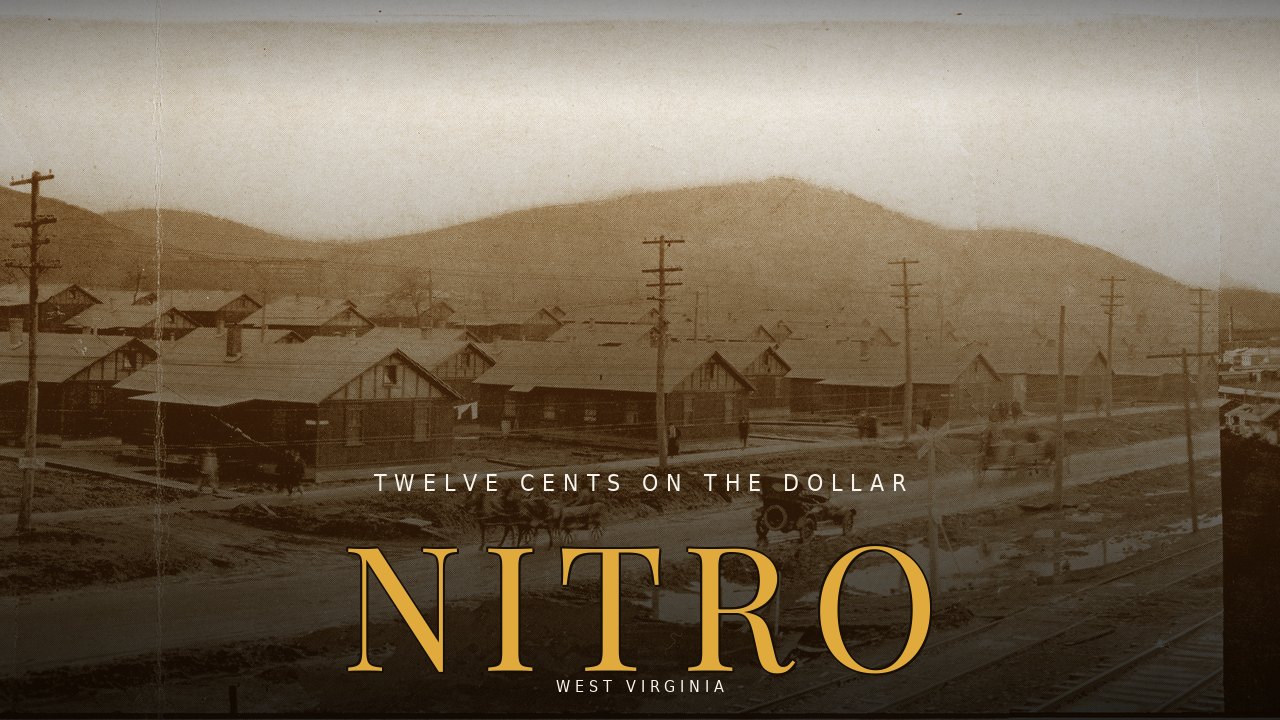
Twelve cents on the dollar.
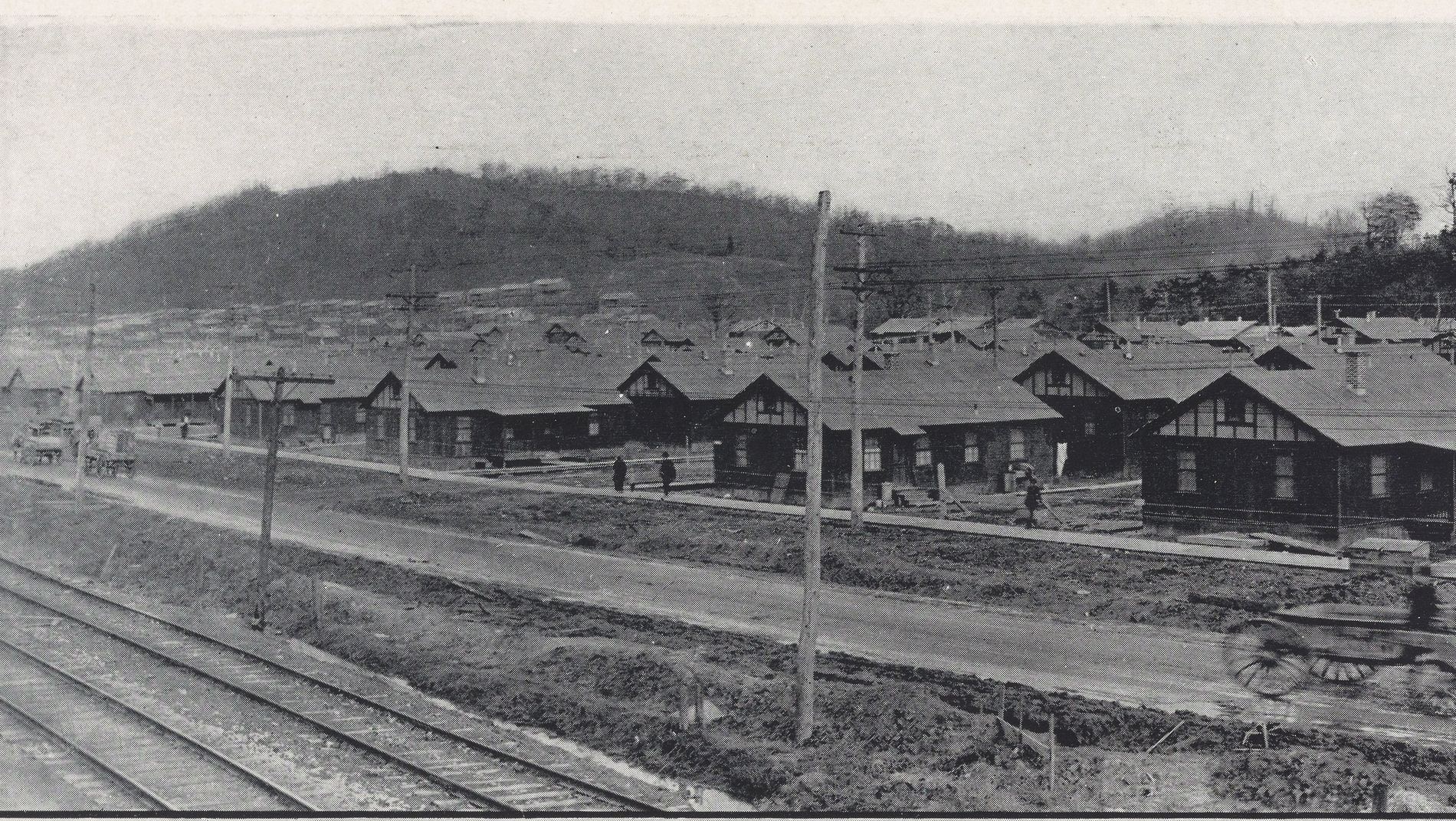
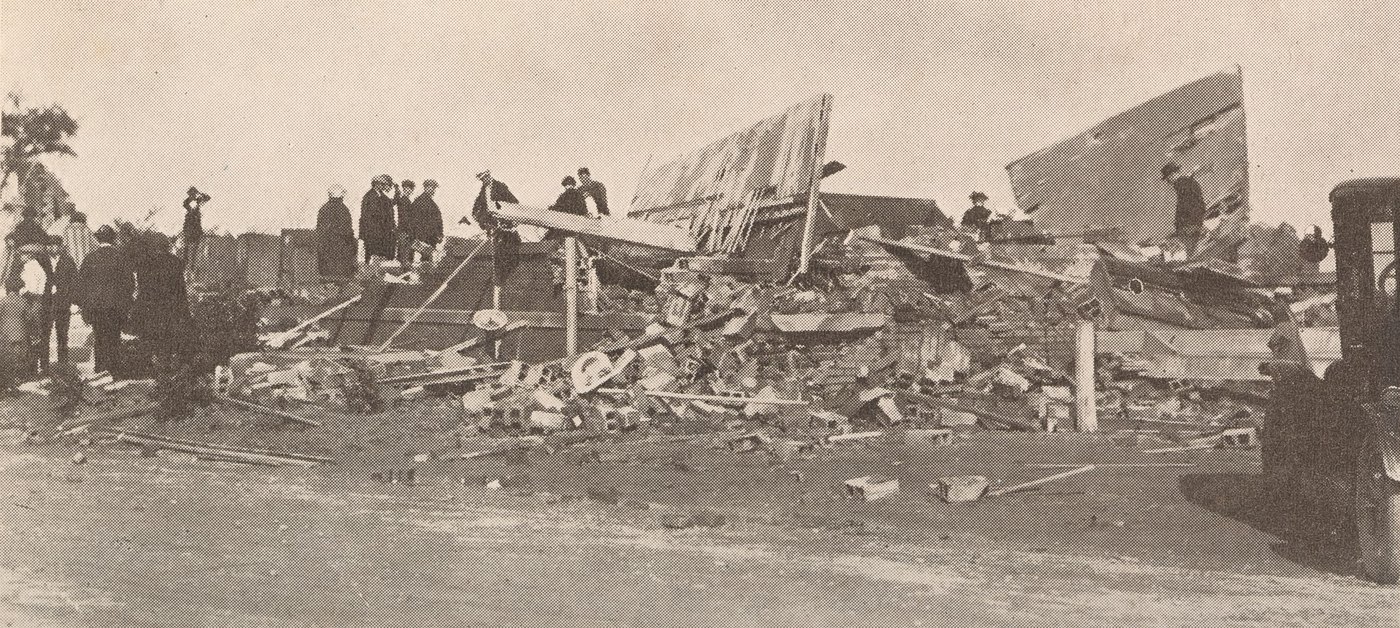
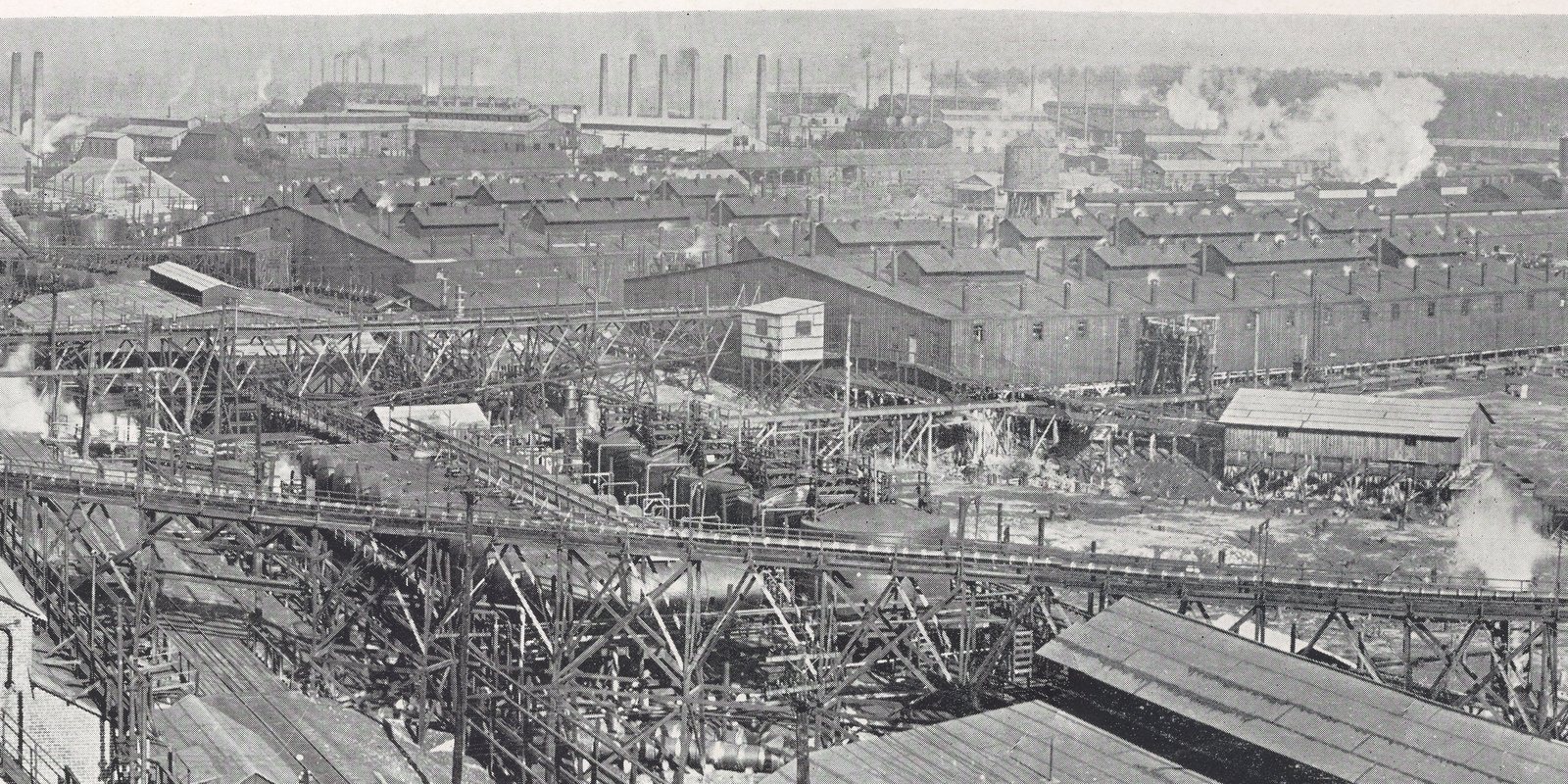
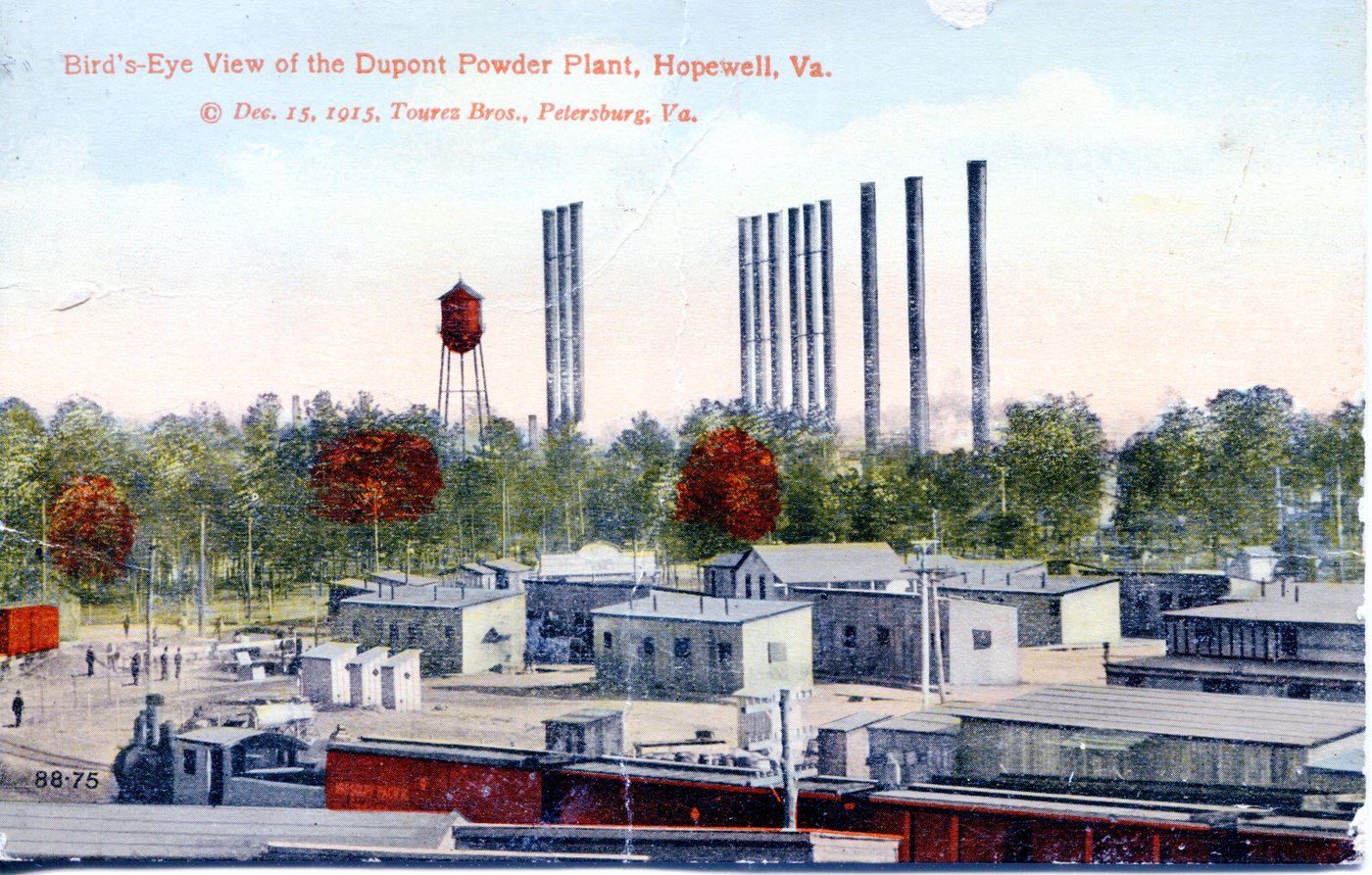
In December 1917 the United States government broke ground on a
cornfield sixteen miles west of Charleston. Eleven months later there was a city
on it. One year after that, the government sold the whole thing.
1,772
acres, laid out on farmland from nothing
737
manufacturing buildings
23,951
people, none of whom lived there the previous Christmas
$70,000,000
cost to the United States
$8,551,000
what it sold for, one year later
The film
The Government Built This City In 11 Months.
Twelve chapters · 50 minutes · 1080p · archival stills, primary documents, no
reconstruction Watch on YouTube →
The Nitro file
The research, published.
The film is free and always
will be. What is for sale is everything behind it — the documents themselves, the
corrections with their page numbers, and the plates at full resolution.
The book
$9.99
Nitro, West Virginia
The full account, expanded from the film
Six archival plates, every source named
Nineteen corrections, each with its source
Seven appendices, including how to check this book
The primary documents as scanned — Williams 1920,
the Crowell report, the 1919 sale notice, full pages
Every plate at full resolution, uncropped
The complete corrections file, and what could not be
verified, and why
What happened
A city built to make gunpowder, sold before it made any.
Congress approved money for three government explosives plants in October 1917.
DuPont chose the ground; then the Wilson administration took the job away from
DuPont, because it did not want the company any bigger. So rather than
let a company build a company town, the government built one.
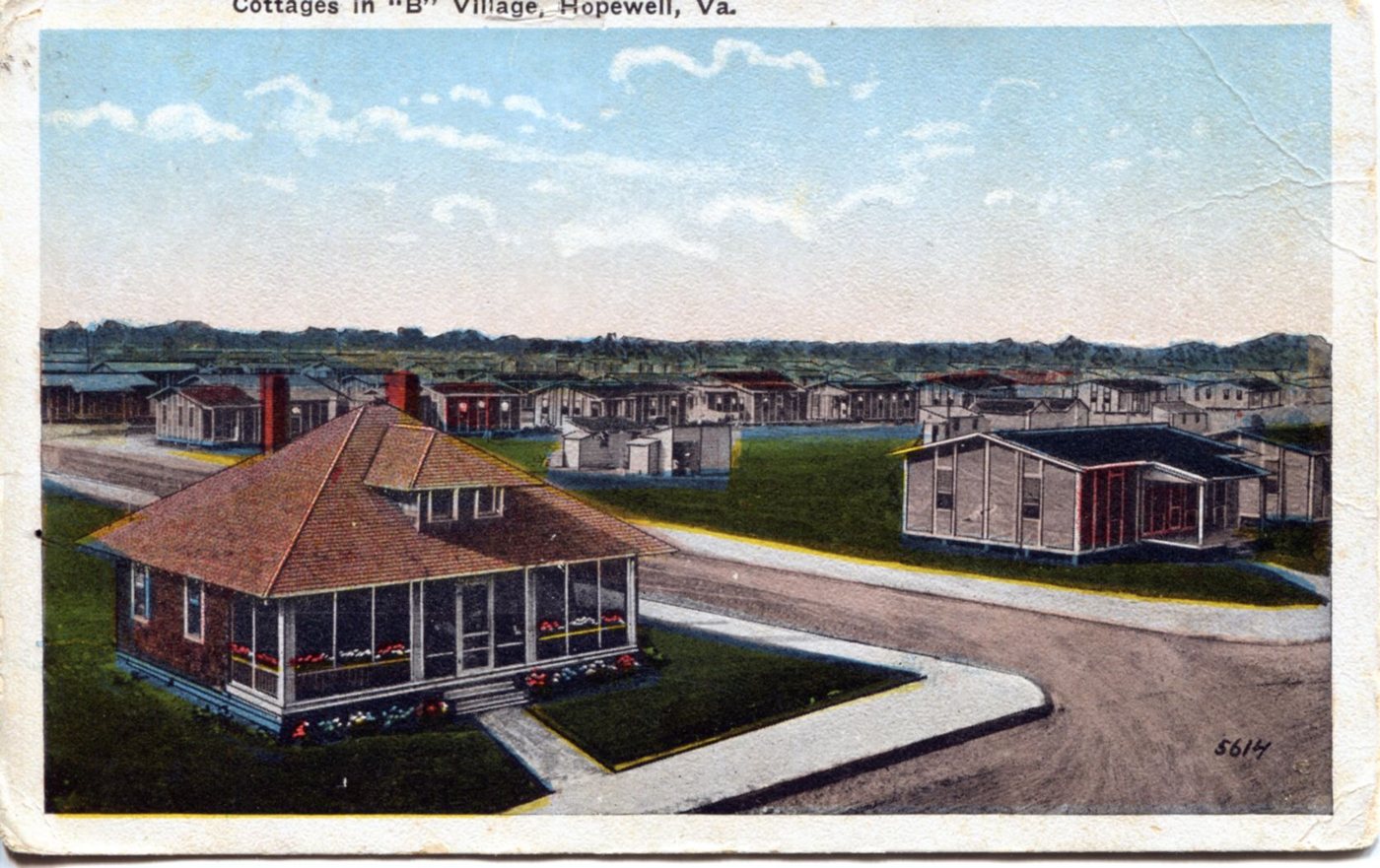
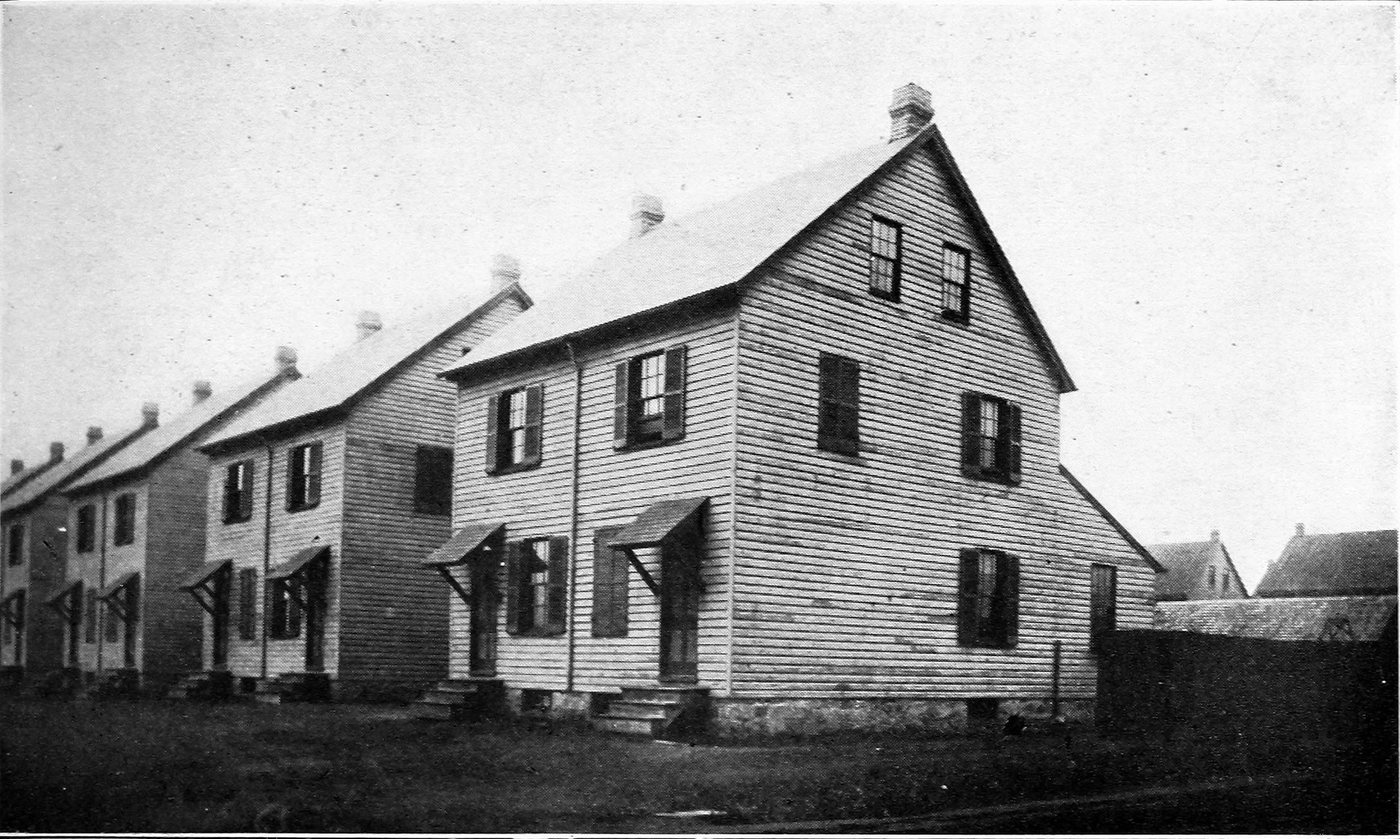
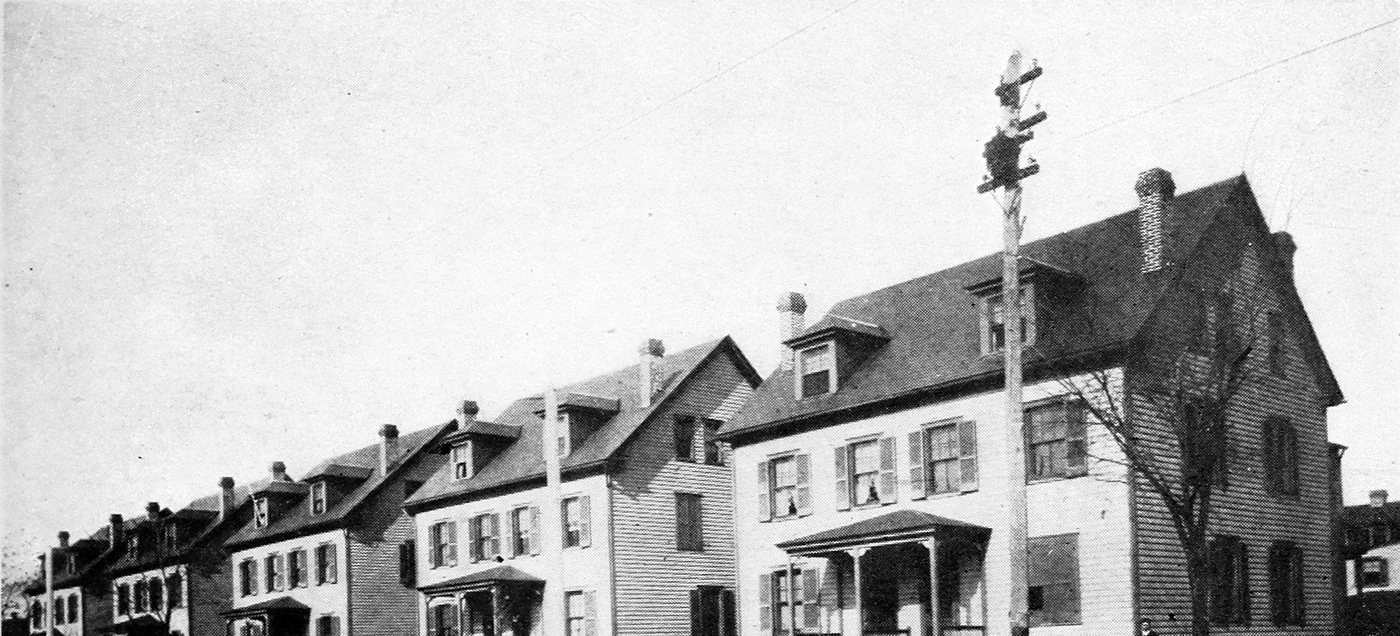
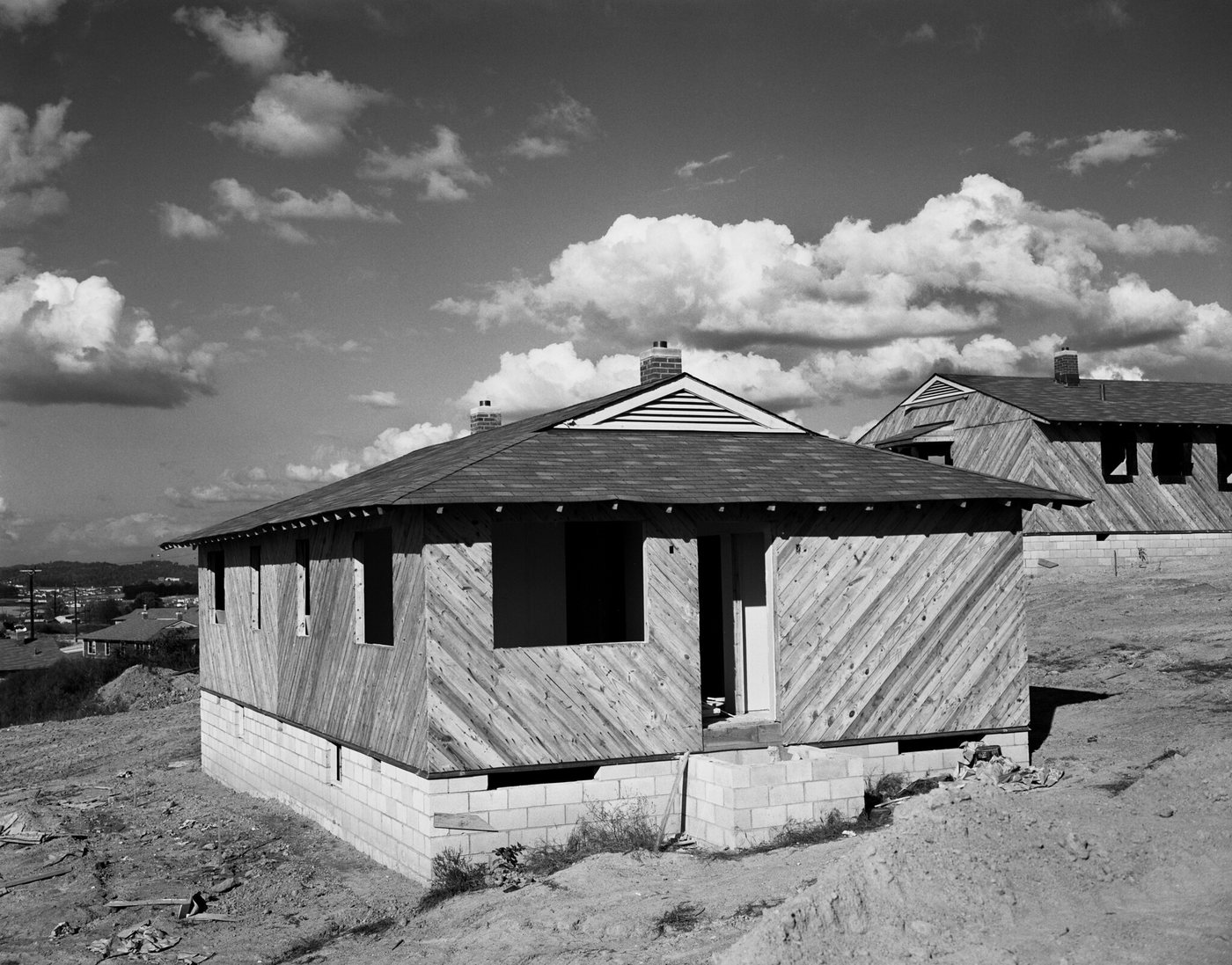
Ground was broken two days before Christmas. At the peak, sixty prefabricated
bungalows went up in a day, and the houses had type numbers — Type 176 was a
five-room bungalow, and the government's own caption says who it was for:
skilled mechanics. Your job description was in the file with your address.
The plant was ninety per cent finished on the eleventh of November 1918 — the
day the war ended. Within a fortnight, roughly twelve thousand people had left.
In September 1919 the War Department advertised the town for sale, and in
November a syndicate of six Charleston businessmen and five New York investors
bought it in a single lot.
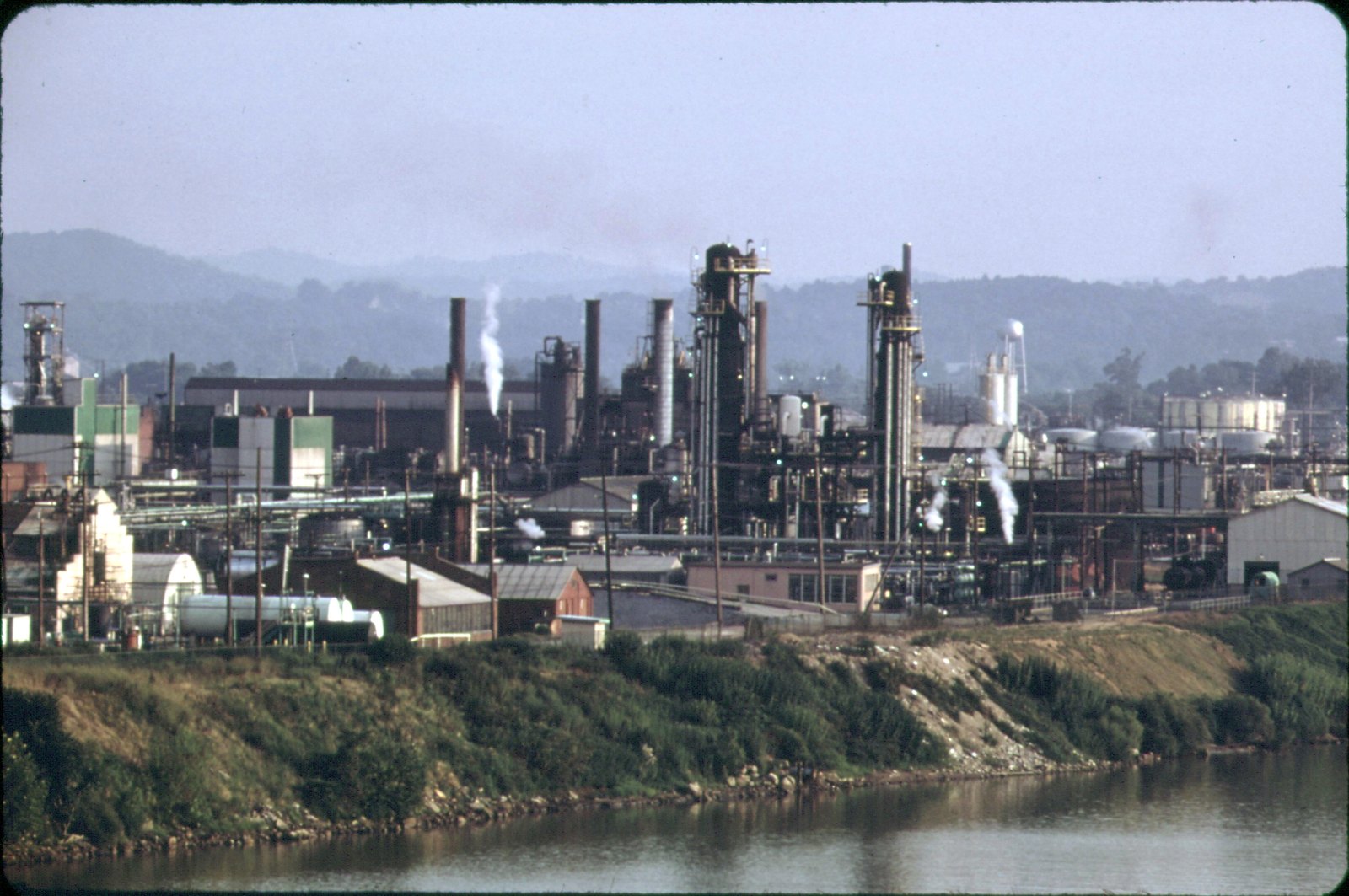
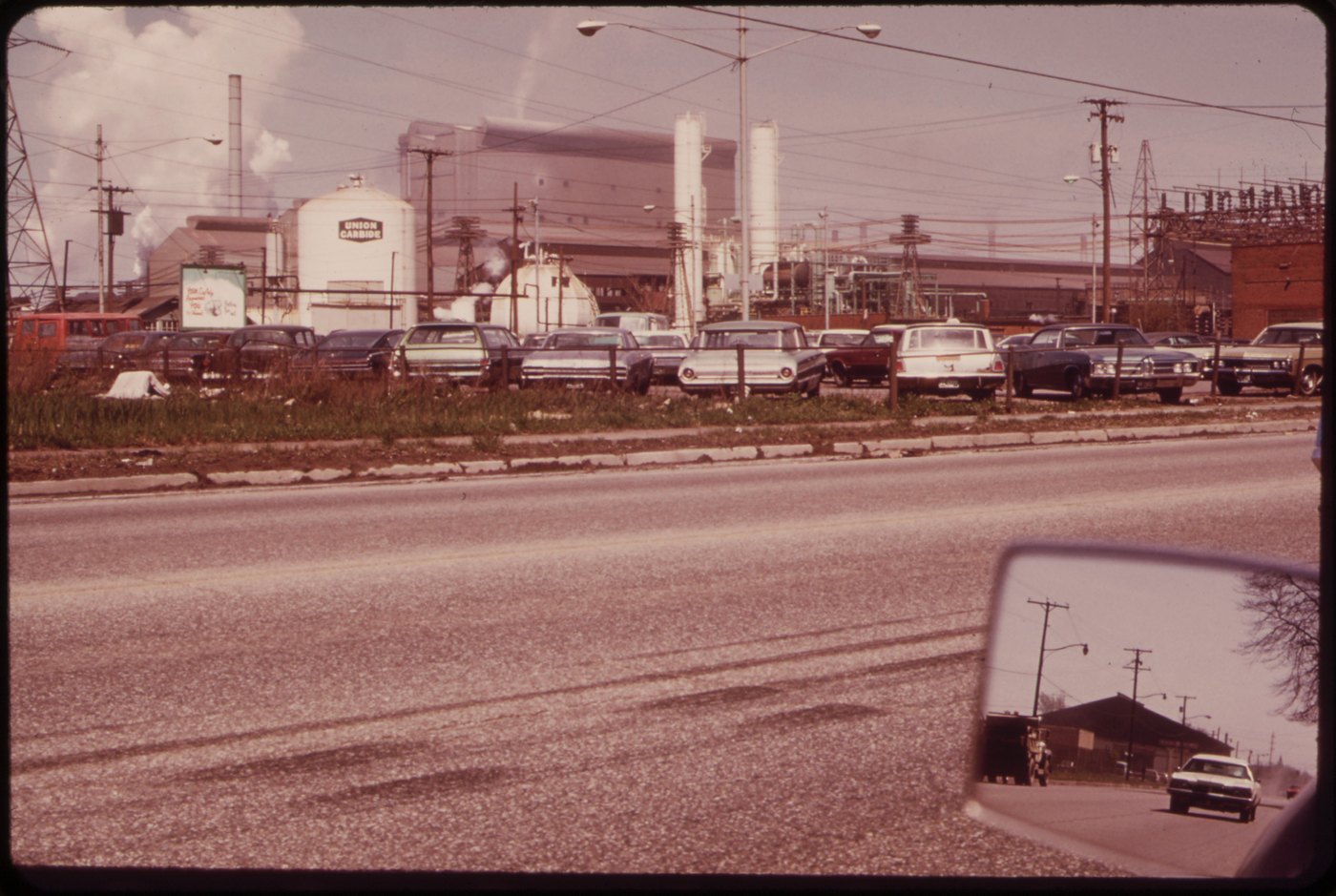
By 1929 the ground belonged to Monsanto. From 1948 it made 2,4,5-T there — the
half of Agent Orange that carried the dioxin. On the eighth of March 1949 an
autoclave in Building 41 ran away. In 2012, weeks before trial, Monsanto settled
with the town for up to ninety-three million dollars — nearly eleven
times what the United States got for the entire city.
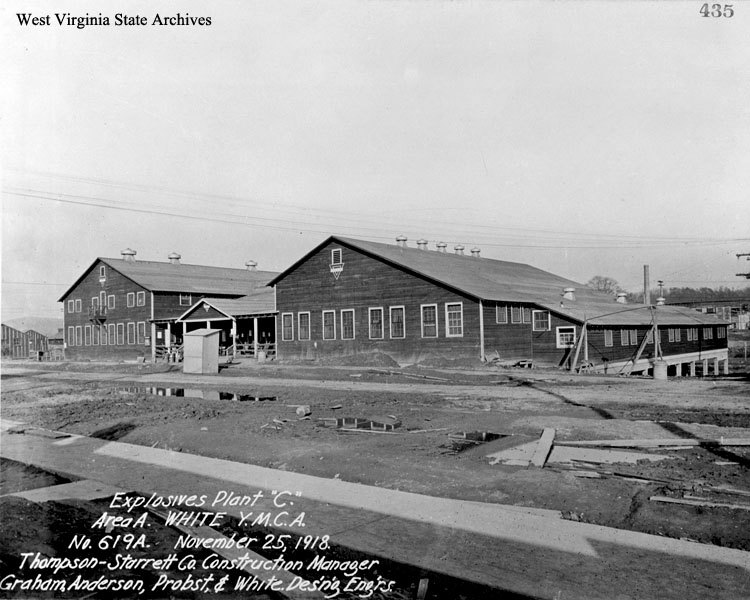
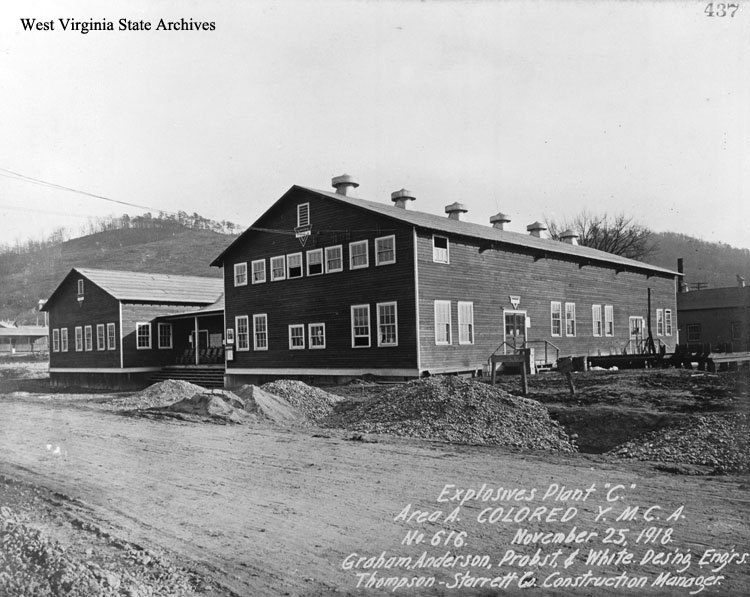
The two photographs
The captions are written on the negatives.
Not added by a cataloguer
later — written across the bottom of each plate in white ink, in the government
photographer's own hand. Negatives 616 and 619-A: three apart, the same November
afternoon, the same two firms named underneath.
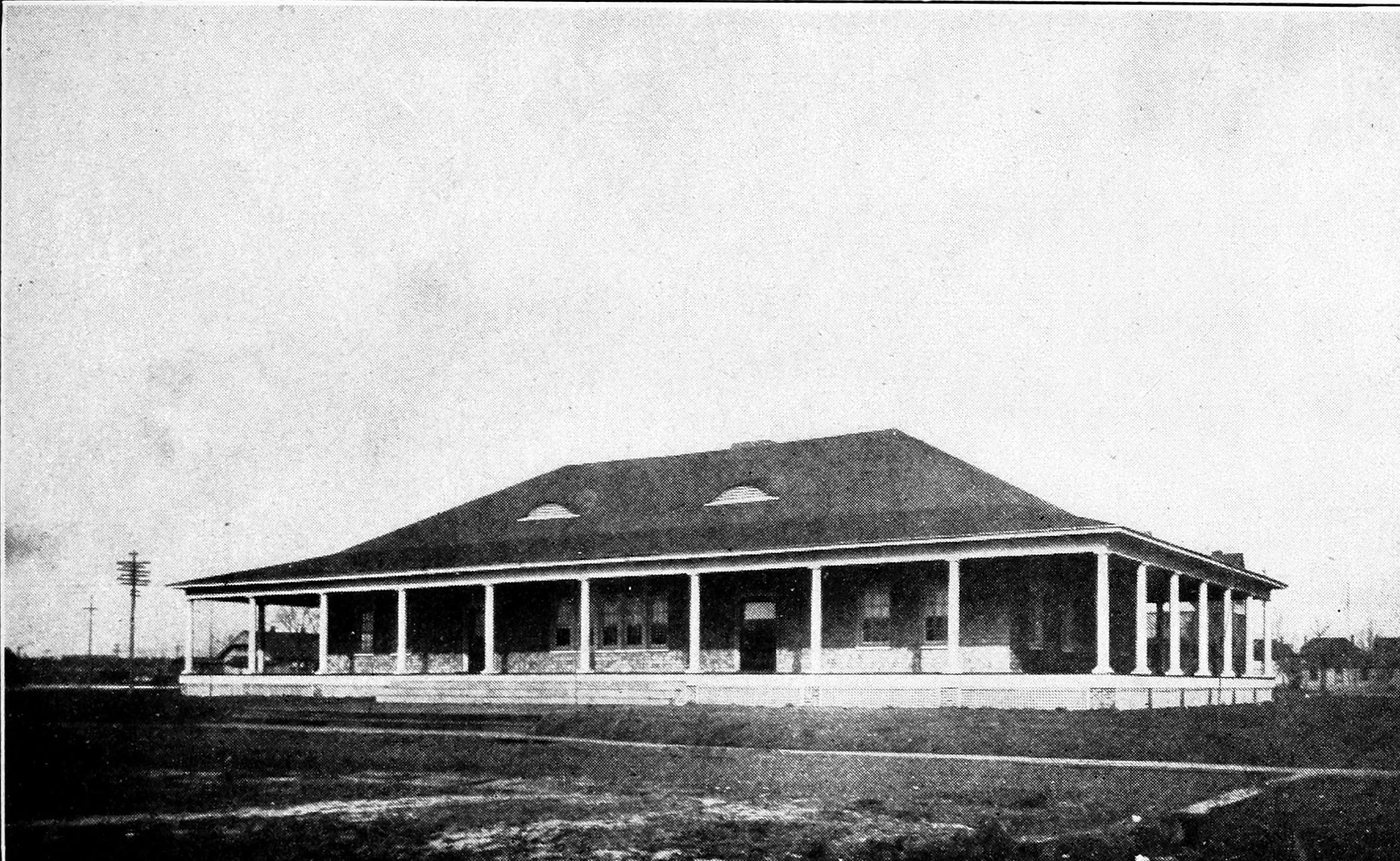
Area A. WHITE Y.M.C.A. No. 619A. November 25, 1918.
West Virginia State ArchivesArea A. COLORED Y.M.C.A. No. 616. November 25, 1918.
West Virginia State Archives
Nobody wrote these captions to make a
point. They are two entries in a survey of a government facility, filed in order by
a man with a list and a pen — and they tell you the entire social architecture of
the town in the difference between two words.
Corrections
What the record actually says.
Left: what almost every
published account of Nitro says. Right: what the document says.
Nobody records how much powder Nitro made.
4,500,000 pounds, over "an operating period of
about a month" — against a design capacity of 15,625,000 pounds a month. That
is roughly seven days of its own capacity, for seventy
million dollars. About $15.56 a pound.
W. Bradford Williams, History of the Manufacture of
Explosives for the World War, 1920, p.31
The War Department's own victory report never mentions Nitro.
It names the town, gives its capacity as 625,000 lb a day,
names the builder and the operator, and prints a photograph captioned
Nitro, West Virginia. It also gives the output at the armistice as
109,000 lb a day — 17% of capacity — "with the expectation of
early and speedy increase."
A cumulative count on a job where the average man lasted forty
days. There were never more than 19,000 on site on any given
day. This was not a workforce; it was a current.
The plant's own daily records
The record names no women at the plant.
It records them — "about four hundred technically trained
men and women and six thousand laborers" — while the plan
printed inches earlier had asked for "five or six hundred technical men."
Not an absence. The record confirms women did technical work here and gives
not one of their names.
Williams, 1920, p.31
The government sold the town to the people living in it.
Residents did buy their houses — but from eleven
investors, not from the United States. The government sold the entire
plant-and-town as one lot to a syndicate, which then sold the houses on. The
comfortable version skips the syndicate. The syndicate is the story.
Charter, State of West Virginia, 3 November 1919
Daniel J. Jackling ran the explosives-plant programme.
Daniel Cowan Jackling. The West Virginia
Encyclopedia has the middle initial wrong; the War Department's own report
gives "D. C. Jackling". If a state encyclopaedia has the name of the man in
charge wrong, hold everything else loosely too.
Crowell, 1919, p.110
Nitro is named for nitroglycerine, and made high explosives.
Named from nitro-cellulose — the guncotton the
plant was built to make. And it made a propellant: smokeless
powder pushes the shell out of the gun. It is not the thing that detonates
when it arrives.
Contemporary plant records
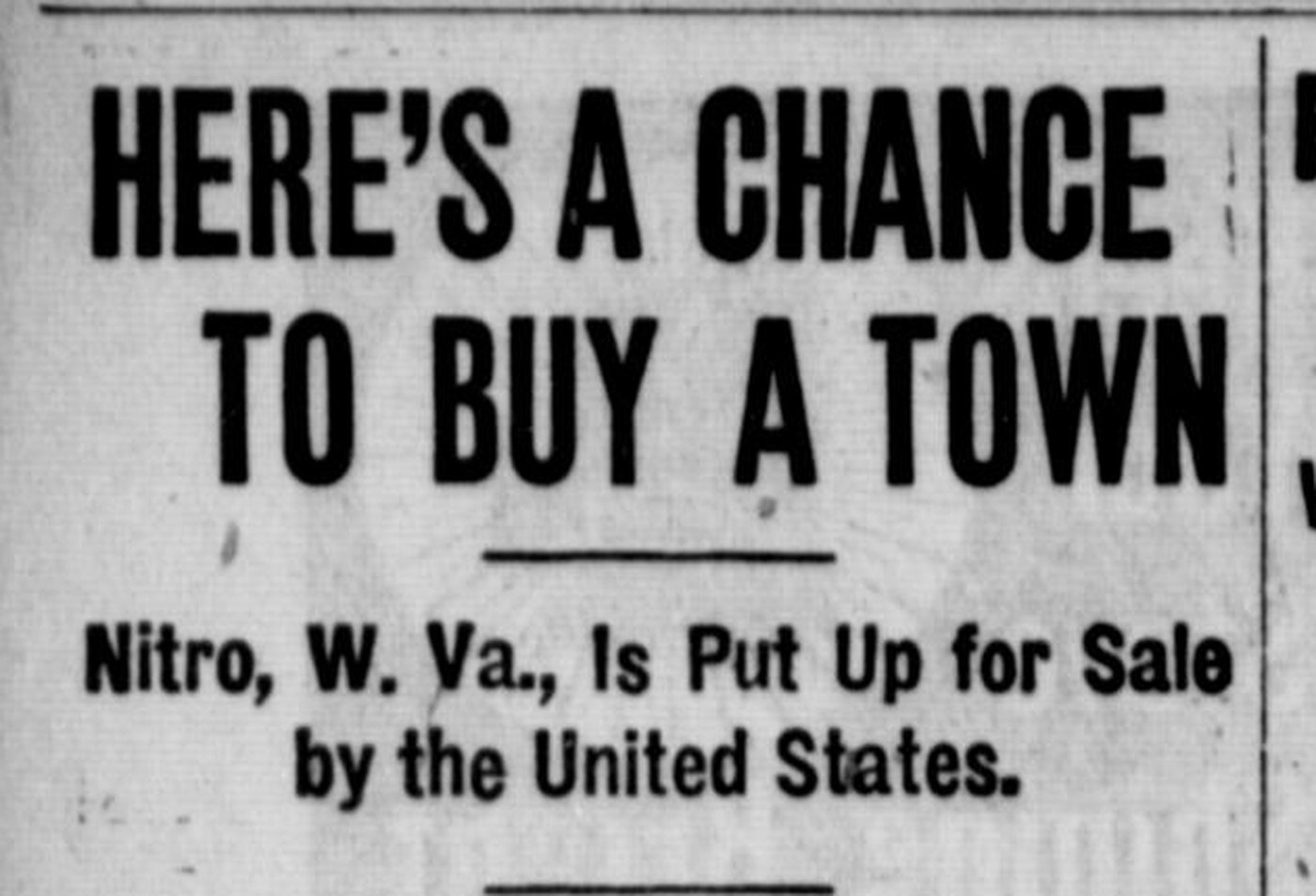
"HERE'S A CHANCE TO BUY A TOWN"
Charlevoix County Herald, East Jordan, Michigan, 19 September 1919 · Chronicling
America, Library of Congress
The sale
Five hundred miles away, a paper ran the listing.
Underneath the headline: "Nitro, W. Va., Is Put Up For Sale By The United
States. Cost Seventy Millions." Then the particulars, written like an
estate agent's — 737 manufacturing buildings, housing for twenty thousand
persons. There were twelve thousand of them still living in it.
The same page gives the hour. Bids would be opened at twelve noon on the
thirtieth of September 1919, and the paper is careful to say that it is not only
the plant being sold but "the civic community as well, to which the United
States also holds title."
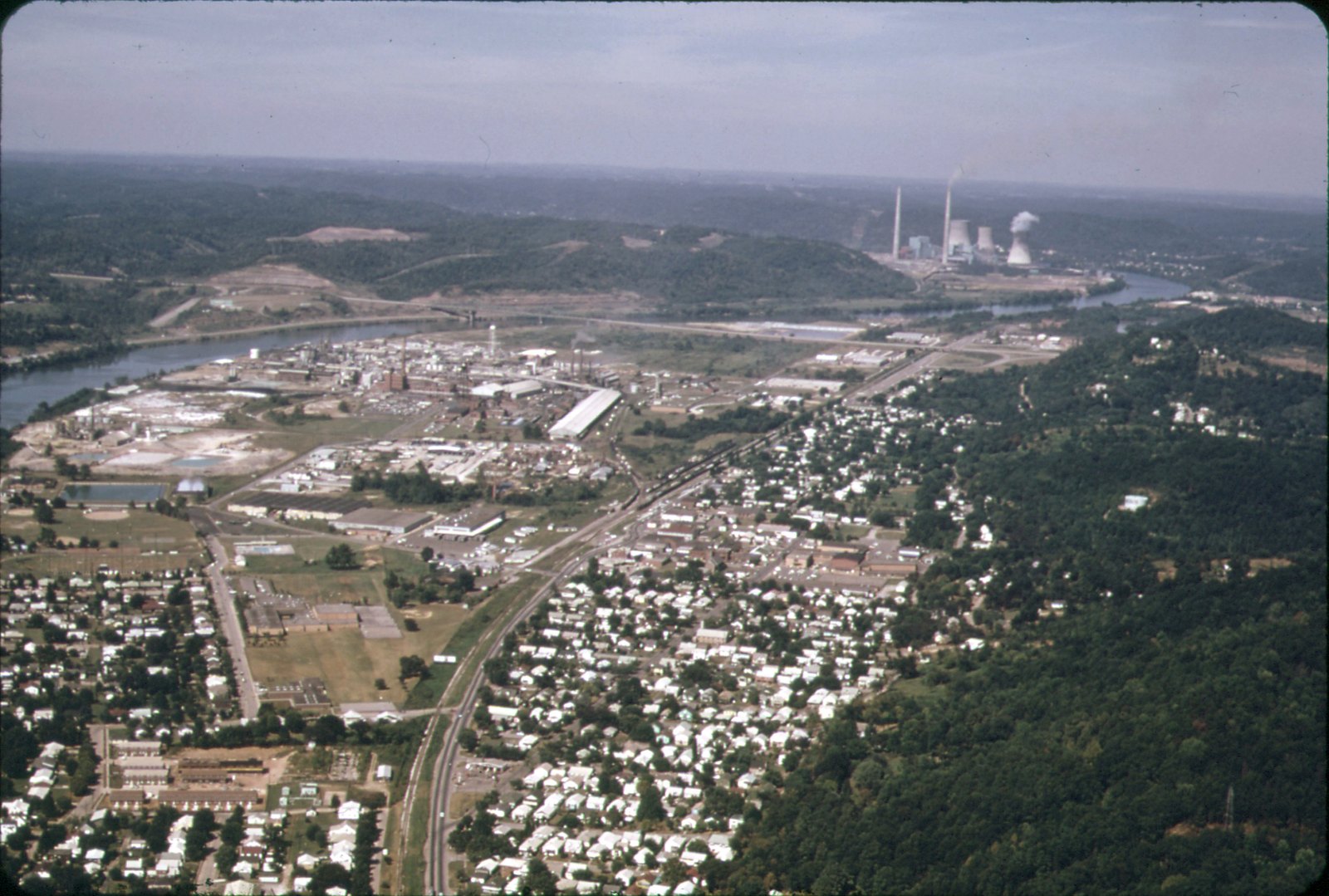
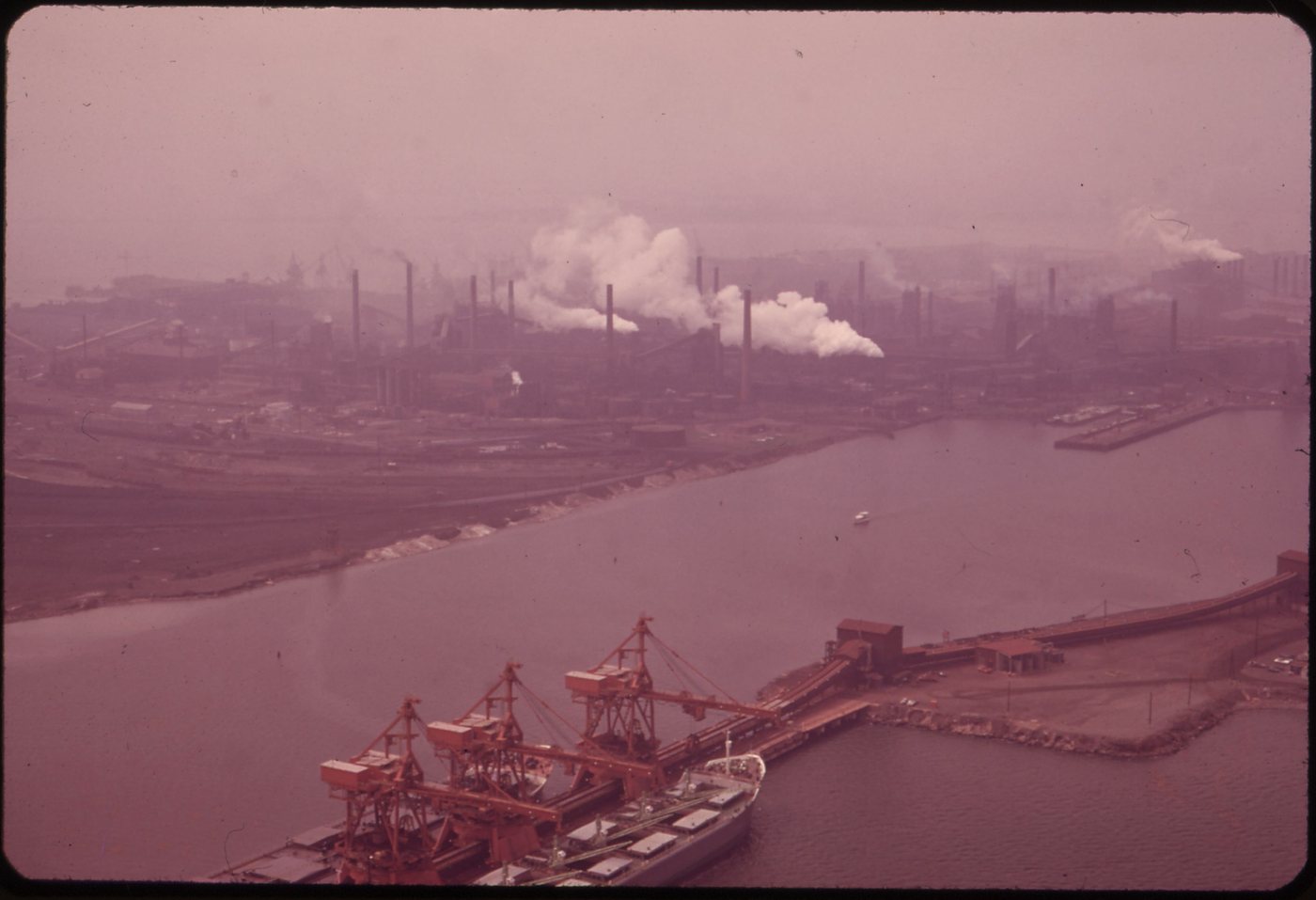
Nitro from the air, the town beside the plant, September
1973. Harry Schaefer · DOCUMERICA, U.S. Environmental Protection Agency ·
National Archives
The archive
Where all of it came from.
Science History Institute
West Virginia State Archives
WVU West Virginia & Regional History Center
Library of Congress · Chronicling America
DOCUMERICA · U.S. EPA, via the National Archives
UCSF Industry Documents Library
U.S. Environmental Protection Agency
Supreme Court of Appeals of West Virginia
U.S. District Court, S.D. West Virginia
U.S. Department of Labor, 1921
Every frame in the film names its repository on screen. Nothing in it
is generated, reconstructed or dramatised.
Sugar Land · Texas
The company town that won.
Every town in this series ended the same way: the company left and
the place died. Sugar Land did not. It is one of the wealthiest suburbs in Texas.
In February 2018 a man on a backhoe, digging the foundations of a new school,
hit a bone.
$136,217
median household income
10th
best place to live in America, U.S. News & World Report
95
people exhumed from the ground under the school — 94 men, one woman, aged roughly 14 to 70
1879–1909
the years they were buried there
3,500+
Texas prisoners who died between 1866 and 1912
The film
The Company Town That Won. Then They Dug the Foundations for a School.
Twelve chapters · 1080p · archival stills and primary documents ·
no image of any person in this film is generated Watch on YouTube →
The Sugar Land file
The research, published.
The film is free and always
will be. What is for sale is everything behind it — the documents themselves, the
corrections with their page numbers, and the plates at full resolution.
The book
$9.99
Sugar Land, Texas
The full account, expanded from the film
Nine Library of Congress plates, every item number printed
The corrections — including three of mine
Seven appendices, including how to check this book
The primary documents as scanned — the Black Codes of 1866, the National
Register nomination, House Resolution 1324, full pages
The Lomax photographs at full resolution, uncropped
The complete corrections file, and what could not be
verified, and why
What happened
Slavery ended in 1865. In Fort Bend County, the sugar kept coming.
The land was granted in 1828 to Stephen F. Austin's secretary, and by 1843 there
was a mill on it pressing cane into raw sugar. It has been operating on that
property ever since — a federal historic nomination calls it the oldest
continuously operating business in Texas. In 1860 the two men who gave the place
its name held a hundred and eighty people as property.
Sugar is worse work than cotton. Cane has to be cut by hand, hauled, crushed and
boiled within a day or two of cutting or the juice spoils, in Gulf Coast heat,
around open fires. Sugar plantations had death rates that stood out even against
the rest of American slavery, and everyone involved understood that.
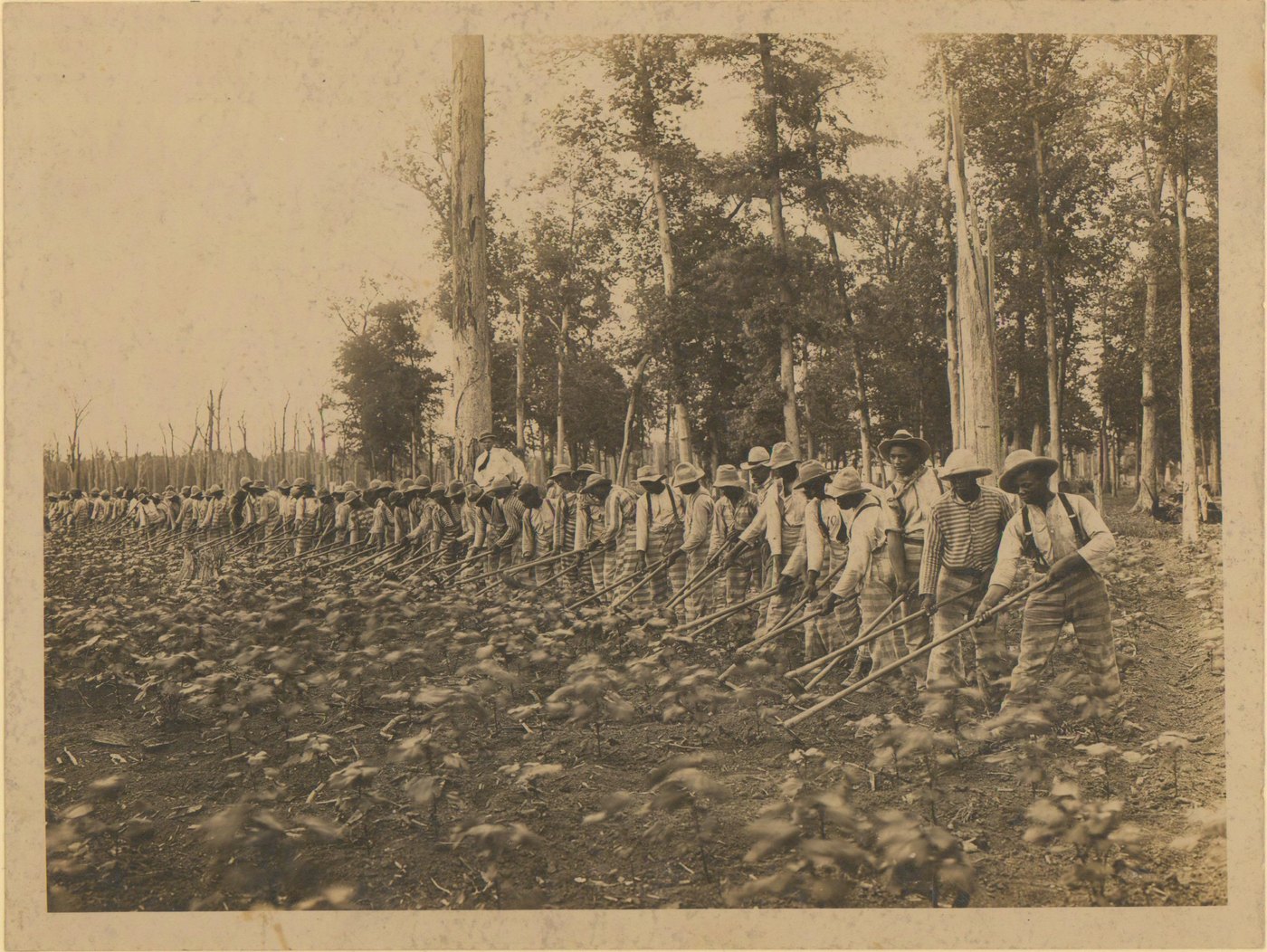
Then the Thirteenth Amendment abolished slavery — with one clause left open. In
1866 the Texas legislature passed three interlocking labour laws that walked
through it. By February 1867 the state was leasing prisoners to railroads. In
1878 two sugar planters, Edward Cunningham and Littleberry Ellis, leased
the entire prison population of Texas and put it in the cane.
A prison chaplain went to a newspaper in 1908; the legislature abolished convict
leasing in 1910 and the last contracts were cancelled at the end of 1912. But the
state had already bought the land — 5,235 acres in 1908 — and simply worked the
fields itself. The Central Unit at Sugar Land did not close until August
2011. The whip was legal in Texas prisons until 1941.
The clause
It was not hidden. It was not a drafting error.
Neither slavery nor involuntary servitude, except as a punishment for crime
whereof the party shall have been duly convicted, shall exist within the
United States, or any place subject to their jurisdiction.
Thirteenth Amendment to the Constitution of the United
States, ratified December 1865
A man could be arrested for being idle,
tried in a court he was barred from testifying in, fined an amount he could not
pay, and have his labour sold to cover the fine. None of it was slavery, legally
speaking, because a court had said the word guilty. Black Texans were
about a quarter of the state's population and somewhere between half and sixty per
cent of its prisoners. A man assigned to a contract work farm could expect to live
seven years.
1934
The year somebody came to listen.
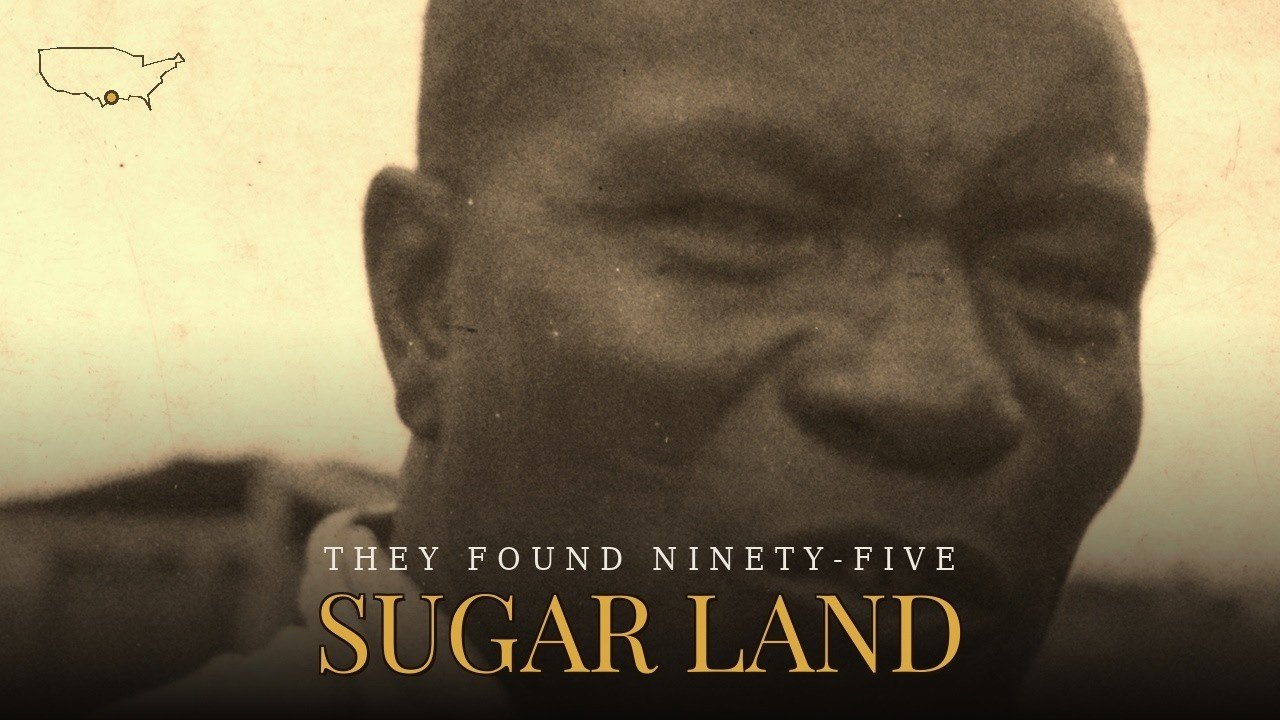
John A. Lomax went into the
Texas prison farms with a recording machine for the Library of Congress. These two
men were photographed at Sugar Land — one sat for the camera, the other did not
stop working for it — and they are named in the Library's own catalogue, which is
more than the records managed for most of the people who worked that ground.
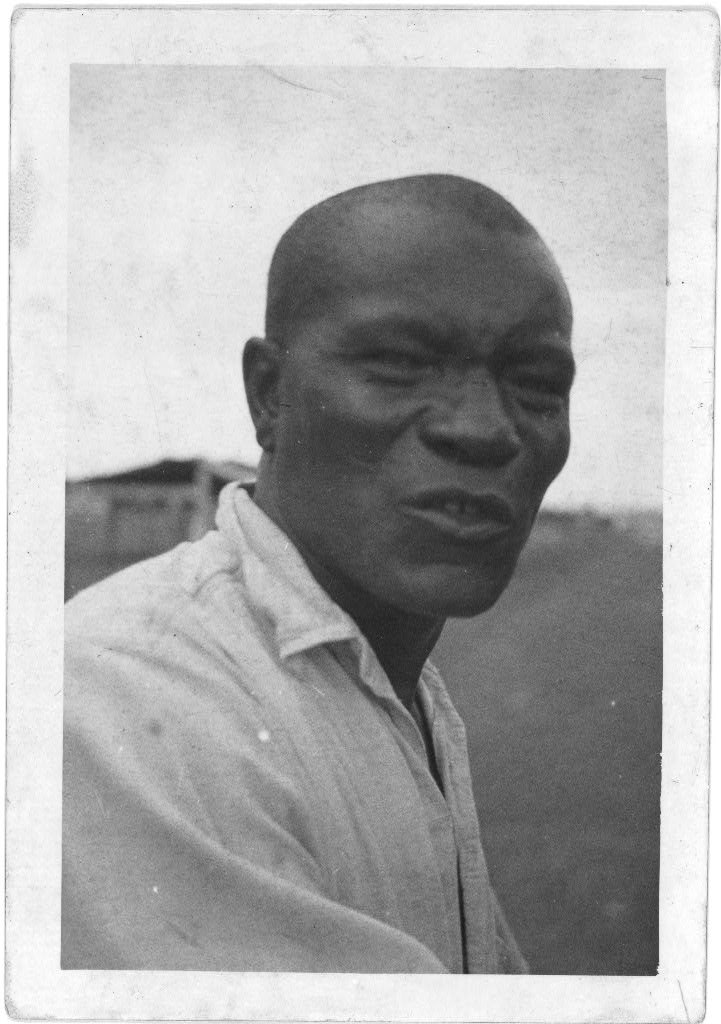
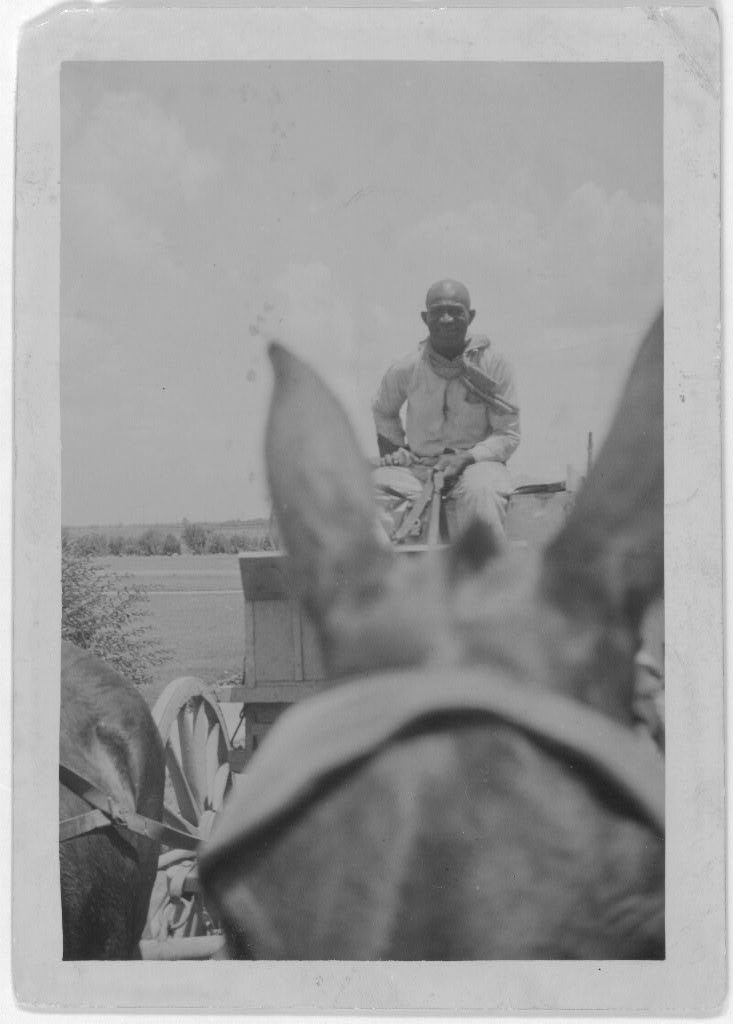
James Baker, known as Iron Head. Sugar Land, 1934.
John A. Lomax Collection · Library of CongressMoses Platt, known as Clear Rock — photographed behind
a plough mule, in the field. Sugar Land, 1934.
John A. Lomax Collection · Library of Congress
Four men
Named in the camp's own records.
The 2020 bioarchaeological
report compiled an archival roster of about seventy men who worked and died at the
camp between 1879 and 1909. No name has been matched to any set of remains.
Nathan Pope
Eighteen. Convicted of burglary. Died in 1879, two days after arriving at the Freeman Camp, during an escape attempt.
Robert Brown
Given twenty-five lashes for laziness, twenty-five for disobedience and twenty-five for impudence to a guard. Died of heat stroke.
William Crawford
Twenty-one, married, accused of forgery. Gunned down trying to escape.
Ed Jackson
Twenty. Accused of stealing a horse. Died of malaria.
Fort Bend ISD, Back to Bondage, 31 August 2020 · site 41FB355
Corrections
What the record actually says.
Left: what is commonly
written about Sugar Land. Right: what the document says.
Convict leasing was slavery under another name.
It was a separate legal system, built in the
gap the Thirteenth Amendment left open. Collapsing the two loses the argument
entirely — the point is not that the law was ignored. The point is that the
law worked exactly as written.
Thirteenth Amendment; Texas Black Codes, Eleventh
Legislature, 1866
Texas abolished convict labour in 1910.
Texas abolished convict leasing. The same Act
required prisoners to work on farms owned by the state — so the
state bought the plantations. By 1921 it held more than 81,000 acres, over
50,000 of them bought from the men who had been leasing convicts.
Texas State Library and Archives Commission; TSHA
The state bought the prison farm land from Cunningham, the convict lessee.
It did not. Cunningham defaulted and sold to Kempner and
Eldridge. The state bought 5,235 acres from the Imperial Sugar
Company in 1908. The Imperial State Prison Farm opened in April
1909.
THC marker; Rice University Digital Collections; Texas
Tribune
Lead Belly was a leased convict at Sugar Land.
Leasing had ended before he got there. Huddie Ledbetter was
state prison-farm labour, transferred to the Imperial State
Farm and pardoned in 1925 — which is the whole point. The thing that was
abolished had been replaced.
Library of Congress; TSHA
"Midnight Special" was written at Sugar Land, about Sugar Land.
That reading is John Lomax's interpretation.
The song predates Lead Belly — Howard Odum printed lyrics in 1905 and Carl
Sandburg published full versions in 1927, and early versions place it
elsewhere.
Odum, 1905; Sandburg, The American Songbag, 1927
Imperial Sugar paid its workers in company scrip.
No source documents scrip at Sugar Land. It was
payroll deduction at company-controlled stores and banks —
which does the same work and is what the record actually shows.
City of Sugar Land; NRHP nomination
Segregation at Sugar Land is an inference.
It is in a federal document. The National Register nomination
records that "minorities lived in a separate area of town and had their
own school" and "did not receive the same housing assistance."
The neighbourhood was Mayfield Park, and around 1920 the convict-lease
Prisoner's Quarters physically framed it.
NRHP nomination, National Park Service; Roberts, 2020
One man
Reginald Moore.
He was a Texas correctional officer between 1985 and 1988, at a prison farm a
few miles from this ground, and that is where the research started. He spent
roughly two decades warning Fort Bend ISD and anyone else who
would listen that there were unmarked convict graves on that land. He was the
volunteer caretaker of the cemetery next door and he got it a state marker in
2016.
When the bones came up, he was kept away from the excavation.
They won't even let me see it, and that hurts me so bad. All that work I've
done, and they ran me off.
Reginald Moore, 1959–2020 · Texas House Resolution 1324,
87th Legislature
He died on 3 July 2020, aged sixty — six weeks before the report was
released.
Where it stands
Still not identified. Still not built.
The ninety-five were reburied in November 2019 where they were found, each grave
individually marked so that identification remains possible. Permanent markers
went in in September 2020, the site became a Historic Texas Cemetery in February
2021, and the state's marker was dedicated on 19 June 2025 —
Juneteenth.
No individual has been identified by name. A handful of
families have been linked by DNA. In 2023 a public broadcaster reported that
nobody was funding the identification work and a genealogist was paying for it
out of pocket. The memorial was designed by MASS Design Group and costed at four
to four and a half million dollars; Fort Bend County approved one and a half
million of it in December 2025. It has not been built.
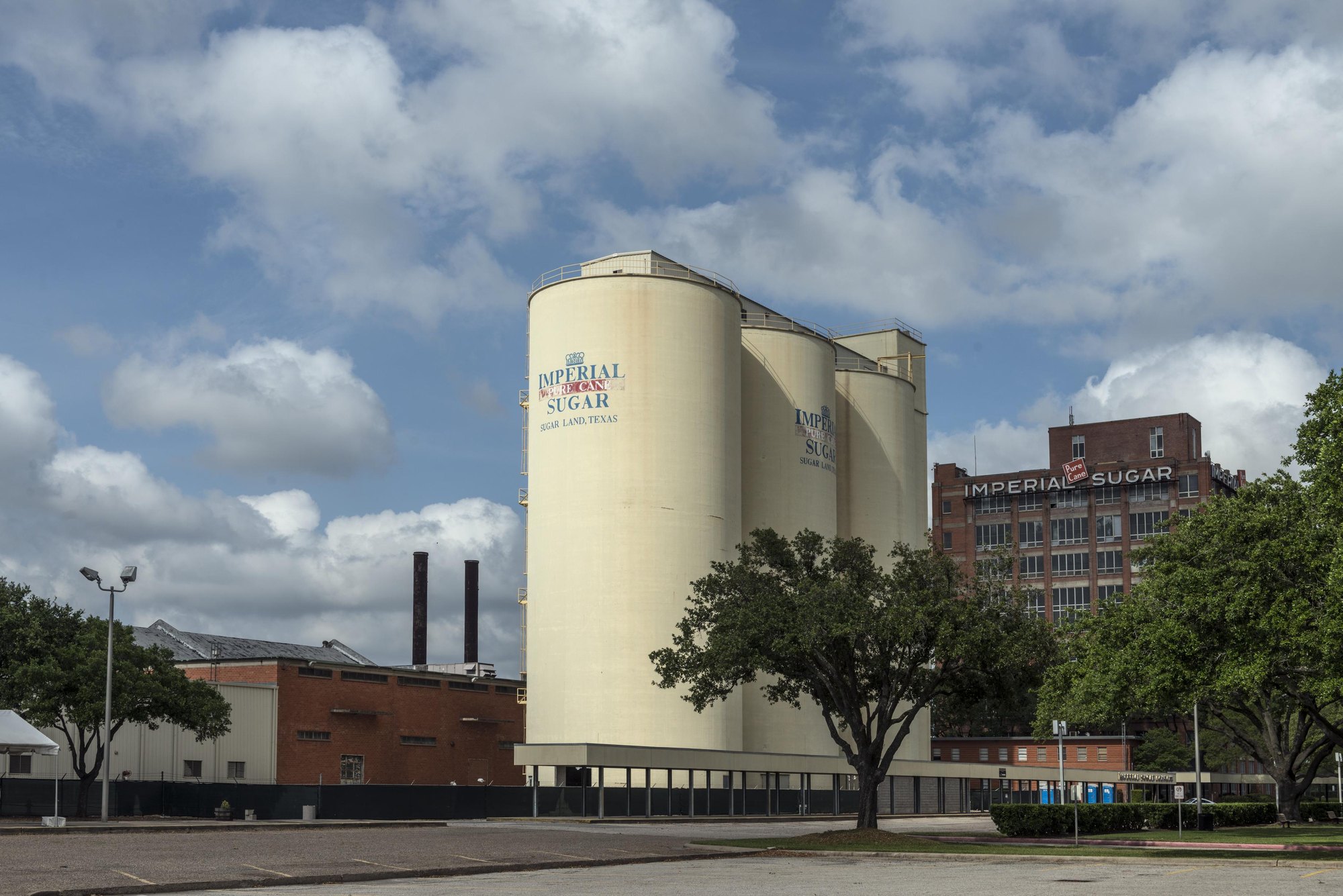
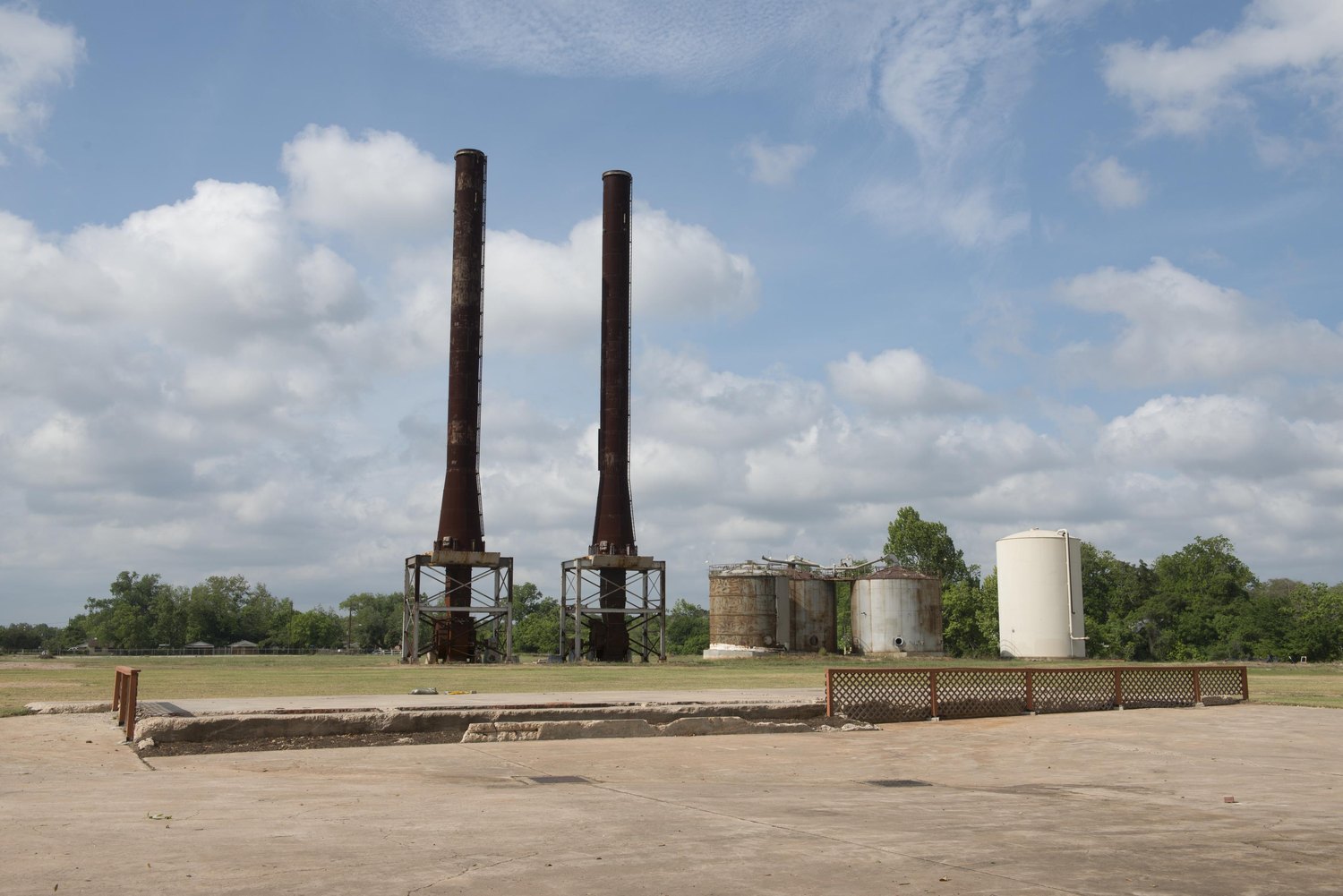
What is left of the refinery. The city bought the site
in June 2025 — the first time it has ever owned it.
Carol M. Highsmith · Library of Congress
Six words
Checked term by term.
The City of Sugar Land's official City History page runs from Austin's
land grants through Oakland Plantation, the 1907 sale to Kempner and Eldridge,
the railroad and incorporation in 1959. It does not contain the words
slave, slavery, enslaved, convict, prison or
penitentiary — not once. The city's July 2025 staff report on
the Imperial Historic District, twenty years of redevelopment history for the
refinery site, does not mention convict leasing at all.
That is an absence on a specific page and in a specific document, checked on a
specific date, and it is worth being precise about what it means. The city runs a
Convict Lease Memorial page, joined a task force in 2018 and restored the old
prison-farm cemetery. The acknowledgment came from the school district,
the state historical commission, and one man with a day job — not from the city's
story about itself.
The archive
Where all of it came from.
Texas State Historical Association · Handbook of Texas
Texas State Library and Archives Commission
Texas Historical Commission
Texas Legislative Reference Library
National Register of Historic Places · National Park Service
Library of Congress · John A. Lomax Collection
Fort Bend ISD · Back to Bondage, 2020
Texas House Resolution 1324, 87th Legislature
U.S. Census Bureau
Rice University Digital Collections
City of Sugar Land
Walker, Penology for Profit, 1988
Every frame in the film names its repository on screen. Some
illustrative plates are generated and are drawn in a non-photographic style so they
cannot be mistaken for archival material. No image of any person in the film is
generated.
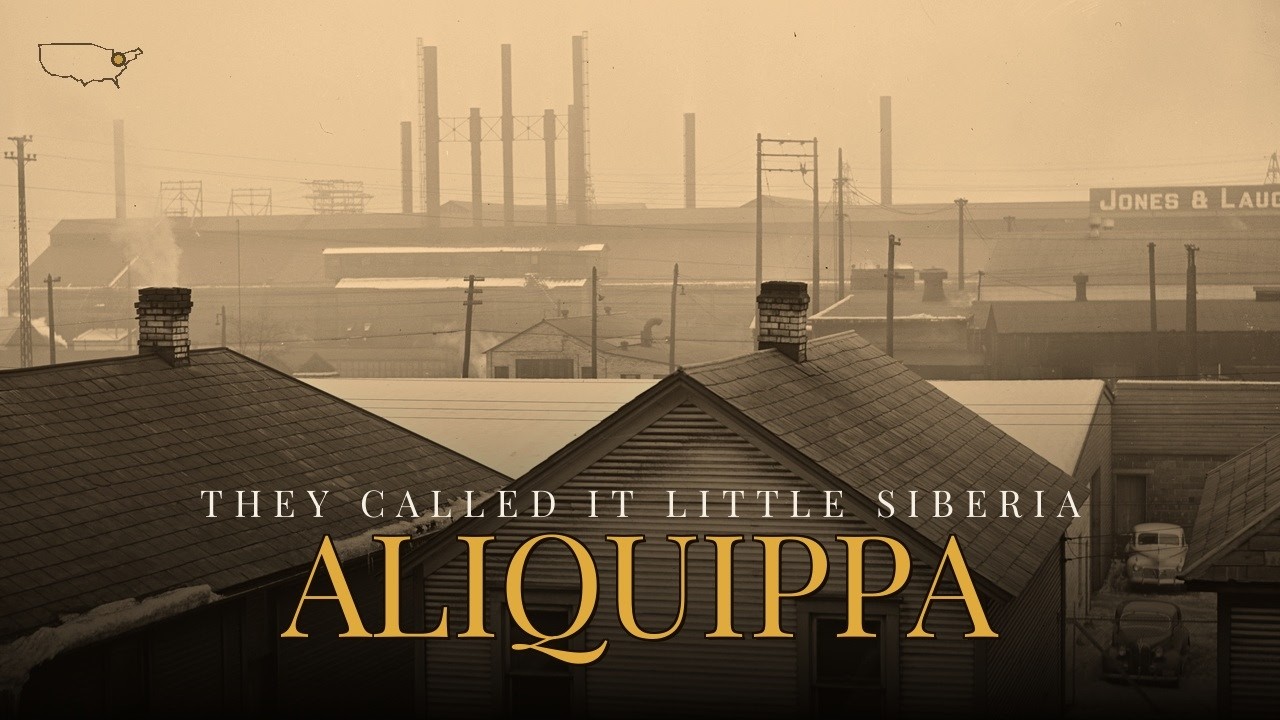
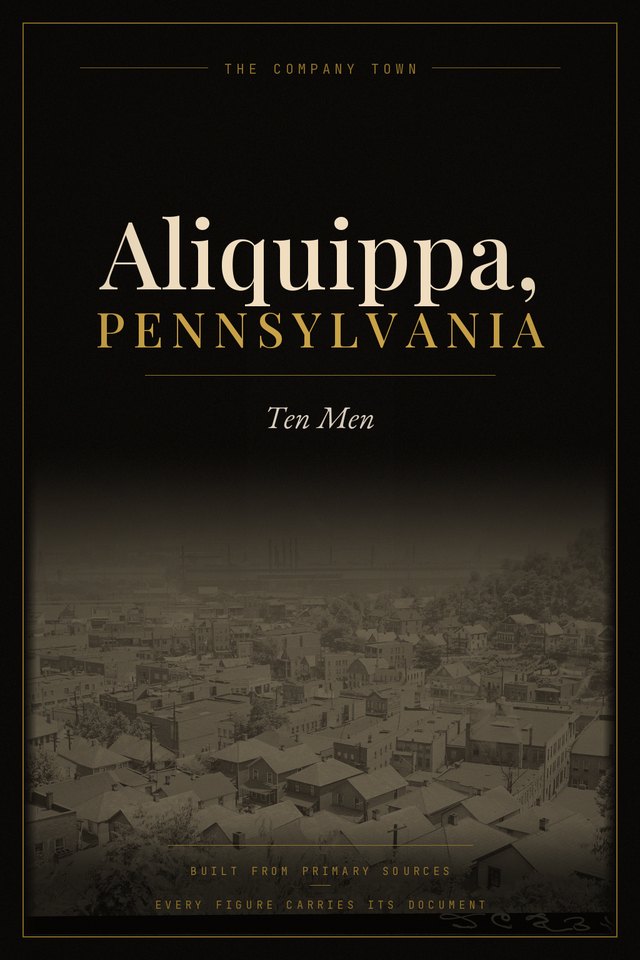
Aliquippa · Pennsylvania
Drawn before anyone arrived.
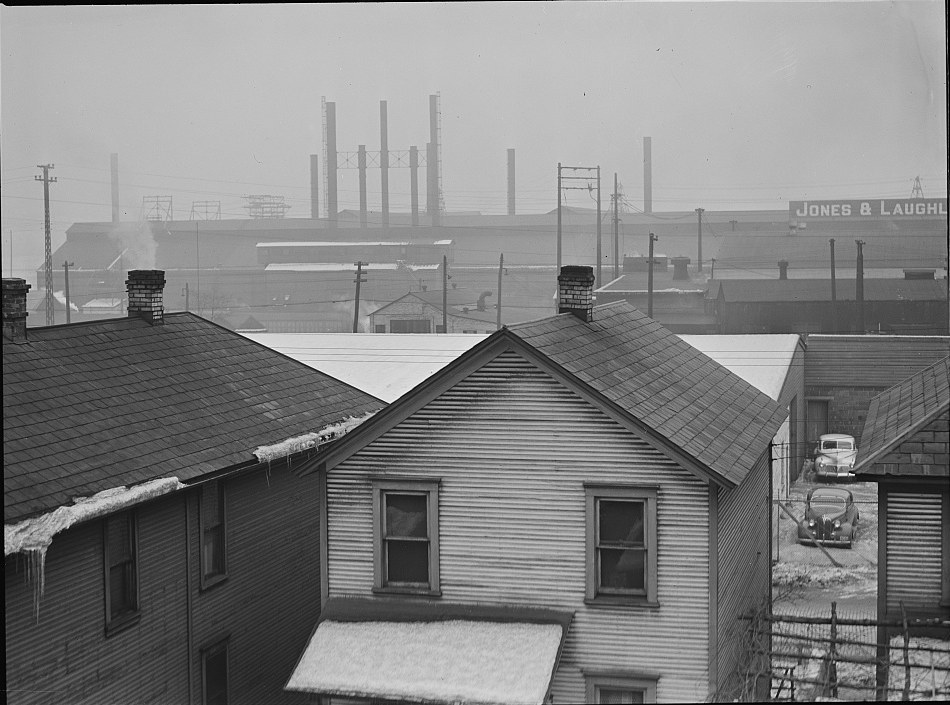
Jones & Laughlin Steel cut twelve numbered neighbourhoods into the
hillsides above the Ohio between 1907 and 1912 — for a workforce it had not yet
hired, in a town that did not yet exist. It owned the water company, the land company
and the street railway. Pennsylvania sold companies police commissions for a dollar
each, and the town acquired a nickname.
12 Plans
numbered, not named. Plan One begun 1907, Plan Twelve finished 1912 — and settled nationality by nationality
7 miles
the Works along the south bank of the Ohio, about 1,400 acres. Raw ore in at one end, finished product out at the other
$1
the price of a Coal and Iron Police commission after 1871. 7,632 were issued before Gifford Pinchot abolished the force in 1931
5–4
12 April 1937. Ten men had been fired; the Court upheld the Wagner Act and rewrote the rights of every working person in the country
27,116 → 9,238
the population, 1930 to 2020. In 1984 LTV closed most of the Works and about 8,000 lost their jobs in a stroke
The film
The American Town So Controlled They Called It Little Siberia.
Twelve chapters · 31 minutes · 1080p · archival stills and
primary documents · photographed by Jack Delano, John Vachon and Arthur Rothstein Watch on YouTube →
The Aliquippa file
The research, published.
The film is free and always
will be. What is for sale is everything behind it — the documents themselves, the
corrections with their page numbers, and the plates at full resolution.
The book
$9.99
Aliquippa, Pennsylvania
The full account, expanded from the film
The names of the ten men, from the case file
Eighteen corrections, each with its source
Nine appendices, including the Labor Board’s decision in full
The primary documents as scanned — NLRB v. Jones & Laughlin Steel
Corp., 301 U.S. 1 (1937), the J&L Aliquippa Works records at the
University of Pittsburgh, and the census returns from 1930
Every plate at full resolution, uncropped
The complete corrections file, and what could not be verified, and why
What happened
A mill did not grow into a town. A mill drew one.
The site was chosen for three reasons and none of them were about people. It had
seven miles of flat riverbank — the longest continuous stretch of buildable land
on that section of the Ohio. It had the river, which meant barges, which meant coal
and ore and limestone arriving by water at a fraction of the cost of rail. And it was
eighteen miles from Pittsburgh: close enough to the money, far
enough from the city that a company could do as it liked.
Jones & Laughlin began building the works between 1905 and 1910,
and while the furnaces were going up it was laying out the town. The hillsides were
divided into twelve sections and given numbers rather than names. Construction
started in Plan One in 1907; by 1912 Plan Twelve was finished. The company built
twelve neighbourhoods for a workforce it had not yet hired, and then settled them
nationality by nationality — so that a Serbian crane operator and an Italian
labourer might work forty feet apart for ten hours and go home to different worlds,
with no common tongue but the handful of English words the job required.
An 1865 statute let Pennsylvania commission private police for private companies.
After 1871 a commission cost one dollar. For a dollar a steel company
could put a man on the street with the authority of the state and the loyalty of an
employee. J&L owned the water company, the land company and the street railway by
1912; it built the schools and the churches; and on election day its agents counted
the votes. 7,632 commissions were issued across the Commonwealth
before Governor Gifford Pinchot abolished the force in 1931.
Ten men were fired for union activity. Their union was the Amalgamated Association's
Beaver Valley Lodge No. 200, and the company's argument was that
manufacturing in Pennsylvania was none of the federal government's business. About
75 per cent of what the Works produced was shipped out of the state
— and that was the fact the case turned on. On 12 April 1937
the Supreme Court upheld the Wagner Act, five to four, Chief Justice Hughes writing.
Then came the best years: employment as high as fourteen thousand, a town of
twenty-seven thousand above it, and a contract. In 1968 LTV acquired J&L. In 1984
it closed most of the Works and about eight thousand people lost
their jobs at once. There had never been a second employer. Demolition ran through
1988, and the men who had built the place stood on the hillsides and watched it come
down.
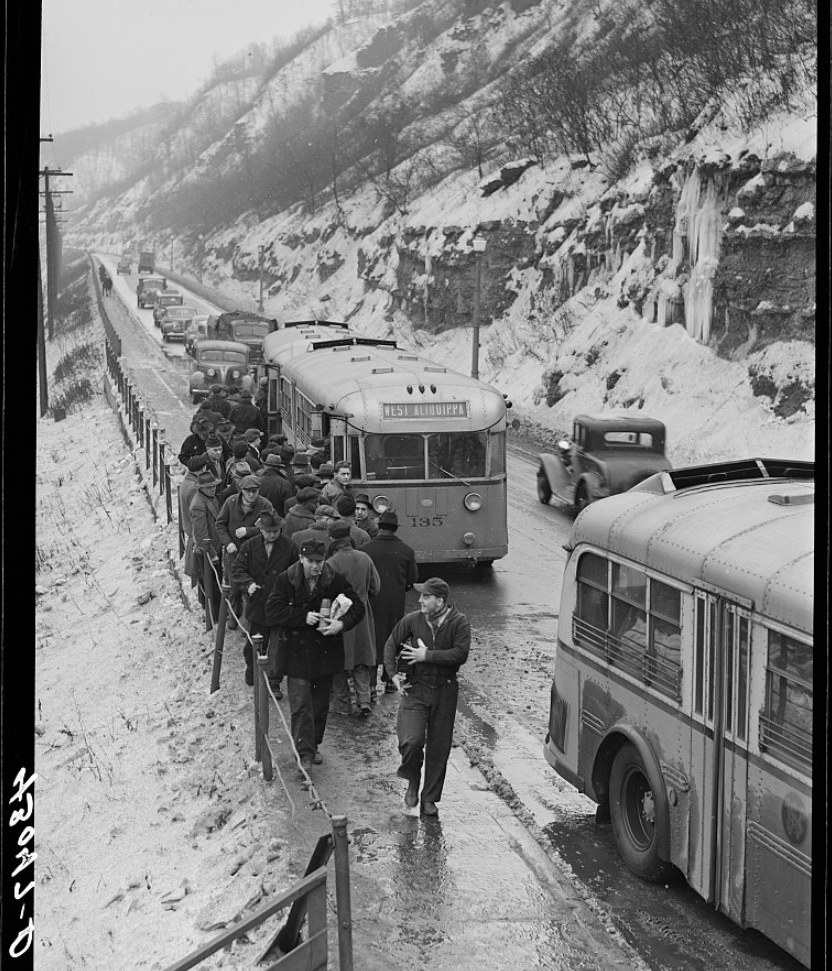
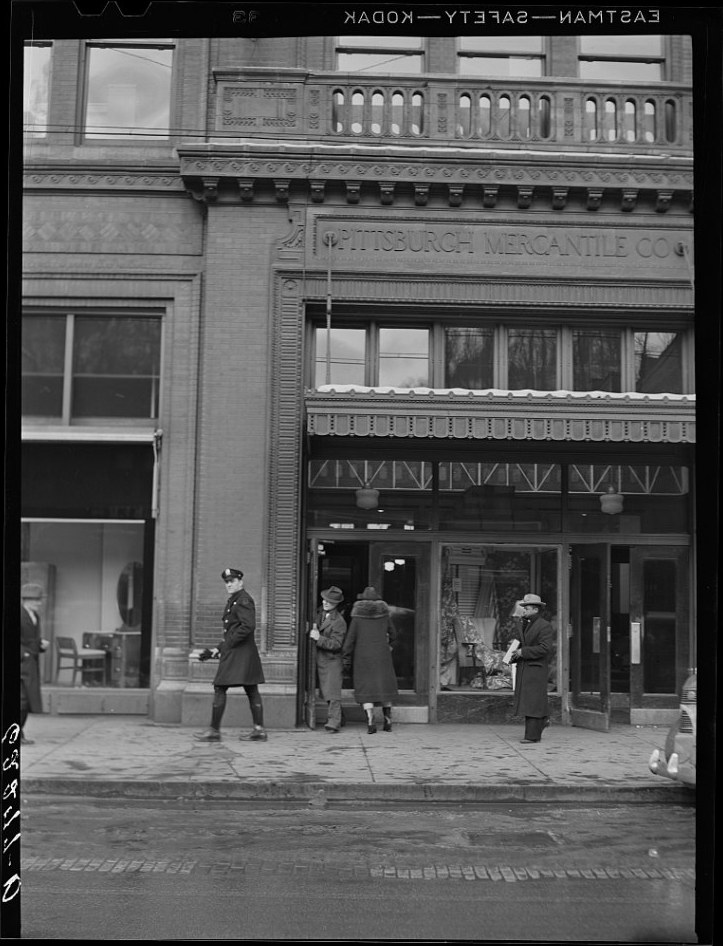
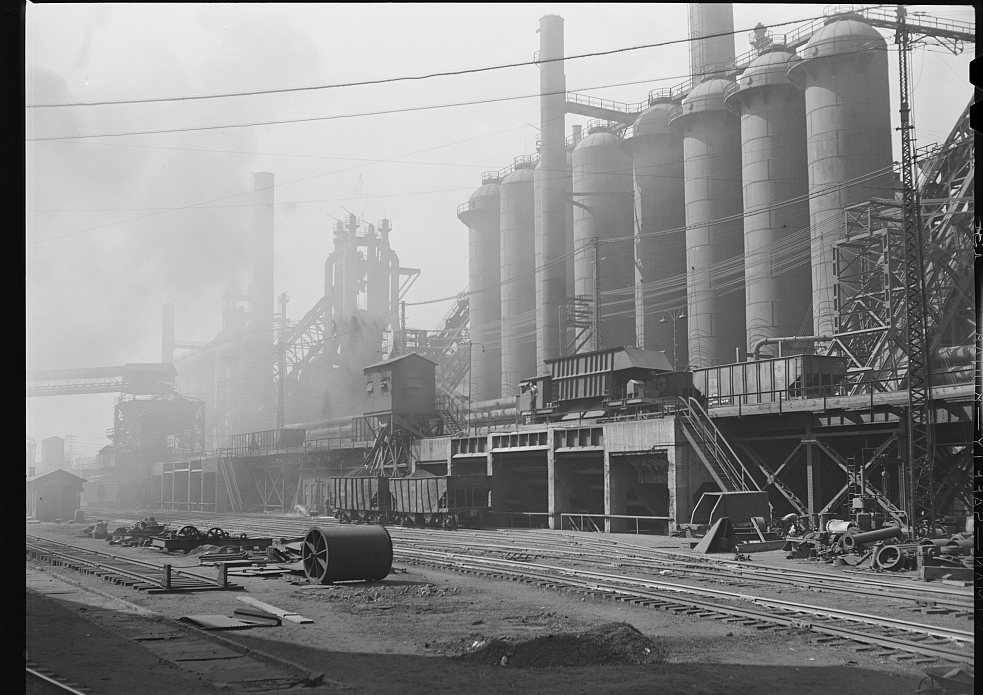
Changing shifts at the Aliquippa Works. The car is marked WEST ALIQUIPPA — the Plans ran down to the mill and the mill ran three shifts, so the road filled four times a day. Jack Delano · Farm Security Administration / Office of War Information · Library of Congress · LC 2017793412. No known restrictions on publication.The Pittsburgh Mercantile Company — the J&L company store. The company owned the water, the land, the street railway and the shop. John Vachon · Farm Security Administration / Office of War Information · Library of Congress · LC 2017811756. No known restrictions on publication.
Ten men
Two motor inspectors, a tractor driver, three crane operators.
The Supreme Court's own recitation lists what the ten discharged employees did for
a living: two motor inspectors, one tractor driver, three crane operators,
one man who washed coal in the coke plant, and three labourers. Ten thousand
men worked in that plant and a community of about thirty thousand lived above it.
The Court's decision reshaped American labour law for everyone who has worked for
wages since.
The opinion does not name them. The Labor Board’s order of 9 April 1936,
printed in the Supreme Court’s own case file, does.
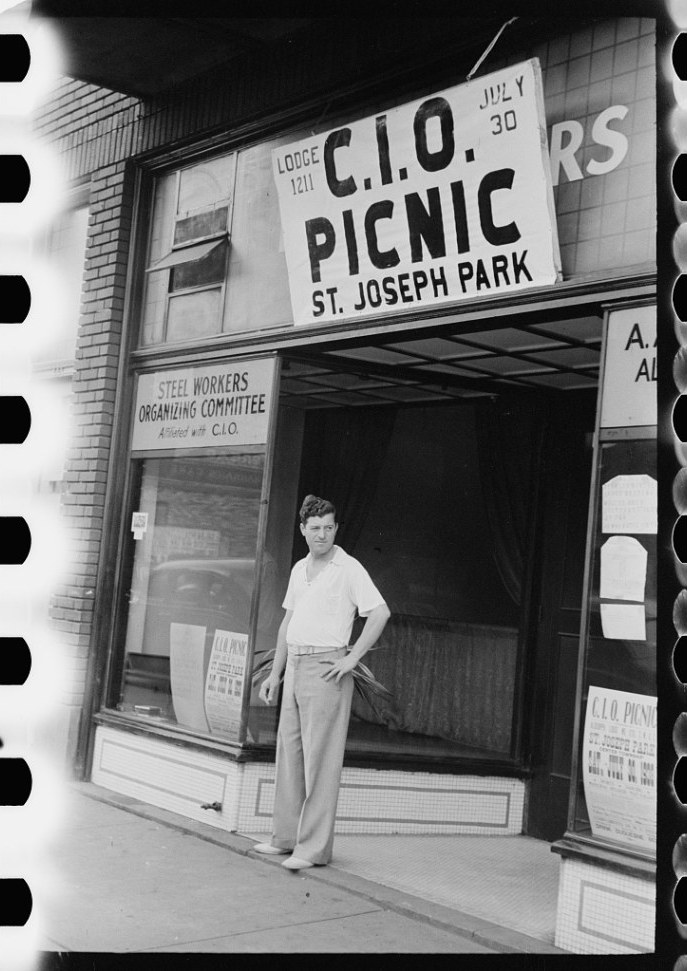
The union headquarters at Aliquippa, photographed in July 1938 — one year and three months after the decision. This is the union's Aliquippa, photographed at the moment it won. Arthur Rothstein · Farm Security Administration / Office of War Information · Library of Congress · LC 2017723757. No known restrictions on publication.
Corrections
What the record actually says.
Left: what is commonly
written about Aliquippa. Right: what the document says — or does not.
SWOC organised the Aliquippa men.
The Supreme Court's record names the Amalgamated Association of
Iron, Steel and Tin Workers, Beaver Valley Lodge No. 200. SWOC
was formed in 1936 and was central to the wider 1937 steel campaign, but the
charge in this case came from the Amalgamated lodge. The film uses the Court's
record.
NLRB v. Jones & Laughlin Steel Corp., 301 U.S. 1 (1937)
Pennsylvania's First Lady coined “Little Siberia”.
The nickname is well attested and the film uses
it. The attribution is single-sourced to one county historical
page, so the film does not make it. If a second independent source turns up, the
line goes back in.
County historical record — uncorroborated
Quinto Mancini worked at Jones & Laughlin.
Henry Mancini's father is documented as a steelworker in
West Aliquippa, which sits beside the Works — but no source states
his employer. The film says he worked in steel and lets the geography imply the
rest. It is not upgraded to J&L.
Documented; employer unrecorded
It was the largest steel mill in the world.
It was described as such at its height, and
nobody who saw seven miles of it argued with the claim. Whether it was ever
precisely true is not established, so the film reports the description rather
than asserting the fact.
Contemporary description
NLRB Case No. C-57 · Order of 9 April 1936
Their names were in the case file.
The Supreme Court’s opinion gives only their jobs. But the Labor Board’s
order is printed in the Court’s own Transcript of Record in No. 419, and it names
all ten: Domenic Brandy, Angelo Volpe, Harry V. Phillips, Martin Dunn, George
Maroll, Royal Boyer, Martin Gerstner, Angelo Razzano, Eli Bozich and Ronald B.
Cox.
Phillips was the lodge’s first president, Volpe its vice-president and Gerstner
its financial secretary. Dunn was Phillips’s half-brother. Brandy, a coal washer
since 1910, signed 665 members. Razzano, the tractor driver, signed 1,500. Boyer
worked the nail machines and signed about 250 of the plant’s 800 Black workers.
Each was fired for a routine slip that other men made without penalty: a key left on
a bench, a door left open, a whistle missed.
Earlier versions of this page and the film said nobody had found the names. That
was wrong. They were never lost, only filed. The transcript is on the Internet
Archive as item micro_IA40386010_0164. What we still don’t know
is what happened to the ten men after April 1937. If your family remembers, we want
to hear from you.
The count
Twenty-seven thousand, then nine.
1930
27,116
1940
27,023
1967
about 26,800
2000
11,734
2020
9,238
US Census, 1930–2020. In 1987 the Commonwealth declared Aliquippa a
financially distressed municipality under Act 47; it received its city charter the same
year. By 1990 thirty per cent of the population was on unemployment. By 1997 around six
hundred people were still working in steel here, out of fourteen thousand at the peak.
The archive
Where all of it came from.
NLRB v. Jones & Laughlin Steel Corp., 301 U.S. 1 (1937)
Library of Congress · FSA/OWI · Jack Delano, January 1941
Library of Congress · FSA/OWI · John Vachon, January 1941
Library of Congress · FSA/OWI · Arthur Rothstein, July 1938
Library of Congress · Harris & Ewing Collection, 1937
University of Pittsburgh · J&L Aliquippa Works Records, 1943–1976
Hagley Digital Archives · Aliquippa Works
Beaver County historical record
U.S. Census, 1930–2020
This town was photographed by three of the most significant
documentary photographers of the twentieth century, all sent here by the same
federal programme: Jack Delano and John Vachon in January 1941, Arthur Rothstein in
July 1938. Every archival frame on this page is Library of Congress, no known
restrictions on publication, and names its repository in the caption. Connective and
atmospheric imagery in the film is illustrated and labelled as such on screen; no
generated image is used for the mill, the company store, any Plan house, any named
person, the 1937 case or the 1984 closure — each of those has a real photograph.
The attribution of the “Little Siberia” nickname to Pennsylvania's First
Lady is not used: it rests on a single county historical page and no
second source has been found.
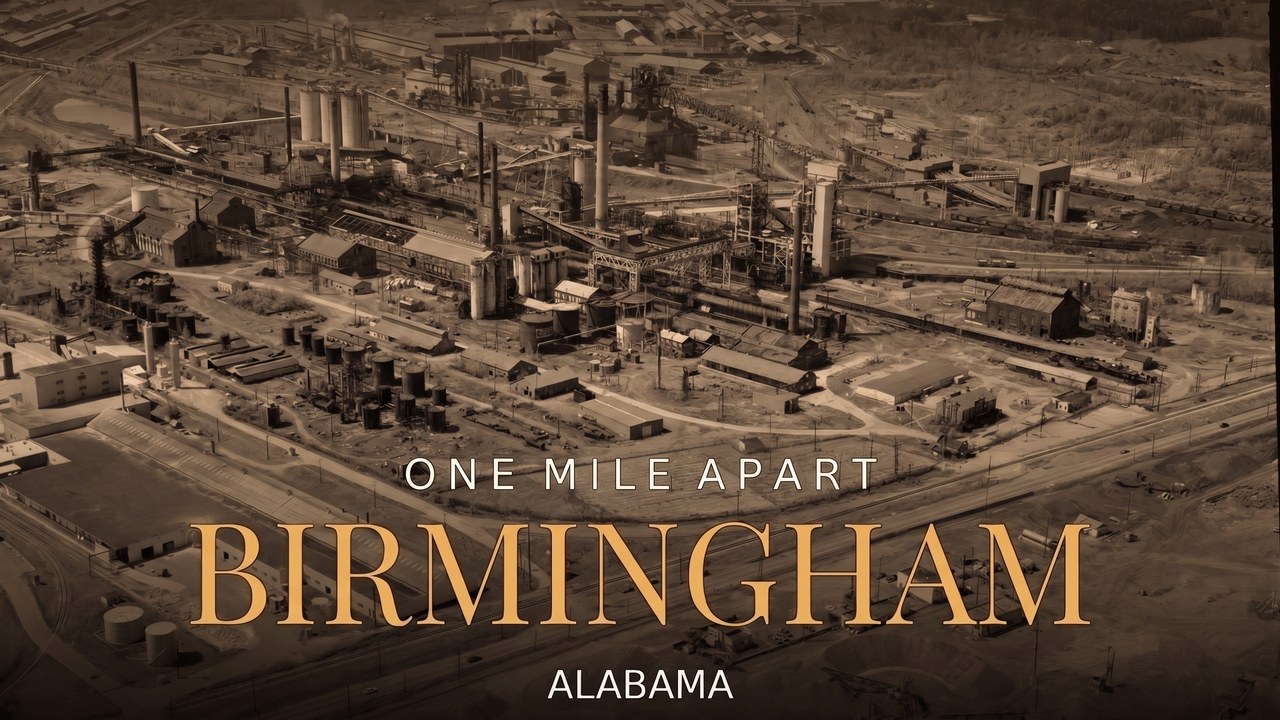
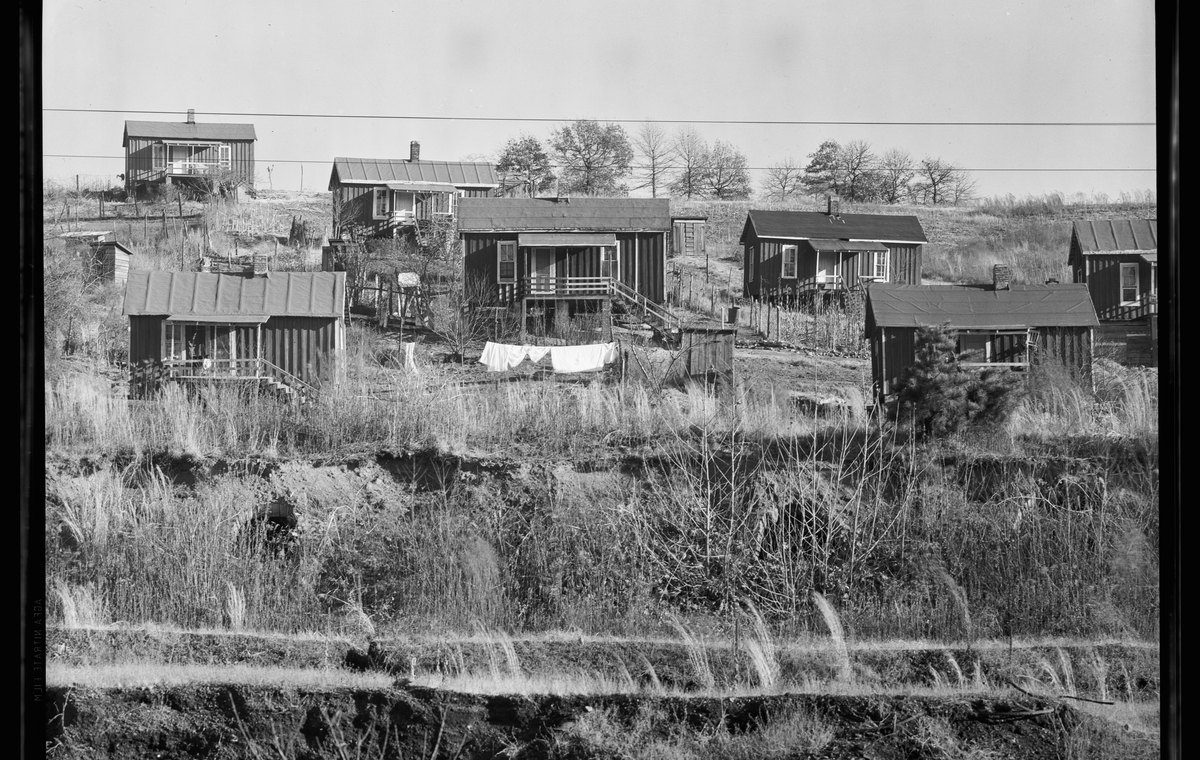
Birmingham · Alabama
One mile apart.
In 1910 U.S. Steel's Alabama division laid out a town called Fairfield
and planted thirty thousand trees in it — a central park, tennis courts, four
churches and a 318-bed hospital. The federal survey records who it was for in five
words. Seven years later, one mile north, the same company built fifty houses for
its Black employees, next to the slag dump.
30,000 trees
planted at Fairfield from 1910, with a central park, tennis courts, four churches and a 318-bed hospital. The federal survey: “Fairfield housed only skilled white labor”
50 houses
Westfield, 1917, one mile north — built expressly for the company's Black employees, and sited in the record's own words “directly across from the plants and next to the slag dump”
$9 – $18.50
per prisoner per month, graded by ability. In 1888 Tennessee Coal, Iron and Railroad contracted for every able-bodied state convict in Alabama; by 1894 it was working 1,138 of them
128 dead
Banner Mine, 8 April 1911, twelve miles away. At least 123 of them were prisoners — most convicted of vagrancy, gambling or selling liquor
160 of 1,256
houses built on the lots platted at Fairfield, by about 1914. The model city was one house for every eight plots, on a scheme designed for fifteen thousand people
The film
One Mile Apart: U.S. Steel's Company Towns.
Nine chapters · 29 minutes · 1080p · archival stills and
primary documents · Library of Congress, the National Archives and the Historic
American Engineering Record Watch on YouTube →
The Birmingham file
The research, published.
The film is free and always
will be. What is for sale is everything behind it — the documents themselves, the
corrections with their page numbers, and the plates at full resolution.
The book
$9.99
Birmingham, Alabama
The full account, expanded from the film
Six federal plates, every item number printed
Twenty-eight corrections, each with its source
Seven appendices, including how to check this book
The primary documents as scanned — the Historic American Engineering
Record surveys of Docena, Edgewater, Muscoda, Bayview and the Pratt Mines
convict cemetery, the Tennessee Coal and Iron Land Department album compiled
for E. H. Gary, and the 1946 federal survey of the company camps
Every plate at full resolution, uncropped
The complete corrections file, and what could not be verified, and why
What happened
The garden city and the graveyard are the same policy.
Alabama leased its prisoners to private companies for fifty-three
years. In 1888 Tennessee Coal, Iron and Railroad signed a ten-year contract
entitling it to every able-bodied state prisoner in Alabama, at nine
dollars to eighteen dollars fifty a month, graded by ability. By 1894 it was working
1,138 convicts. At the Pratt mines around 1900, Black men were about
sixty-five per cent of the coal workforce and ninety per cent of the
convicts. The state penitentiary physician, Dr Russell Cunningham, reported
that he had cut mortality at Pratt from eighteen per cent in 1881 to two per
cent in 1884. Eighteen per cent a year is the coldest figure in the file.
One of the leased men was Green Cottenham, arrested in Shelby County
on 30 March 1908 for vagrancy. Thirty days became a year once the
fees were added. TCI paid twelve dollars a month for him and put him
in Slope No. 12, where the task was eight tons of coal a day, enforced
by whipping. What happened to him after that is not in the record, and this page stops
where the paperwork does.
U.S. Steel bought TCI in November 1907, and in the 1910s its Alabama
division built model villages — Docena, Edgewater, Westfield, Fairfield —
in a programme to stabilise a workforce excluding prison labour. The villages
and the lease are not two stories. They are the same company solving the same problem
four years apart. And the company wrote the segregation down itself: whites on the
higher ground at Docena, “colored workers on the northern part”; Edgewater A
and Edgewater B; the Muscoda mine with separate entrances for white and Black miners;
rent at Docena six dollars a month with utilities, medical care a
dollar twenty-five.
Then the industry went. Most of the ore mines closed in 1962, when
Venezuelan ore undercut Red Mountain. Ensley Works closed in 1976
after eighty-eight years. Fairfield Works employed more than fifteen thousand people
in the 1960s, nine thousand by the late seventies, two thousand by 2006; on
17 August 2015 U.S. Steel ended steelmaking there, about eleven
hundred jobs of the thirteen hundred on site. The blast furnaces came down in October
2017. On 21 May 2020 the City of Fairfield — the model town,
the one with the thirty thousand trees — filed for bankruptcy with nearly
nineteen million dollars of debt.
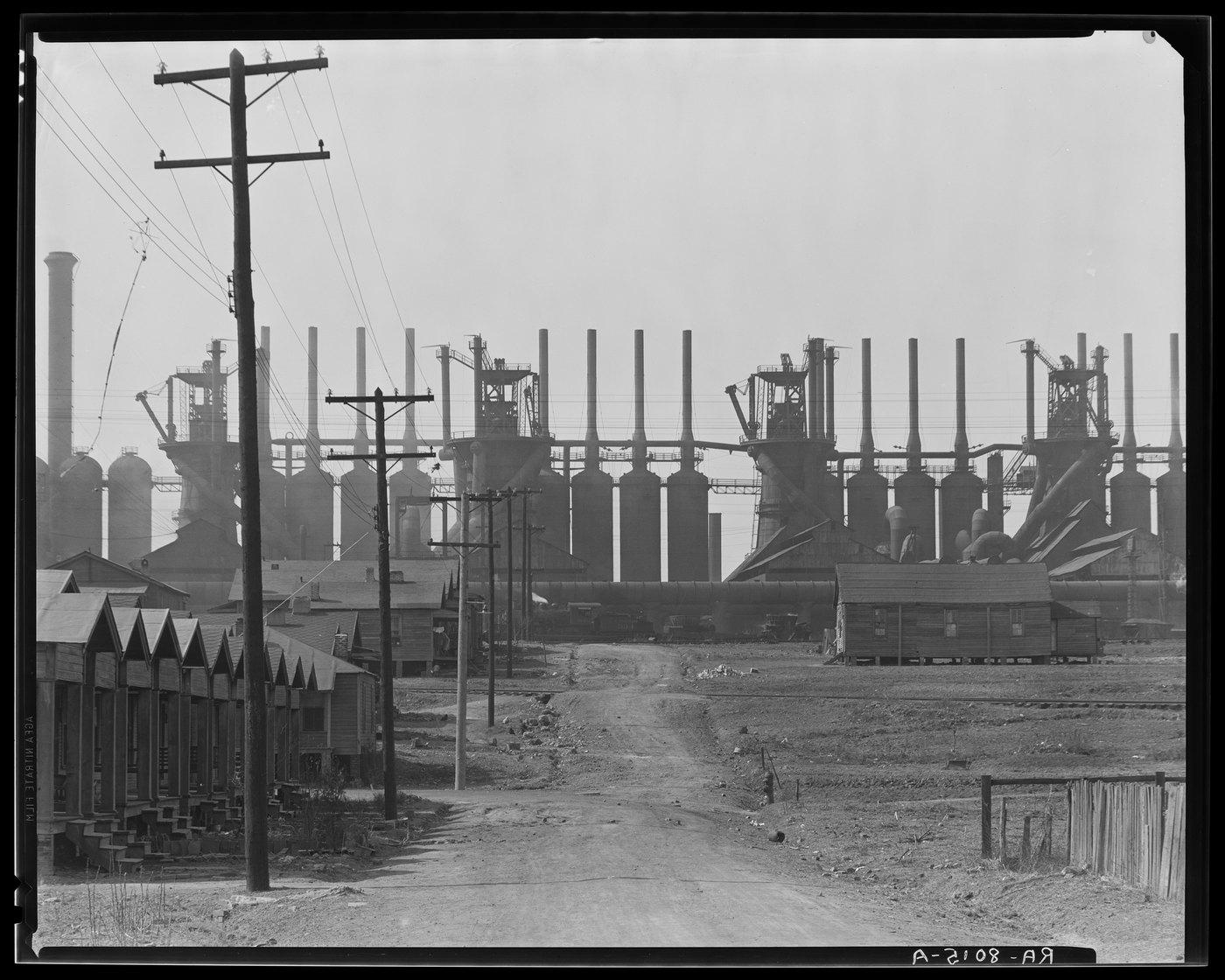
“Steelmill and workers' houses. Birmingham, Alabama.” The Library's own title for the frame, and the whole arrangement in four words: the mill, and the houses the mill owned. Walker Evans · Farm Security Administration / Office of War Information · Library of Congress · LC 2017762201. No known restrictions on publication.
Fifty houses
The company wrote the segregation down itself.
The captions in the Tennessee Coal and Iron Land Department's own photograph album
— compiled between 1910 and 1915 for E. H. Gary, chairman of
U.S. Steel — do the work no narration could:
“Interior of Bath House, at Fossil, White Section.” “Two and three room dwelling houses for African American employees
showing concrete fence posts and curbing, graded streets and sidewalks.” “School for colored children.”
Those are the company's words about the company's own town, written for the man who
owned it. In 1913 the Black miners at Muscoda were relocated to a new camp on the
southern slopes. In 1917 Westfield was built — fifty houses. Fairfield, one mile
south, had a 318-bed hospital and thirty thousand planted trees. Willie
Mays was born in Westfield in 1931; U. W. Clemon, raised
there, became Alabama's first Black federal judge. And A. G. Gaston,
who had worked as a TCI miner at Fairfield and sold sandwiches to the men at lunchtime,
founded a burial society at twenty-five cents a week — building a
fortune on the one service the company would not provide, in a district where the
company's own graveyard has no names on it.
Company housing for Black miners, PORTER MINE, ADAMSVILLE, 26 July 1946. Not Westfield and not a TCI camp — a different company, the same county, the same arrangement. Westfield itself is one of the least photographed places in this story. Russell Lee · Solid Fuels Administration for War · U.S. National Archives · NARA 540603. US federal government photograph.
Corrections
What the record actually says.
Left: what is commonly
written about the Birmingham district. Right: what the document says — or does not.
The Banner Mine was owned by Tennessee Coal & Iron — and so by U.S. Steel.
The deadliest convict-labour disaster in American history is
routinely put on the wrong company. Pratt Consolidated Coal was Erskine
Ramsay's own firm, organised in December 1904 after he left TCI, where he
had been chief engineer of mines. It was never a TCI or U.S. Steel subsidiary, and
it was sold in 1925 to Alabama Byproducts. Banner was near Littleton,
about twelve miles from Pratt City.
Corporate record; the Wikipedia sentence as retrieved
Seventy-two of the 128 dead at Banner were convicts.
Seventy-two is the number of the dead convicts sentenced in
Jefferson County — a subgroup, not the total. Promoted to a total it
undercounts the convict dead by roughly fifty-one men and implies fifty-six free
miners died, when at most five did. The film says “at least a hundred
and twenty-three”, which both surviving counts support.
Encyclopedia of Alabama: 125 convicts. Bhamwiki: 123
Fairfield was a completed model city.
The federal survey: “By about 1914, approximately 160
houses had been built on the 1,256 lots subdivided for residential
development.” One house for every eight platted lots, four years in,
on a scheme designed for fifteen thousand people. Every account calling it a
finished model city is describing a plat, not a place.
Historic American Engineering Record
Fairfield was laid out by the Olmsted firm.
No source supports it. Three independent ones — the HAER
survey, Encyclopedia of Alabama and the Fairfield Housing Authority — name
George H. Miller of Boston, on a plan modelled on Gary, Indiana.
Fairfield's organiser did commission Olmsted Brothers for Mountain Brook in the
1920s, which is the likeliest way the name travelled backwards; that explanation
is inference, and the film does not make it.
HAER · Encyclopedia of Alabama · Fairfield Housing Authority
James Knox died in a U.S. Steel mine, and his death ended convict leasing.
The death that ended the system in Alabama happened at the
Flat Top Mine Prison — a Sloss-Sheffield operation, not TCI
and not U.S. Steel. Knox, a white convict, died in 1924; he had been whipped and
immersed in hot water, it was reported as suicide by poison, and the autopsy found
heart failure with the poison injected after death. Leasing was abolished effective
30 June 1928.
Flat Top Mine Prison, Sloss-Sheffield; exact date in 1924 not established
Docena and Edgewater are on the National Register.
Checked four ways: they are not listed. What they
have is HAER documentation, which is a survey, not a designation. Both villages
still stand, largely intact, and neither carries any protection at all.
National Register of Historic Places — no listing
Company housing at Edgewater, photographed for the federal survey in spring 1993 — eighty years after it was built, and still standing. Edgewater A was the white side, Edgewater B the Black side, each with its own church and school. Jet Lowe · Historic American Engineering Record · Library of Congress · HAER ALA,37-BIRM.V,7-. US federal government photograph.
The date nobody can give you
When did U.S. Steel stop using convicts?
Four reputable sources give four answers, and the disagreement is the finding.
U.S. Steel says 1912.The state lease lapsed at the end of
1911.The convict graveyard at Pratt kept taking bodies until
1914. An Associated Press investigation in 2022 could only say the company
used leased convicts “for at least five years”.
The likely reconciliation is that these are three different populations — the
state lease, the county convicts leased separately and running on, and a cemetery that
records burials rather than contracts. That is inference, so the film narrates the
dispute and states no year. The document that would settle it exists: the
Alabama Board of Inspectors of Convicts biennial reports, 1908–1916,
in Montgomery, which list every lessee, contract and convict count by company and year.
Nobody has published them against this question.
The ending, and the open question
No marker, no fence, no sign.
West of Howze-Sanford Park in Pratt City, on the site of the old Pratt mines, is the
burial ground where the company put its prisoners. The federal survey records
“an unknown number of graves”, visible only as depressions
in heavily overgrown terrain, with an iron fence around a single one. Its period of use
runs from about 1880 to 1914. U.S. Steel owns the ground, says it has
no plans to disturb it, and says it has no records of who is buried there or whether
convicts are among them. There has been no ground-penetrating radar, no excavation and
no memorial. It was found in 1994 by an industrial archaeologist,
Jack Bergstresser, while mapping coal operations for the federal
government — a man who located a mass grave with survey instruments. A short walk
away is the Pratt Mines Fraternal Cemetery, where the free miners are buried.
The district has federal reference numbers for a streetcar commercial strip and a coke
works. It has none for that ground.
In September 2022 U.S. Steel offered to consider a memorial plaque if
the community wanted one. Ellen Spencer, president of the Pratt City community, said
she hoped for acknowledgment beyond a plaque alone. That was four years ago.
If you know whether anything has been placed since, we want to hear it
— and we will publish it with your name on it if you want it there.
The count
Fifteen thousand jobs, then a bankruptcy.
1960s
Fairfield Works, more than 15,000
late 1970s
about 9,000
2006
about 2,000
2015
steelmaking ends — about 1,100 of 1,300
2020
the City of Fairfield files for bankruptcy
Most of the ore mines closed in 1962 when Venezuelan ore undercut Red
Mountain; Ensley Works closed in 1976 and was demolished in 2019; the Fairfield blast
furnaces came down in October 2017. The city's debts at filing were close to nineteen
million dollars, with more than two hundred creditors, and the Walmart had closed in 2016
and taken the sales tax with it. The mayor's summary was six words: “Basically,
we're just seeking a fresh start.”
The archive
Where all of it came from.
Alabama Department of Archives and History · TCI Land Department album, 1910–15 · LPP117
University of Alabama Libraries · Tennessee Coal, Iron and Railroad photographs, 1907–14
Birmingham Public Library · Thomas Dukes Parke Collection · convict photographs, July 1907
Library of Congress · FSA/OWI · Walker Evans, December 1935 and March 1936
Library of Congress · FSA/OWI · Arthur Rothstein, February 1937
Historic American Engineering Record · Docena, Edgewater, Muscoda, Bayview and the Pratt Mines convict cemetery
U.S. National Archives · Solid Fuels Administration for War · the 1946 survey of the company camps
Samford University · TCI Oral History Project, recorded 1979 at Docena
Encyclopedia of Alabama · Bhamwiki · Equal Justice Initiative
Every archival frame on this page is a US federal government
photograph — Library of Congress with no known restrictions, the Historic
American Engineering Record, or the National Archives — and names its repository and
item number in the caption. Where a photograph is of the right subject but the wrong
place, the caption says so: the 1946 camp above is Adamsville, not
Westfield. Westfield is one of the least photographed places in this story, which
is itself part of the record. Connective and atmospheric imagery in the film is illustrated
and labelled as such on screen; no generated image is used for any village, any named
person, the Banner Mine or the burial ground. The official histories are quoted
rather than paraphrased, because what they leave out is the argument: the City of
Fairfield's own history does not contain the words convict, segregation,
African American, union, strike or Westfield, in a city
that is ninety per cent Black.
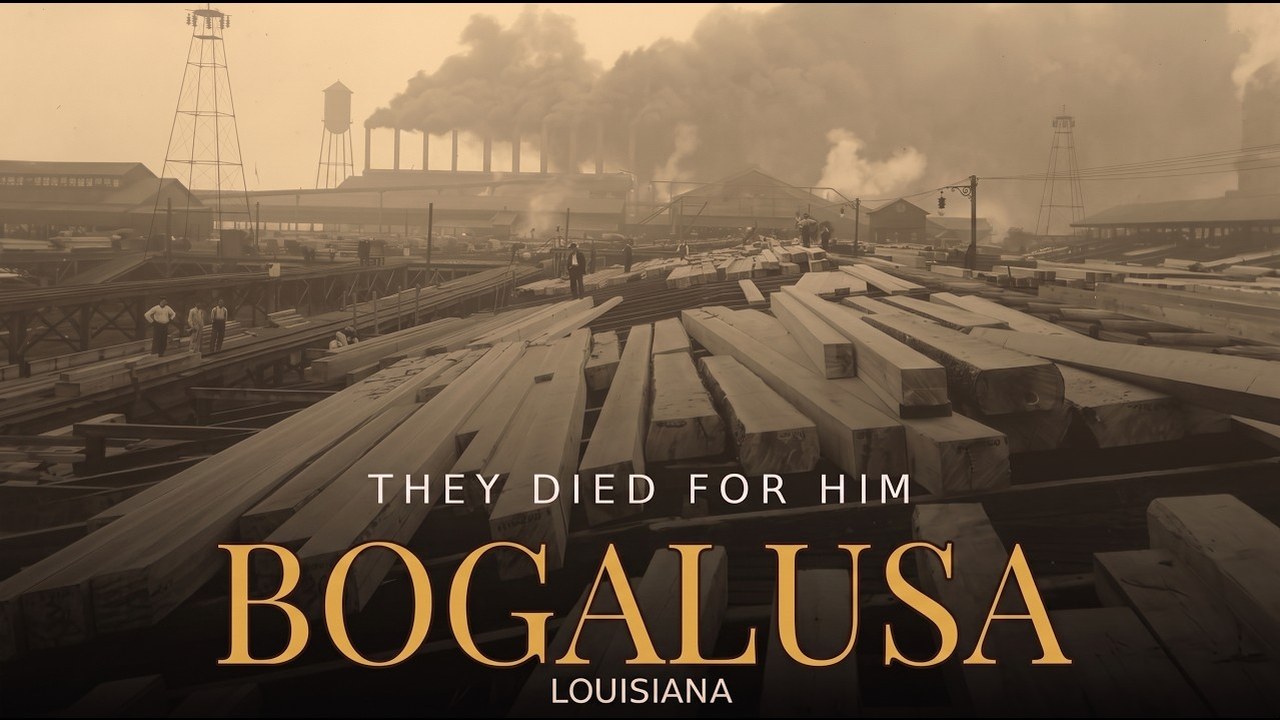
Bogalusa · Louisiana
They made common cause twice.
In 1906 a lumber company from Buffalo, New York bought pine country in
Washington Parish and built a city from nothing — streets, water, sewers, an
electric plant, schools, churches, a hospital, a hotel, a bank, a newspaper and a
commissary. The man who ran the mill was also the mayor. Twice, forty-six years apart,
Black and white workers here stood together against the same employer. The town’s
official history mentions neither occasion.
1906
the Goodyear brothers of Buffalo — no relation to the tyre company — came south for longleaf pine and laid out a city on empty ground. It called itself the Magic City
1914–29
the years William H. Sullivan was both the mayor of Bogalusa and the Great Southern Lumber Company’s general manager. Not an ally of the mayor — the mayor
2,500 men
“white and colored” — the Supreme Court’s own count of the mill’s workforce in 1919. The union’s offence, in the Court’s words, was “an effort to unionize the colored laborers”
4 dead
22 November 1919 — Lem Williams, J. P. Bouchillon, Thomas Gaines, and Stanley J. O’Rourke, who died six days later. All four white, all four union. No account records a conviction
416 F.2d 980
the sentence a federal court wrote in 1969 about the seniority list at this mill. It is the ancestor of disparate impact, and it is still quoted
The film
The Company Town That Changed American Law.
Ten chapters · 35 minutes · 1080p · archival stills and
primary documents · the National Archives, the Library of Congress and the reported
cases Watch on YouTube →
The Bogalusa file
The research, published.
The film is free and always
will be. What is for sale is everything behind it — the documents themselves, the
corrections with their page numbers, and the plates at full resolution.
The book
$9.99
Bogalusa, Louisiana
The full account, expanded from the film
Six National Archives plates, every item number printed
Twenty corrections, each with its source
Seven appendices, including how to check this book
The primary documents as scanned — Williams v. Great Southern Lumber
Co., 277 U.S. 19 (1928), Local 189 v. United States, 416 F.2d 980
(5th Cir. 1969), the National Archives photographs of the mill, and the Sanborn
fire insurance maps of Bogalusa
Every plate at full resolution, uncropped
The complete corrections file, and what could not be verified, and why
What happened
A creek called dark water.
Charles W. and Frank H. Goodyear had already cut the Pennsylvania hemlock. In
1906 they came south for longleaf pine, bought the timber of
Washington Parish, and built a city to cut it in — a street grid, water, sewers,
an electric plant, schools, churches, a hospital, a hotel, a bank, a newspaper and a
commissary, on ground that had been forest. They named it after the creek:
Bogue Lusa, Choctaw, usually rendered dark water. The town
called itself the Magic City, and it was not an unreasonable boast.
The mill was, on the company’s own claim and in the trade press of the day, the
largest sawmill in the world. The company said it cut a million board feet a
day, and sixty acres of standing timber every working day. Those are company
figures and this page reports them as company figures. What is not in doubt is the
shape of it: a forest that took two centuries to grow was converted into a commodity
at industrial speed, by one organisation, employing a whole new city to do it.
And it was, comparatively, a good job. The wages beat farm labour in Washington
Parish. There was a hospital and a school, and electricity in the houses at a time when
most of rural Louisiana had none. The company also did something almost no other
company in this series did: it planned for the end. Great Southern replanted on a large
scale and built the successor industry — a paper mill — before the sawmill
ran out. The saws cut out in 1938, thirty-two years from the first
survey stake, and the town survived it. The mill is still there and still one of the
largest employers in the parish.
The other thing the company built was an arrangement. The town plan sorted housing by
race and by nativity, with districts labelled for “colored” and
“foreign” workers. At the paper mill that replaced the sawmill, the same
division became the organisation of the work itself: white job ladders and Black job
ladders, a white union and a Black one. That arrangement outlasted the lumber, the Goodyears, the
sawmill and the company itself — and it was challenged, seriously, twice.
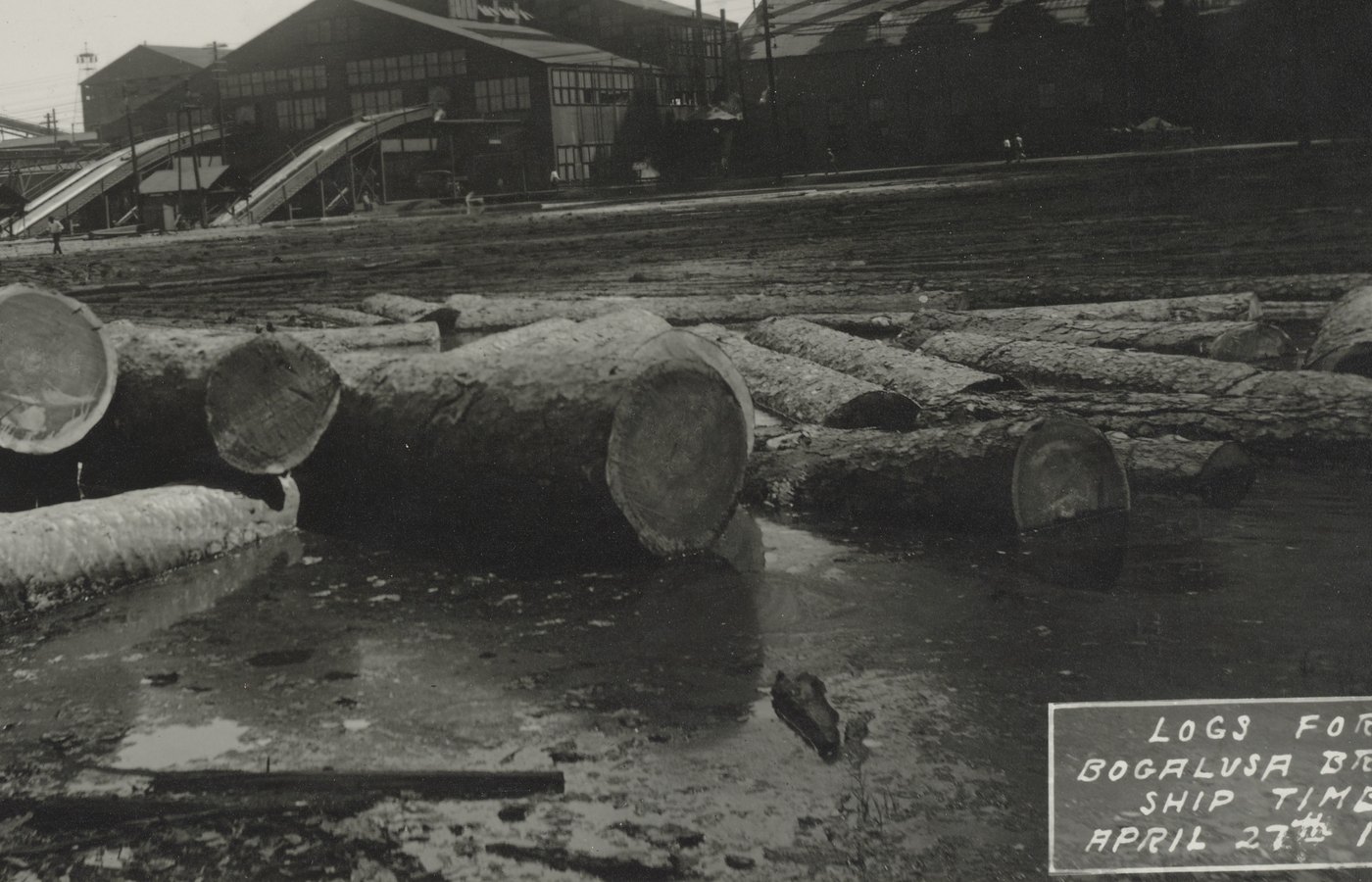
“Plant of Great Southern Lumber Co., Bogalusa, Louisiana. Large logs in foreground.” The card propped in the frame by the photographer reads LOGS FOR BOGALUSA BRAND SHIP TIMBERS, APRIL 27 1918. The mill was cutting for the war. Industries of War series · U.S. National Archives · NARA 31490297. US federal government photograph.
The twenty-second of November
Three men walked down a street.
In 1919 the American Federation of Labor organised at the Great Southern Lumber
Company, on the federation’s segregated model — white locals and Black
locals, working together. The mill ran as an open shop and would not deal with the union.
The Supreme Court later described the cause of the trouble in one phrase: “an effort
to unionize the colored laborers.” In Louisiana, in 1919, that was the
provocation.
By late November Sol Dacus, president of the Black timber workers'
local, had been driven out of his house and was hiding in the swamp outside town,
because armed men deputised by his employer were looking for him. On the twenty-second,
two white union men walked into town with him, carrying shotguns, so that he could
walk down a street in his own city.
Three independent sources describe that walk in almost the same words: the New
York Times of 23 November 1919; Mary White Ovington in The Liberator; and
the Supreme Court of the United States, in a judgment that went for the
company.
They went to the building where Lem Williams, president of the local union, had his
office and his home. The mill’s siren whistle sounded — the police had arranged
with the company’s manager that it would summon the volunteer police of the
Self-Preservation and Loyalty League — and a posse came to serve warrants on Dacus and
the two armed men. Some employees of the company went along who had not been summoned. What
happened at the door was described in flatly incompatible ways, and no court ever resolved
it. What is not in dispute is who was dead at the end: Lem
Williams, shot at his own door;
J. P. Bouchillon, one of the two men who had walked with Dacus;
Thomas Gaines; and Stanley J. O’Rourke, wounded
that afternoon, who died on the twenty-eighth. All four were white. All four were
union. Sol Dacus escaped and lived.
No account of the day records anyone being convicted of any of the four deaths.
The federal caption on this frame reads: “Col. Frank P. Stubbs of Louisiana, responding to MAYOR SULLIVAN’S welcome at the ceremonies attending Co. ‘G’ Day, July 27, 1917, Great Southern Lumber Co., Bogalusa, La.” The mayor welcoming the state’s guests on the company’s grounds was the company’s general manager. He held both offices from the town’s incorporation in 1914 until his death in 1929. U.S. National Archives · NARA 23924037. US federal government photograph.
Corrections
What the record actually says.
Left: what is commonly
written about Bogalusa. Right: what the document says — or does not.
Sol Dacus was killed on 22 November 1919.
He was not. Dacus escaped and survived. The four men
who died were the white union officers who had put themselves between him and the
guns. Half the accounts online have this the wrong way round, which inverts the
whole meaning of the day.
Contemporary reporting; Williams v. Great Southern Lumber Co., 277 U.S. 19 (1928)
It was an IWW campaign.
The Brotherhood of Timber Workers had dissolved in
1916, three years earlier, and neither it nor the IWW was at Bogalusa in
1919. This was an American Federation of Labor campaign —
seventeen chartered locals on the AFL’s segregated model, cooperating through
a joint council. The duller version is the true one, and it is the more remarkable:
the AFL mostly did not do this, and it happened anyway, in Louisiana, in 1919.
AFL organising records of 1919–20
The Supreme Court ruled the killings were lawful.
It did not, and the usual correction is wrong too. Lem Williams’s
widow, Lena Williams, sued the company for her husband’s death — and
won. A federal jury gave her a verdict. The appeals court threw it out
over two rulings on evidence and ordered a new trial, and in 1928 the Supreme Court
agreed. No court ever decided that the company was not responsible.
The case was sent back to be tried again; this page has not found a record that it
ever was.
Williams v. Great Southern Lumber Co., 277 U.S. 19 (1928); 17 F.2d 468 (5th Cir. 1927); 13 F.2d 246 (E.D. La. 1926)
The company created the Self-Preservation and Loyalty League.
The company always said the League was independent, and the Supreme
Court’s account describes it as business and professional men, with nobody
connected to the company admitted. This page does not assert otherwise. It states what
the same judgment records: the police arranged with the company’s
manager that the mill’s siren whistle would summon the
League’s volunteer police, and on 22 November the company’s superintendent
sounded it. The company’s general manager was also the mayor.
277 U.S. 19, at 22–24; National Register nomination, Sullivan House (1979)
The Deacons for Defense were founded in Bogalusa.
They were founded in Jonesboro, Louisiana, in 1964.
The Bogalusa chapter was chartered on 21 February 1965 and became
the largest and most visible in the organisation — which is why most people
have heard of the Deacons at all. It was a chapter, and the film does not give
Bogalusa a founding it does not have.
Charter record, 21 February 1965
The mill cut a million board feet a day.
That is the company’s figure, repeated in the
trade press, as is “sixty acres a day” and “the largest sawmill in
the world.” They are reported here as claims, with the claimant named, because
laundering a company’s advertising into a fact is how most of the errors on
this site began.
Great Southern Lumber Company, via contemporary trade journals
Forty-six years later
A rifle on a porch on East Ninth Street.
By 1965 the sawmill was a paper mill and the company was Crown Zellerbach, but the
arrangement had not changed. There were two unions: Local 189, white,
and Local 189-A, Black, with segregated lines of progression —
whole job ladders reserved by race. In the court’s words, Local 189-A “had
jurisdiction over the left-overs,” and “the lowliest white jobs paid more and
carried greater responsibility than the most exalted Negro jobs.” When Title VII
arrived, the company merged the job ladders — which, the court found, “merely
meant tacking the Negro lines to the bottom of white lines.” A Black worker with
twenty years’ service started again at the bottom. Formal equality, delivered as a
demotion.
In February 1965 two white CORE field workers, Bill Yates and
Steve Miller, were sheltered at the home of Robert
Hicks, a Black paper-mill worker, at 924 East Ninth Street. A deputy sheriff and the
chief of police came to the door, told Hicks a mob planned to bomb his house unless he put
the two men out, and refused to protect them: “We have better things to do than protect
people who aren’t wanted here.” Valeria Hicks was in the house. Black
neighbours came with rifles and stood watch through the night, and out of that night
came the Bogalusa chapter of the Deacons for Defense and Justice.
The mill wage is the mechanism, and it is worth saying plainly: what let a Black man in
Washington Parish own a house, a car, a telephone and a rifle — and be
independent enough of the local white economy to survive doing this — was the job
at the company’s mill.
Present effects of a biased past
The sentence that came out of a seniority list.
The United States Department of Justice sued Crown Zellerbach and Local 189 over the
job-seniority system at the Bogalusa mill — the neutral rule that carried the old
segregation forward. In 1969 the United States Court of Appeals for the Fifth Circuit
decided it, and wrote this:
“Job seniority, embodying as it
does, the racially determined effects of a biased past, constitutes a form of present
racial discrimination.”
The court was not looking for intent, and it did not find that anybody at Crown
Zellerbach was a racist. It held that a rule which is neutral today, applied to a
workforce that was sorted by race yesterday, produces racial discrimination today
— and that the law reaches it. That principle is the ancestor of what American law
calls disparate impact; two years later the Supreme Court decided
Griggs v. Duke Power on the same logic, and it became a load-bearing wall of
American employment law.
A substantial part of the foundation under it was laid in an argument about the order
of names on a promotion list at a paper mill in Washington Parish — in a town
drawn on empty ground by a lumber company from Buffalo, which put the Black houses on
one side and the white houses on the other because in 1906 there was nobody to stop it.
The company drew the line. Sixty-three years later a federal court held that the line
was still in effect, and that it did not matter that nobody was drawing it any more.
“Crowds in Goodyear Park on Company ‘G’ Day, July 27, 1917… Great Southern Lumber Co., Bogalusa, LA.” The park, like the water, the electricity, the hospital, the newspaper and the houses, belonged to the company. The federal caption calls Frank P. Stubbs the governor of Louisiana; a second frame in the same series calls him a colonel, which is correct. U.S. National Archives · NARA 23921651. US federal government photograph.
What the town says about itself
A perfectly decent short account.
The City of Bogalusa publishes an official history called About the City. It
is a good short account: the Goodyear brothers, the founding, the mill, the growth, and
the nickname the town gave itself — the Magic City, conjured out of pine forest in
twenty-four months.
It does not mention the twenty-second of November, 1919. It does not mention Lem
Williams, or Bouchillon, or Gaines, or O’Rourke, or Sol Dacus. It does not mention
the Self-Preservation and Loyalty League, or the Supreme Court taking the case and
ruling for the company. It does not mention that the town was laid out by race, or
Local 189-A, or Robert Hicks, or the night on East Ninth Street, or the Deacons for
Defense and Justice — the single thing Bogalusa is best known for anywhere else in
the world. And it does not mention the sentence about the racially determined effects
of a biased past, which is the most consequential thing this town ever produced.
That is not a conspiracy. It is the ordinary thing towns do: keep the founding, let go
of the rest. But a company town is not only what the company built. It is everything the
arrangement produced, including the things the company would not have chosen — and
the four men who died in the street in 1919, and the men with rifles on East Ninth Street
in 1965, were produced by that arrangement as surely as the sawmill was.
If your family worked at that mill — on either side of it — we
want to hear from you. Photographs of Bogalusa before 1930 are scarce and
scattered, and the ones this page could not find are listed in the film’s sources.
Anything you have with a date and a place on it is worth more than another paragraph of
commentary.
The archive
Where all of it came from.
U.S. National Archives · “Industries of War” series · Great Southern Lumber Company, Bogalusa, 1917–18
Williams v. Great Southern Lumber Co., 277 U.S. 19 (1928)
Local 189, United Papermakers and Paperworkers v. United States, 416 F.2d 980 (5th Cir. 1969)
Griggs v. Duke Power Co., 401 U.S. 424 (1971)
Library of Congress · Sanborn Fire Insurance Maps of Bogalusa, 1908–1925
Library of Congress · Chronicling America · the Bogalusa Enterprise and American, November–December 1919
Evening Star, Washington DC, 23 November 1919
National Park Service · National Register nominations · Robert “Bob” Hicks House (14001174) and Sullivan House (79001096)
Library of Congress · FSA · Dorothea Lange, Fullerton, Louisiana, 1937
Bogalusa is the thinnest archive this series has worked with. The
Library of Congress holds almost nothing of the town itself, so the film uses photographs
of other Louisiana lumber towns — Fullerton and Elizabeth — and
captions every one of them with the town and the year on screen, for the whole time it is
visible. They are the right stand-ins: the same industry, the same decades, the
same model of company town. They are not Bogalusa and the film never lets them pass for
it. The plates on this page are different: all three are federal photographs of the
Great Southern Lumber Company at Bogalusa itself, taken for the government in 1917 and
1918. No generated image is used for any person, the killings, the Loyalty League, or the
night on East Ninth Street.
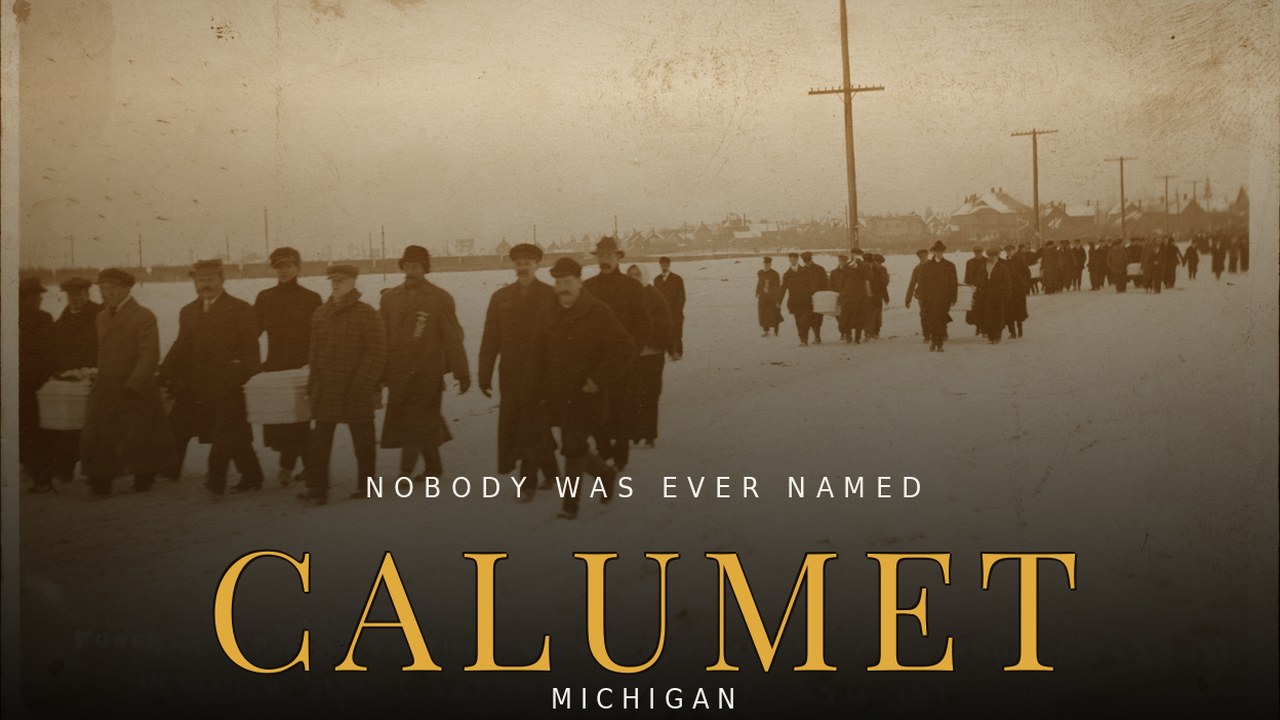
Calumet · Michigan
Seventy-three, and a staircase.
For a time the richest copper mine on earth, and the most complete company
town in the Midwest — houses at a dollar a room, a hospital, a library in a dozen
languages. On Christmas Eve 1913, five months into a strike, someone shouted
“fire” at a party for strikers’ children. There was no fire. Almost
everything most people know about what happened next is wrong.
63%
of all the copper mined in the United States in 1882 came from Calumet and Hecla. Over its life it paid more than two hundred million dollars to shareholders in Boston
$1 a room
the district’s average monthly rent for a company house, found by a federal investigator in 1913. A man who built his own house on company land paid about five dollars a year for the ground, on a lease that gave him ninety days to carry the house away
15 days
how long a tenant could stay after he quit or was fired. If he had built his own house on a ground lease, he had ninety days to carry it off the land, or it became the company’s
73 dead
24 December 1913, Italian Hall. Fifty-nine of them were children. Nobody was ever identified and nobody was ever charged
5 ft 9 in
the width of the staircase down from the hall, with more than four hundred people above it. Not the doors. The staircase
The film
73 People Died On A Staircase.
Twelve chapters · 39 minutes · 1080p · archival stills and
primary documents · the Historic American Buildings Survey, Detroit Publishing
Company, John Vachon, and the newspapers themselves · no generated images Watch on YouTube →
The Calumet file
The research, published.
The film is free and always
will be. What is for sale is everything behind it — the documents themselves, the
corrections with their page numbers, and the plates at full resolution.
The book
$9.99
Calumet, Michigan
The full account, expanded from the film
Six photographs, from the shaft house to the hall
Eighteen corrections and refinements, each with its source
Twelve appendices, including the company’s leases in full
The primary documents as scanned — the 1914 House hearings on conditions in
the copper mines, Bureau of Labor Statistics Bulletin 139, the Calumet News
of October 1908 on the hall’s opening, the 1975 federal survey of Italian Hall,
and the Sanborn maps of Red Jacket
Every plate at full resolution, uncropped
The complete corrections file, and what could not be verified, and why
What happened
The richest hill in the world.
A surveyor named Edwin Hulbert began tracing the Calumet conglomerate lode in the late
1850s, and by 1864 he had found it. Boston money followed. In May 1871
the Calumet, Hecla, Portland and Scott companies were consolidated as the
Calumet and Hecla Mining Company, and for a generation it was the
leading copper producer in the country. In 1882 it produced
sixty-three per cent of all the copper mined in the United States.
Over its life it took more than four and a half billion pounds of metal out of one hill
and paid its shareholders more than two hundred million dollars.
By 1916 its share of national production was about thirteen per cent. Sixty-three to
thirteen in a working lifetime is the real story of the company, and it is why the
strike came when it did: the mine was deeper, the rock poorer, and the company needed
more ore out of fewer men. The drill at the centre of the dispute was the new one-man
drill, which did the work of two and left one man alone at the face.
The company built the town, and built it well. By 1898 it owned about a thousand houses
and leased the ground under about a thousand more that workers had built themselves
— the company believed a man would be more loyal in a house he had built. It ran a
hospital from 1868. It told the federal government it owned ten school buildings, rented to the township as public schools, and it gave
land for the thirty-odd churches and $35,762 towards them. There was a bathhouse that cost $50,000, with a pool 26 by 40 feet, where women and
children bathed free and everyone else paid two and a half cents. And
there was a library of thirty-five thousand volumes in many languages,
which the federal landmark nomination describes as “a quiet means of
social control” and the federal building survey says “performed a
didactic role” and “helped to acculturate the many foreigners in
Calumet.” The bathhouse and library figures here are the company’s own,
given to the Bureau of Labor Statistics in 1913.
Underneath all of it was the lease. A company tenant had no right to stay more than
fifteen days after he quit or was fired; a man on a ground lease had
ninety days to physically remove his own house. When the Western Federation of Miners
struck on 23 July 1913, the companies first said they would not evict
strikers, and in September some began serving notices anyway. A court paused them. But by
February 1914 union leaders feared four thousand families could be put out, and that fear
helped end the strike on 13 April 1914. The eviction weapon was held
cocked rather than fired, and it won anyway.
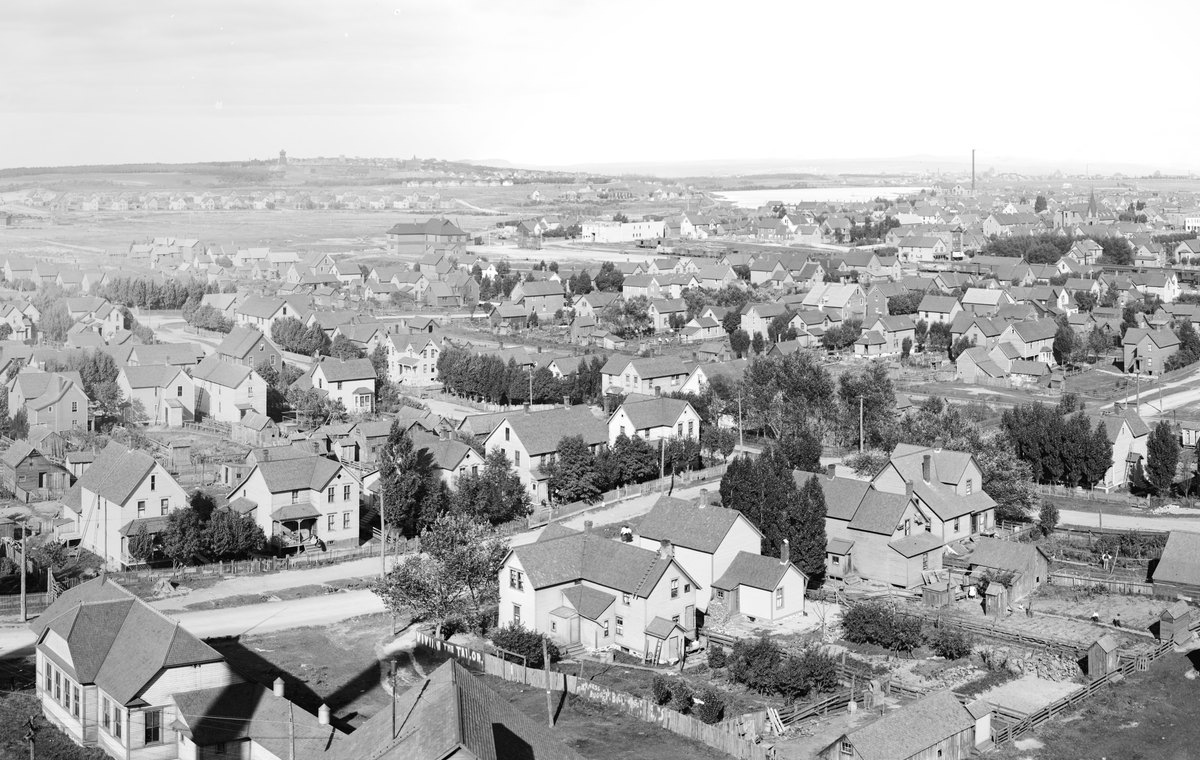
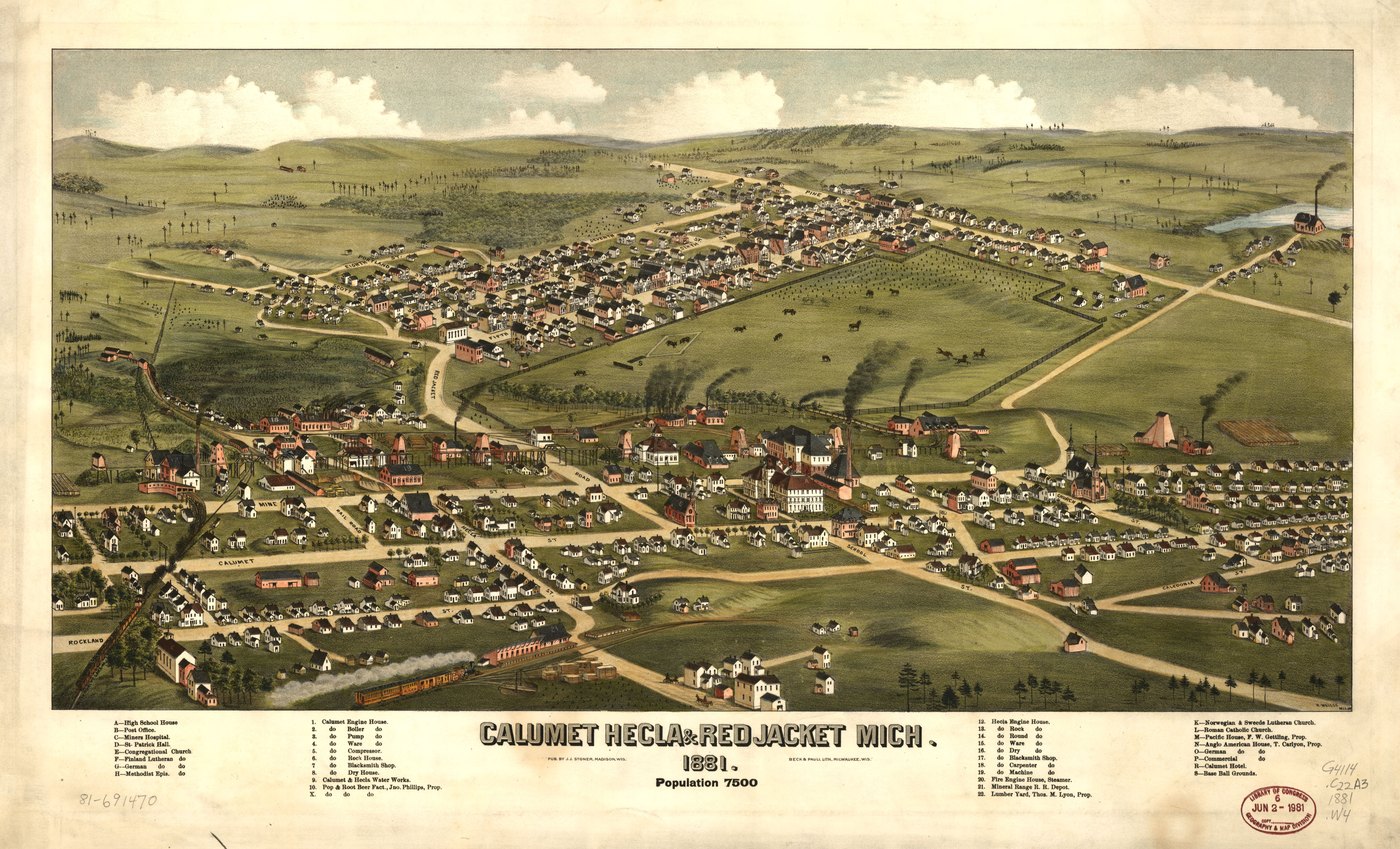
“Calumet, Hecla & Red Jacket, Mich. 1881.” The village was called RED JACKET, and it kept that name through the strike and the disaster, until 1929. Calumet was the township. Bird’s-eye view · Library of Congress, Geography and Map Division · LC 81691470. Published 1881.
The twenty-fourth of December
There was no fire.
Italian Hall was built in 1908 by the Società Mutua Beneficenza
Italiana, an Italian mutual-aid society: two storeys of brick, a grocery and a
saloon on the ground floor, and upstairs a hall seventy-eight feet by thirty-eight. The
only way up was a staircase five feet nine inches wide. The union did
not own it. It was an Italian society’s building, rented for a mostly Finnish and
Slavic crowd, which tells you exactly what the town was.
On Christmas Eve 1913 the Women’s Auxiliary of the Western Federation of Miners,
led by Annie Clemenc, held a party there for the strikers’ families. More than four
hundred people came. The children were filing up to the stage for their presents when
someone shouted “Fire!” — in English. The Red Jacket
fire department’s log records no fire that night, and no investigation ever
produced a witness who saw one.
Seventy-three people were crushed to death on the stairs. Fifty-nine of them
were children. That is the inquest’s count, the count on the marker and on
the 2018 monument. Contemporary newspapers gave anything from seventy-two to eighty-three,
and some spelled the names so badly that families could not find their own dead in the
lists — which is itself a measure of how the town’s institutions treated its
immigrants. On 28 December more than twenty thousand people followed the funeral, in a
village of under five thousand.
The inquest was held in English, on witnesses many of whom did not speak it. It named
nobody. Two days after the disaster the union president, Charles Moyer, was shot in the
back near Hancock by men associated with the mine owners, marched bleeding to a train, and
put out of the district. Nobody was ever identified as the man who shouted, and
nobody was ever charged.
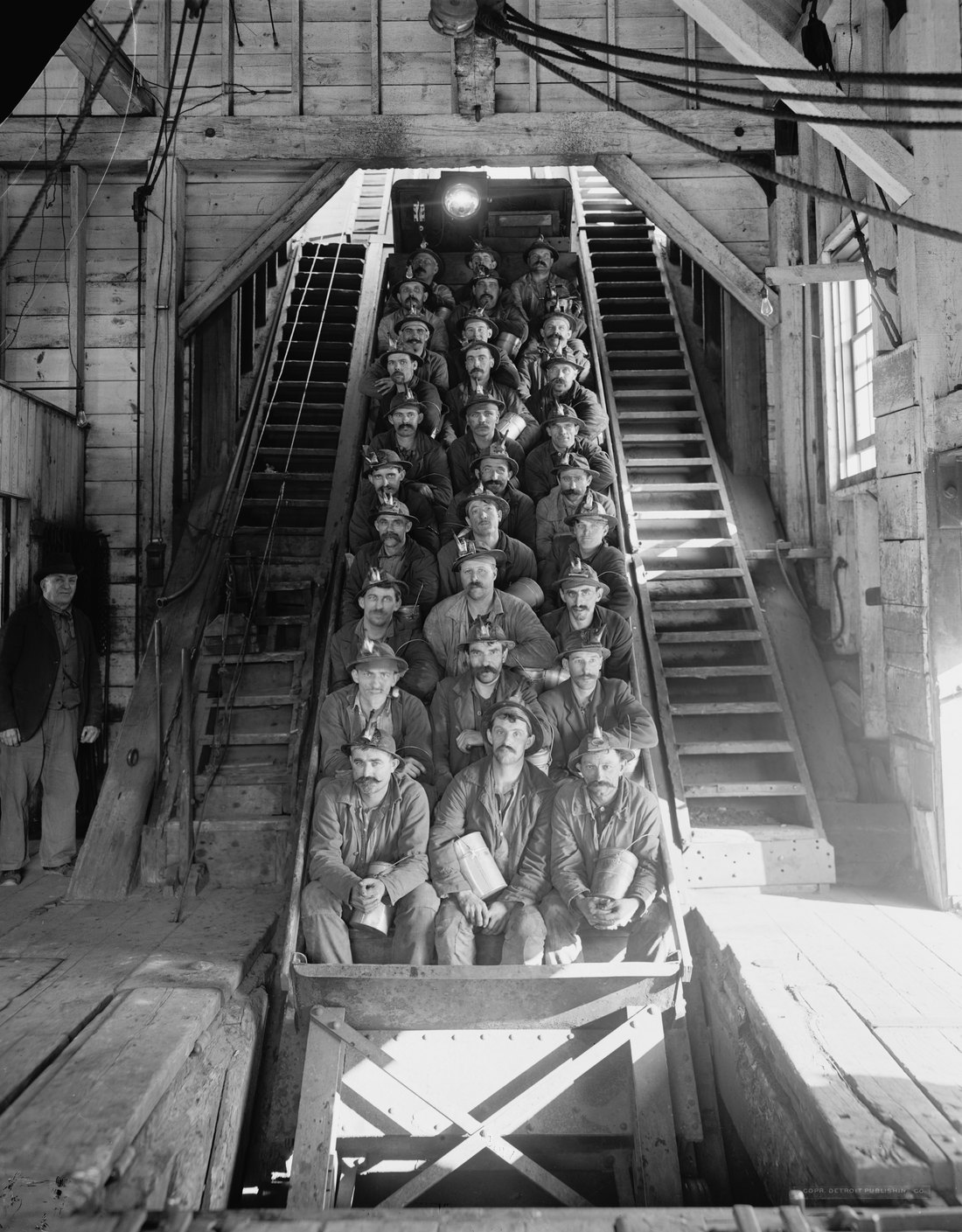
Calumet and Hecla shaft No. 2, about 1906: miners coming up the incline at the end of a shift. The workings ran on the slope of the lode, which is why the mine’s famous depth figures are so often misread — see the corrections below. Detroit Publishing Company · Library of Congress · LC-D4-19051. Published before 1930; public domain.
Corrections
What the record actually says.
Left: what is commonly
written about Calumet. Right: what the document says — or does not.
The doors at the bottom of the stairs opened inward, and the crowd could not get them open.
They did not. The Calumet News reported at the hall’s
opening in October 1908 that “all doors open outward”;
the architect’s drawings agree; and not one witness at the inquest or
before Congress blamed the doors — including the people with every
reason to blame somebody. The claim appears decades later: in a narrative passage of a
1975 federal survey, then carved into a state historical marker in 1984, the year the
building was demolished. The marker was quietly corrected in June 2013. What killed
them was a staircase five feet nine inches wide and a crowd of four hundred.
Seventy-three people died, and fifty-nine were
children; fourteen were adults. The figure of seventy-three children comes
from a song written around 1941, which also has company men holding the door shut.
There is no evidence for that either. The song has been heard by far more people than
have ever read the inquest.
Coroner’s inquest, 1913; Woody Guthrie, “1913 Massacre”, c. 1941
The company built the Calumet Theatre.
It was built by the village council of Red Jacket, out of its
own treasury surplus, as an opera-house addition to the town hall, and opened
on 20 March 1900 with twelve hundred seats. Calumet and Hecla provided the land. That
is the extent of the company’s part that could be verified, and the town paid for
the rest.
Calumet Historic District National Historic Landmark nominations, 1989 and 2021
It all happened in the town of Calumet.
The village was Red Jacket until 1929; Calumet was
the township. The first village to call itself Calumet was the one next door, in 1889
— it had to rename itself Laurium in 1895 when it found the post
office name was taken. For the whole of the strike and the disaster the place was Red
Jacket, in Calumet Township, next to Laurium, and everyone called all of it Calumet
anyway. A 1916 House committee had to sort it out.
NHL nominations; U.S. House of Representatives, 1916
The Red Jacket shaft went almost two miles down.
In 1897 the Red Jacket shaft reached 4,900 feet,
vertically — then the deepest mine in the world, until a Brazilian mine passed it
around 1915. “Almost two miles” is the length of the inclined workings,
which followed the slope of the lode. Both are true, of different measurements.
National Park Service; NHL nomination, 2021
Calumet had the first industrial hospital in America.
The company opened a hospital in 1868 and a new one
with surgical and laboratory equipment in 1898, and that is well documented. The
“first in the nation” claim is repeated everywhere and could not be traced
to a primary or scholarly source, so this page does not make it.
Unverified — not used
The end
Bought as a by-product of a tube factory.
In 1923 the company merged into Calumet and Hecla Consolidated, and its outsized place in
the national industry was over. In May 1968 Universal Oil Products of
Illinois bought it for $123 million — for its profitable Wolverine Tube subsidiary,
not for the mines. Nine days later the miners struck, over wages and a defective bell
signalling system in the shafts.
On 9 April 1969 operations stopped. The next day more than a thousand
jobs were ended, the pumps were switched off, and the shafts were allowed to flood. Once
the pumps stop, the decision cannot be undone; that was the day the mining town died. The
paperwork took until 1978.
About two hundred million tons of stamp sands, slag and process waste went into nearby
Torch Lake between the 1860s and 1968, filling something like a fifth of it. It is a
federal Superfund site.
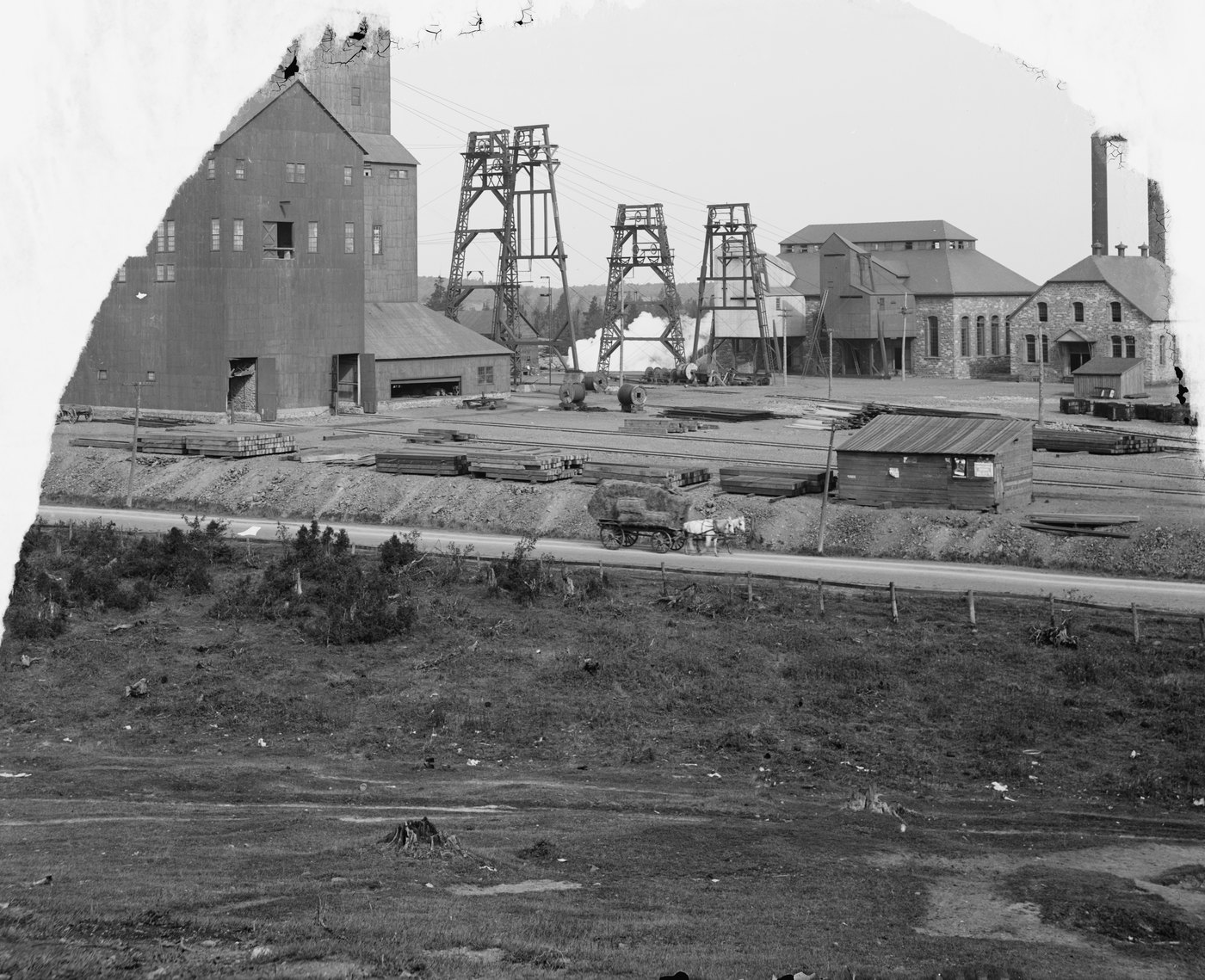
Tamarack No. 5, Calumet, about 1900–1910. Tamarack was a separate mining company working the same lode beside Calumet and Hecla, and its shafts were some of the deepest in the world. The ground under the whole district is a single hill. Detroit Publishing Company · Library of Congress · LC 2016809629. Published before 1930; public domain.
The archive
Where all of it came from.
U.S. House of Representatives · Committee on Mines and Mining · Conditions in the Copper Mines of Michigan, 1914
U.S. Bureau of Labor Statistics · Bulletin 139, Michigan Copper District Strike, 1914
Steve Lehto · Italian Hall: The Official Transcript of the Coroner’s Inquest, 2007
Historic American Buildings Survey · Italian Hall, HABS MI-425, 1975
National Park Service · Calumet Historic District National Historic Landmark nominations, 1989 and 2021
Library of Congress · Detroit Publishing Company · Calumet and Hecla, Tamarack
Library of Congress · FSA/OWI · John Vachon, August 1941
Library of Congress · Sanborn Fire Insurance Maps of Red Jacket, 1884–1917
Chronicling America · The Calumet News and The Daily Mining Gazette, 1908–1914
Larry Lankton, Cradle to Grave · Arthur Thurner, Rebels on the Range
Michigan Tech Archives · Keweenaw National Historical Park
The Library of Congress holds no photograph of the strike or of the
disaster. The film tells that half of the story with the pages of the newspapers
themselves, the federal survey’s drawings of the hall, and the names — and
it contains no generated images at all. Photographs of the funeral exist
and are in the public domain; neither the film nor this page shows them. The name of the man
who shouted “fire” is not given here, because no source reached for the film
establishes it. If you have one that does, with its evidence, we want to see it.
Chester · Pennsylvania
The largest shipyard on earth.
William Penn landed here in 1682. It is the oldest city in Pennsylvania,
older than Philadelphia. In the Second World War the Sun Oil Company’s shipyard on
its riverbank built two out of every five tankers America produced. In November 2022
the city filed for bankruptcy.
1682
William Penn arrived and renamed the settlement of Upland after Cheshire. The province’s first assembly sat here that December
281
T2 tankers built at Sun Ship during the Second World War, about forty per cent of the national total. In 1944 alone the yard launched seventy-five ships
35–40,000
people at the yard at its wartime peak. The sources disagree, and the film says “as many as forty thousand” for that reason
66,039
people in Chester at the 1950 census, the peak. In 2020 there were 32,605, fewer than half
6 Apr 1995
the date the Commonwealth declared the City of Chester financially distressed under Act 47. Twenty-seven years later it filed under Chapter 9
The film
How the World’s Largest Shipyard Left a City Bankrupt.
Ten chapters · 34 minutes · 1080p · archival
photographs where they exist; the connective scenes are illustrated and labelled as
such on screen · no generated image of any real person, and none of the men of
Yard No. 4 Watch on YouTube →
The Chester file
The research, published.
The film is free and always
will be. What is for sale is everything behind it — the documents themselves, the
corrections with their page numbers, and the plates at full resolution.
The book
$9.99
Chester, Pennsylvania
The full account, expanded from the film
Six plates, from the Sun yard to the river front
Seventeen corrections, each with its source
Ten appendices, including the courts on 1936 and on the incinerator
The primary documents as scanned — the Army Signal Corps and War Department
photographs of the Sun yard, 1917–18, the census tables for Chester from 1900
to 2020, and the Commonwealth’s Act 47 determination and recovery plans for
the city
Every plate at full resolution, uncropped
The complete corrections file, and what could not be verified, and why
What happened
A shipyard built for one company’s oil.
The river made Chester before any company did. The Delaware from Philadelphia down to
Wilmington became the densest run of shipbuilding in the country, and in
1871 the Irish-born industrialist John Roach bought a
yard at Chester and turned it into the Delaware River Iron Ship Building and Engine
Works. For its first fifteen years it was among the largest and most productive yards in
the United States, and it built the first steel ships of the modern U.S. Navy. The
enterprise went into receivership in 1885.
What Roach left behind was the workforce: men who knew how to build a large watertight
steel structure and put it in the sea. In 1916 the Sun Oil
Company, under J. Howard Pew and the Pew family, came to Chester for exactly
that. Sun had oil in Texas and a refinery at Marcus Hook, a few miles downriver, and it
wanted its own tankers between them. The new yard was a separate site from Roach’s.
It launched its first ship, the tanker Chester Sun, on
30 October 1917, in heavy rain, because delaying a launch was thought to
bring bad luck.
That origin decides everything after it. The yard existed to serve one oil
company’s supply chain. The capital, the board and the reason for the business
were elsewhere, and Chester was the address.
“A vessel almost ready to go to sea. Sun Ship Building Co., Chester, Pa.” The name on the bow is CHESTER SUN, the yard’s first ship, some weeks after her launch. Capt. A. K. Dawson, U.S. Army Signal Corps, December 1917 · U.S. National Archives · 111-SC-1817. Work of the U.S. government.
1941–1945
Two tankers in every five.
Twenty slipways were added during the war, and at its height the Sun yard at Chester
was the largest shipyard in the world. What it built, over and over, was the
T2 tanker: about five hundred feet long, carrying the fuel for
Allied aircraft, tanks and convoy escorts across two oceans. Sun built 281 of them,
about forty per cent of the American total, and in 1944
it launched seventy-five ships, one every five days.
It could only be done because shipbuilding had just been rewritten. Riveted hulls
needed men with long apprenticeships, and in 1941 there were nowhere near enough of them.
Welding and prefabrication needed people who could be trained in weeks. So the yard hired
people who had never been hired for this work before: farmhands, clerks, teenagers,
women, and Black workers from the South arriving in the Great Migration.
The Sun-built T2 tanker Esso Manhattan off Brisbane on 22 October 1943, fitted with extra decking to carry seven PT boats as deck cargo. The tankers carried more than oil. Royal Australian Air Force, No. 71 Squadron, 1943 · public domain.
Yard No. 4
Both things, at once.
In June 1941 President Roosevelt signed Executive Order 8802, banning
discrimination in the defense industries. Sun hired Black workers at a scale no private
employer in the country matched; during the war it was the largest private-sector
employer of African Americans in the United States. It also put a great many of
them in a separate yard, Yard No. 4.
Those are not competing accounts. They are the same institution. For thousands of
families Yard No. 4 was the best industrial job open to them anywhere: skilled,
union-represented, well paid, and building ships that crossed oceans. It was also a
separate yard with its own number because of who they were.
Between 1948 and 1951, a mile away in Upland, a seminary student named Martin Luther
King Jr. was studying at Crozer Theological Seminary. He graduated as valedictorian.
This page shows no picture of the men and women of Yard No. 4, and the
film does not either. No photograph of them could be found that is cleared to publish,
and the film would not put an illustration in their place. If your family worked there
and you have one, we would like to hear from you.
“Sun Shipbuilding Yard, Chester. Hull #8.” Staging around a steel hull on the ways, 24 April 1918, the first war. By the second, the yard had twenty more slipways. War Department · U.S. National Archives · 165-WW-497D-6. Work of the U.S. government.
1936
Who got a job.
Delaware County was run for most of the century by one of the most durable political
machines in America, and its boss from 1907 until his death in 1965 was
John J. McClure. In 1936, the standard account is that
the Pew family gave McClure’s organisation control over hiring at Sun
Ship as patronage.
That makes the largest employer in the city, and soon the largest shipyard on earth,
also a patronage office. A job came through the organisation and could be taken back the
same way. When the industry went, the political habits built around tens of thousands of
patronage jobs stayed behind, with nothing left to hand out. Machines of this kind ran
cities of every political colour across industrial America; this is not a partisan
point.
The long fall
A third gone while the yard still worked.
Chester peaked at 66,039 people in 1950. Ford closed its Chester
assembly plant in 1961. Employment at the yard fell from its wartime
high to about four thousand by 1962. Between 1950 and 1980, by the figure the film uses,
thirty-two per cent of all the jobs in the city disappeared, and the
population fell to 45,794. The people who could leave went to the
suburbs a few miles away. The county did well. The city at its centre did not.
Sun sold the yard to Pennsylvania Shipbuilding in 1982,
and it closed in 1989. By then the closure was not the disaster. It was
the confirmation.
On 6 April 1995 the Commonwealth declared the City of Chester
financially distressed under Act 47. A fiscal emergency followed in
2020, and a state-appointed receiver. In November 2022 the city filed
for Chapter 9 bankruptcy. Chapter 9 is not a liquidation. A city
cannot be sold. It is a legal shelter while a city restructures what it owes, mostly to
its pension funds. Nothing visible happens on the day, which is how it can take
twenty-seven years to arrive and still surprise people.
The Chester waterfront, about 1875: the river that made the town before any company did. Roach had bought his yard four years earlier. Engraving by Lauderbach after an unattributed original, c. 1875 · published before 1930; public domain.
Corrections
What the record actually says.
Left: what the film says, or
what is commonly written about Chester. Right: what the document says — or does
not.
Chester entered Act 47 in 1992, the same year the regional incinerator opened in the city.
The Commonwealth’s own list of distress determinations gives
the City of Chester: 6 April 1995. The film’s Chapter Nine
builds an argument on the two events falling in the same year. They did not. The
incinerator opened in the early 1990s; the distress determination came in
1995. The sequence the film describes still holds: industry gone, tax base gone,
the region’s waste sited in the city, the state taking over its finances. It
was not one year.
Chester was the thirty-first American municipality ever to file for bankruptcy.
Far more have filed. The federal courts’ own summary says
there were fewer than five hundred municipal bankruptcy petitions in
the first sixty years of Chapter 9. That count includes water, sewer and hospital
districts as well as cities. “Thirty-first” appears in secondary accounts
without saying what it counts, so this page does not repeat it.
Administrative Office of the U.S. Courts, Chapter 9 — Bankruptcy Basics
The historical record says Sun “controversially segregated many of the black workers to yard number four.”
The fact is right, but those words are not from a historical
document. They are the sentence in the English Wikipedia article on Sun
Shipbuilding, and the film quoted it as “the language of the historical
record.” The primary record of Yard No. 4 is at the Independence Seaport
Museum and the Delaware County Historical Society. It has not yet been read for this
project.
“Sun Shipbuilding & Drydock Company,” Wikipedia · primary sources still to be read
Ford had been running an assembly plant in Chester since 1917.
Ford’s Chester assembly plant opened in 1927,
not 1917, and closed in 1961. It was built on the site of John
Roach’s old shipyard. Harriman’s Merchant Shipbuilding Corporation had
reopened that yard for the First World War and closed it for good in 1923.
Secondary accounts; the opening year is given as 1927 or 1928
The Covanta incinerator became operational in 1992.
It was built as a Westinghouse plant and opened in
the early 1990s. It carries Covanta’s name today, and that name came later.
Its exact first year of operation has not been confirmed from a primary document, so
this page does not give one.
Unverified — year not given
Martin Luther King Jr. studied in Chester.
He studied at Crozer Theological Seminary in Upland,
the borough next door, from 1948 to 1951. The film has this right. It is the
correction most often made in the other direction, so it is recorded here.
Standard biographical record; the film’s own fact notes
The archive
Where all of it came from.
U.S. National Archives · Army Signal Corps photographs, 111-SC · War Department photographs of industry, 165-WW, 1917–18
Independence Seaport Museum · J. Welles Henderson Archives · Sun Shipbuilding & Dry Dock Company records, 1916–1998
U.S. Census · Chester, Pennsylvania, 1900–2020
Pennsylvania Department of Community and Economic Development · Act 47 determination and recovery plans, City of Chester, 1995–2020
U.S. Bankruptcy Court, Eastern District of Pennsylvania · City of Chester, Chapter 9, November 2022
Administrative Office of the U.S. Courts · Chapter 9 — Bankruptcy Basics
Delaware County Historical Society
The Library of Congress holds almost nothing on the Sun
yard: eight items, and not one Farm Security Administration photograph of shipbuilding at
Chester. The yard’s own records are at the Independence Seaport Museum, with
copyright restrictions, so the photographs on this page are the ones the federal
government took in the First World War. The film fills its gaps with illustrations,
labelled as such, and it never illustrates a named person or the workers of Yard No. 4.
If you have photographs of the yard, and above all of Yard No. 4, we want to see them.
Gary · Indiana
He never lived there.
In 1905 a lawyer began buying nine thousand acres of dunes on Lake Michigan
without saying who he was buying for. Three years later there was a steel mill on the
sand, and a city beside it, all built by one corporation at once. They named it after
the chairman of the board. He ran it from 71 Broadway in New York. In 1919, when the
men who built it asked to meet him, he would not see them.
9,000 acres
of dune and marsh, assembled from 1905 by the lawyer Armanis Knotts for U.S. Steel, seven miles of shore running two miles inland
14 July 1906
the vote to incorporate the town, held in the Gary Land Company’s office, the first permanent building in Gary. It was also the first post office and the first town hall
202 cities
were running the Gary Plan of platoon schools by 1929, designed for the children of steelworkers by the superintendent William Wirt
178,320
people at the 1960 census, the peak. From sand dunes in 1906 to a city of 100,426 by 1930
7 Nov 1967
Richard Hatcher elected mayor, on the same night as Carl Stokes in Cleveland: the first Black mayors of major American cities
The film
They Built a City Out of Sand.
Ten chapters · 39 minutes · 1080p · Library of
Congress panoramas and photographs, the Historic American Buildings Survey, and modern
photography from the Carol M. Highsmith Archive · some connective plates are
illustrated, in a non-photographic style, and none shows a person Watch on YouTube →
The Gary file
The research, published.
The film is free and always
will be. What is for sale is everything behind it — the documents themselves, the
corrections with their page numbers, and the plates at full resolution.
The book
$9.99
Gary, Indiana
The full account, expanded from the film
Six plates, from the 1907 dunes to the mills
Six corrections to the film, each with its source
Twelve appendices, including Judge Gary before the Senate
The primary documents as scanned — the 1919 Senate hearings,
Investigation of Strike in Steel Industries, the Historic American
Buildings Survey reports on the Gary Land Company Building and the Municipal
Building, and the 1930s Home Owners’ Loan Corporation map of Lake County
Every plate at full resolution, uncropped
The complete corrections file, and what could not be verified, and why
What happened
Before the first house, they moved the river.
U.S. Steel was four years old in 1905, assembled in 1901 from Carnegie Steel and a dozen
other firms, and the first company in history capitalised at more than a billion
dollars. It wanted a mill where ore coming down the lakes from Minnesota met coal coming
up by rail. That point was an empty stretch of dune at the south end of Lake Michigan,
twenty-six miles from Chicago. There was a reason nobody had built there: ridge after
ridge of sand, marsh behind it, and the Grand Calumet River curving through exactly
where the mill had to go.
So they moved all of it. Crews took out more than eleven million cubic yards of sand,
cut the street lines through the ridges, dredged a harbour, and picked up the river and
put it further south. By 1908 the corporation had spent about forty-two million dollars.
Elbert Gary announced the whole thing in one flat sentence: “It has been
decided to construct and put into operation a new plant…” Decided
by no one in particular, in no place you could go and argue.
“Removing land dunes, May, 1907, Gary, Ind.” The sand went out by the trainload. Eleven million cubic yards of it came off the site before the city was built. Postcard, Crose Photo Co. and Suhling & Koehn Co., 1907 · published before 1930; public domain · scan from the Steven R. Shook collection.
The First Subdivision
Depending on the income and status of the employee.
The town was built by a company made for the purpose, the Gary Land
Company, a wholly owned subsidiary of U.S. Steel. Its first building went up in
April 1906, a plain two-storey frame house twenty feet by forty. The
federal survey of it records that it was the first permanent structure in Gary. It was
also the first post office. The vote to incorporate the town was held there on
14 July 1906 and the first town officers were elected there two weeks
later. It was the town hall until October 1907, and the first high-school classes met
in the back. The landlord’s office was the seat of government.
The Land Company laid the streets, the sewers, the waterworks and the electric plant,
and built 506 houses on eight hundred acres north of the Wabash tracks.
They were sold or let “depending on the income and status of the
employee.” The best of them, 206 houses of five to ten rooms at $23 to
$42 a month, went to supervisors and skilled men. In 1912 a labourer at the mill earned
on average 16.7 cents an hour. He was never getting one. No rule said so. The pay did.
Everyone else went south of the tracks, onto land the company did not own and had never
planned: the Patch. It had no sewers and more than a hundred saloons. North of the tracks
there were four liquor licences. By 1910 almost half of Gary had been born abroad. From
about 1916 Black families came up from the South, from 340 residents in 1910 to 5,500 in
1920 and 18,000 in 1930, and they did not go north of the tracks either.
The Gary Land Company Building, moved to Gateway Park and abandoned since 1966, photographed for the federal survey. In 1906 it was the land company’s office, the post office, the polling place and the town hall, all at once. Historic American Buildings Survey · HABS IN-196 · Library of Congress · work of the U.S. government.
The Gary Plan
A steel town’s schools, copied by the country.
In 1907 the new town hired William Wirt, thirty-three, from Bluffton,
as superintendent of schools. He noticed that most of a school sits idle most of the day,
so he split the pupils into two platoons and rotated them between the classrooms and
everything else: shop, gym, pool, auditorium, garden. A building for eight hundred could
take sixteen hundred. By 1929 the Gary Plan ran in 202 cities in
forty-one states.
Not everyone saw it as a gift. When New York City moved to adopt it across the city in
1917, immigrant parents saw half a day of real teaching and half a day at a lathe, a
system built to send their children back into the class they had crossed an ocean to
leave. In October 1917 thousands of schoolchildren struck and rioted across the city. The
mayor lost the election that November, and his successor tore the plan out.
Emerson School, Gary, on a postcard mailed in June 1909. Wirt’s work-study-play system began here. Postcard, W. L. Cole Drug Co., 1909 · published before 1930; public domain · scan from the Steven R. Shook collection.
1919
Seventy-one Broadway.
The standard shift in steel was twelve hours, and at each change-over a man worked
twenty-four straight. On 20 May 1919 Judge Gary answered a union letter
in words the Senate later printed in full: “As you know, we do not confer,
negotiate with, or combat labor unions as such. We stand for the open shop.”
At 3 p.m. on Tuesday 26 August 1919 the unions’ committee called
at his office in New York and asked for a meeting. He sent word from an inner room that
he wished to be excused from a personal interview, and that they could put their
business in writing. They did. His reply, dated the next day, declined to deal with them. The strike began
on 22 September.
In Gary, on the evening of Saturday 4 October, strikers coming home
from an open-air meeting met a streetcar held up at a rail crossing. A Black man was on
it, and a fight started. A union witness told the Senate that everything had been
peaceable up to that night. Federal troops arrived under General Leonard Wood at about
eleven o’clock on Monday 6 October, and his proclamation put the
city under military control shortly after midnight. The strike failed. The twelve-hour
day ended four years later, in August 1923, under pressure from the White House.
“Indiana Steel Co.’s big mills, Gary, Ind.” Indiana Steel was the U.S. Steel subsidiary that ran Gary Works. About 1912. Panoramic photograph · Library of Congress, Prints & Photographs · LCCN 2007662110 · published before 1930; public domain.
1930s – 1967
The money and the wall came from one machine.
In the late 1930s the federal Home Owners’ Loan Corporation graded the
neighbourhoods of Lake County for mortgage risk, and a map that tells banks where not to
lend decides where people can buy. By 1950, ninety-seven per cent of Black
residents of Gary lived in one district, Midtown. In September 1945, six weeks
after the war, white students at Froebel School walked out to demand the removal of its
Black students. Frank Sinatra came to the Memorial Auditorium on 1 November and asked
them to stop. They did not, for another eleven days.
The city was at its richest at exactly the moment it was most segregated. The census of
1960 recorded 178,320 people, the most it would ever have. On
7 November 1967, against his own party’s county organisation,
Richard Hatcher was elected mayor with about ninety-six per cent of the
Black vote and twelve per cent of the white vote. For the first time since the lawyer
started buying sand, Gary was run by somebody who lived in it. He held the office for
twenty years while the thing that built the city took itself apart.
“6th Ave. & Broadway, Gary, Ind. Aug. 11th, 1908.” Two years after the incorporation vote: brick shops, a streetcar line and a sidewalk on what had been a dune. Postcard, Mrs. J. F. McArthur / Excelsior, 1908 · published before 1930; public domain · scan from the Steven R. Shook collection.
Corrections
What the record actually says.
Left: what the film says, or
what is commonly written about Gary. Right: what the document says — or does not.
In the middle of the occupation, Judge Gary sat before the Senate to explain why the men were wrong.
The order is the other way round. The Senate committee opened on
25 September and heard Gary on 1 and 2 October
1919, before the streetcar fight in Gary on the 4th and before the troops
arrived on the 6th. He was in Washington during the strike,
but not during the occupation. The film’s point stands: he would travel to the
Senate and would not meet the men.
U.S. Senate, Committee on Education and Labor, Investigation of Strike in Steel Industries, 1919
The incident of 4 October was strikers pulling the wires off a trolley carrying strikebreakers, and a brick hitting one bystander.
The sworn account the Senate heard is less tidy. A crowd coming home
from an open-air meeting met a streetcar stopped at a rail crossing; a Black man was
on it; “somehow or other there was a fight started on this car.” The
witness said he was not there himself. What the record does support is the
film’s larger claim: a union witness testified that everything had been
peaceable up to that night, and within two days the Army was in charge of the
city.
Senate hearings, 1919 · testimony of Mr. Anderson and Lt. Donald C. Van Buren
Forty-two per cent of greater Gary was graded hazardous; only sixteen per cent desirable.
The 1930s map covers Gary together with the rest of Lake County. Measured
by area from the digitised map, about one-sixth was graded A or B,
which agrees with the film, and about a third was graded D, fewer
than forty-two per cent. The film’s figure may measure something else, such as
residential land or Gary proper, but its source does not say what. The appraiser’s
words the film quotes could not be checked against the original sheet for this
page, and are not repeated here.
HOLC map of Lake County, as digitised by Mapping Inequality, University of Richmond
Gary was a company town from its first day of government.
Literally so. The federal survey of the Gary Land Company Building
records that the vote to incorporate (14 July 1906), the
election of the first town officers (28 July) and the town
board’s meetings until 12 October 1907 were all held in the U.S.
Steel subsidiary’s office. It is recorded here because it is stronger than
anything the film says.
Historic American Buildings Survey, HABS IN-196
The archive
Where all of it came from.
U.S. Senate · Committee on Education and Labor · Investigation of Strike in Steel Industries, hearings, 1919
Historic American Buildings Survey · Gary Land Company Building, HABS IN-196 · Gary Municipal Building, HABS IN-197
Library of Congress · panoramic photographs of Gary Works and the city, 1908–1912
Home Owners’ Loan Corporation · Lake County, Indiana · via Mapping Inequality, University of Richmond
U.S. Census · Gary, Indiana, 1910–2020
Calumet Regional Archives, Indiana University Northwest
Raymond Mohl and Neil Betten · “Paternalism and Pluralism: Immigrants and Social Welfare in Gary, Indiana”
Carol M. Highsmith Archive · Library of Congress
The film ends on a figure from the Gary Police Department for 2025 and a
count of the city’s abandoned buildings. Neither could be checked against a
published source for this page, so neither is repeated here. The illustrated plates in
the film are rendered so they cannot be mistaken for photographs, and none of them shows
a person.
Lorain · Ohio
Ships, steel, and cars.
At the mouth of the Black River on Lake Erie, one city spent the twentieth
century building ore boats, making steel pipe and assembling Ford vans, all at once.
The shipyard closed in 1983. Ford left in 2005. The last furnace stopped in 2016 and the
last pipe mill in 2020. Lorain lost everything it made, and most of its people stayed.
909
vessels from the shipyard on the Black River, most of them steel freighters for the Great Lakes ore trade
1 Apr 1895
first steel from the Bessemer converter of the Johnson company’s new works, moved to Lorain from Johnstown, Pennsylvania
78,185
people at the 1970 census, the city’s peak. At the 2020 census there were 65,211, about five in every six
73
people killed in Lorain by the tornado of 28 June 1924, by the Weather Bureau’s count, with 39 still missing when it reported. The whole storm killed 83
31 March 2016
Republic idled its whole Lorain works: the last steel made in the city. U.S. Steel idled its Lorain pipe mills in May 2020
The film
The City That Lost Three Industries.
Ten chapters · 34 minutes · 1080p · archival
photographs and postcards; the connective scenes are illustrated and labelled as such
on screen · no generated image of the 1924 tornado Watch on YouTube →
The Lorain file
The research, published.
The film is free and always
will be. What is for sale is everything behind it — the documents themselves, the
corrections with their page numbers, and the plates at full resolution.
The book
$9.99
Lorain, Ohio
The full account, expanded from the film
Ten plates, from the shipyard to the tornado
Fourteen corrections, each with its source
Thirteen appendices, including the 1924 tornado report in full
The primary documents as scanned — the Army Air Service aerial survey of the
1924 tornado from McCook Field, the census tables for Lorain from 1880 to 2020, and
the postcards of the National Tube works and the shipyard
Every plate at full resolution, uncropped
The complete corrections file, and what could not be verified, and why
What happened
A river meets a lake.
The Black River empties into Lake Erie through water deep and sheltered enough to tie up
a lake boat, and on the nineteenth-century Great Lakes that was everything. Nathan Perry
settled at the river mouth in 1807. The village was platted as Black River in 1834.
People were building wooden boats there from about 1819, and it was that trade, more
than anything, that decided what came next.
In 1897 the Cleveland Shipbuilding Company opened a steel yard on the
river, and on 13 April 1898 it launched the Superior City, then
the largest vessel on the Lakes. Under the American Ship Building Company the yard went on
to build 909 hulls, most of them ore boats: long, flat freighters with the
wheelhouse at the bow, the engines at the stern and one enormous hold between, carrying
iron ore from Lake Superior down to the mills. The yard was building the supply line of
Midwestern steel.
The steel came to Lorain because of a flood. Tom Johnson’s Johnson Company made
streetcar rail in Johnstown, Pennsylvania, and after the disaster of 1889 it went looking
for a new site. It chose Lorain, between the Ohio coalfields, the Lakes ore trade and the
markets east and west. Ground was broken in June 1894, and on
1 April 1895 the Bessemer converter blew its first heat in front of a
crowd of about two hundred people.
“Blast Furnaces and Power House, National Tube Co., Lorain O.” By 1909 the Johnson works had become part of U.S. Steel, as a plant of its National Tube division. Postcard no. 4701, postmarked 11 October 1909 · published before 1930; public domain · Columbus Metropolitan Library, via DPLA.
The International City
Seventeen thousand in the mill.
The works became the Lorain Steel Company in 1898, part of United States Steel in 1901
and part of its National Tube division in 1903. From 1905 it made pipe, and pipe made its
name. At its peak around 1950 it ran five blast furnaces, 385 coke ovens,
twelve open hearths, three Bessemer converters and four seamless mills.
Seamless tube, with no welded joint to split, is what the oil and gas wells take, and that
tied a lakefront in Ohio to the price of a barrel of crude. By the 1920s the plant employed
about seventeen thousand people.
Filling those jobs brought Slovaks, Hungarians, Poles, Italians, Greeks and Ukrainians,
then recruits from Mexico and from Puerto Rico. The city called itself the
International City, and it still is: in 2022 it was about half
non-Hispanic white, more than a quarter Hispanic or Latino and about one-sixth Black.
Toni Morrison was born here in 1931 and set her first novel, The Bluest Eye, in
Lorain.
In 1958 Ford opened an assembly plant. It built Fairlanes, Thunderbirds
and, for decades, the Econoline van. For a generation Lorain had three heavy industries in
three different trades at once, which almost no town in this series ever had. A family
could keep two incomes from two industries that did not fail in the same month.
“National Tube Co., Lorain, Ohio.” The pipe works in 1907, four years after the plant joined U.S. Steel’s tube division. Colour postcard, 16 August 1907 · published before 1930; public domain · Columbus Metropolitan Library, via DPLA.
28 June 1924
The disaster it survived.
Late on a Saturday afternoon a tornado crossed Sandusky Bay, killed five people in
Sandusky, then came ashore at Lorain’s Lakeview Park and went through the middle of
the city. Seventy-three people died in Lorain, by the Weather Bureau’s count, fifteen of them in
a theatre that collapsed and eight in the park’s bath house.
Lorain rebuilt, and quickly. The census went from 37,295 in 1920 to 44,512 in 1930,
straight through the disaster. The mill and the shipyard were untouched, and the town had
the money, the reason and the people to put itself back. The film’s point is that a
town with its industry intact can survive a tornado. The second half of the story is what
happens when the thing destroyed is the industry.
“Lorain, Ohio. Taken after tornado, June 1924.” The Army Air Service flew over the city from McCook Field in Dayton and photographed the damage street by street. McCook Field negative no. 56483 · U.S. National Archives · NAID 68146870 · work of the U.S. government.“Ruins of bath house — Lorain, Ohio.” The tornado came ashore at Lakeview Park. Eight people died in this building. Postcard no. 19, 1924 · published before 1930; public domain · Columbus Metropolitan Library, via DPLA.
1982 – 2020
Passed from hand to hand.
In 1971 U.S. Steel put $120 million into a basic oxygen furnace at Lorain, the act of a
company that expected to stay. The early 1980s broke that. In 1982 a lockout and strike put
more than six thousand people out of work, and on 1 December 1983 the
American Ship Building yard on the Black River closed. A shipyard leaves almost nothing
behind: take the cranes and sheds away and the ways are just a slope down to the water.
The mill did not close. It was sold, again and again. In July 1989 U.S. Steel and Kobe
Steel of Japan formed a joint venture to run it, with 2,850 people on the
payroll, down from about eleven thousand in 1980. In 1999 it was split. Republic
Technologies International took part of it and went bankrupt in 2001. Its assets were sold
in 2002, sold again to the Mexican steelmaker Grupo Simec in 2005, and rebranded Republic
Steel in 2011. None of those deals was about Lorain. Ford closed its assembly plant in
December 2005, with about eighteen hundred jobs.
U.S. Steel kept Lorain Tubular, and the oil-price collapse brought the bill. There were
614 layoffs in January 2015, citing weak oil and gas demand and imports, then more in
2015 and 2016. In May 2020 the company indefinitely idled what was left,
about 250 jobs. Steel employment in Lorain had gone from roughly seventeen thousand in the
1920s to none.
The people did not go. From its 1970 peak the city fell by about a sixth. It never
emptied the way Aliquippa did, and between 2010 and 2020 its population rose. Families who
had already made the hardest move once, from Slovakia or Puerto Rico or the South, had
built parishes and clubs and streets in Lorain. They were not going to move again because a
corporation had reorganised.
“United States Steel plant in Lorain emits foul smelling smoke from its chimneys, affecting neighboring homes.” April 1973, two years after the $120 million basic oxygen furnace, and ten years before the shipyard closed. Frank John Aleksandrowicz for the Environmental Protection Agency’s Documerica project · U.S. National Archives · NAID 550199 · work of the U.S. government.
Corrections
What the record actually says.
Left: what the film says, or
what is commonly written about Lorain. Right: what the document says — or does
not.
Lorain peaked in 1980, with 75,944 people.
The census peak was 1970: 78,185. In 1980 the count was
75,416, and the figure 75,944 does not appear in the decennial
counts. So the city was already shrinking before the shipyard closed, and from the peak
to 2020 it lost about one person in six (17%), not fourteen per cent.
The film’s central point survives. For a city that lost three industries,
that is a small loss.
U.S. Census, decennial counts, 1880–2020
Seventeen thousand in the mill, in a city of forty-four thousand at the 1920 census; then fifty-seven thousand by 1930.
The 1920 census counted 37,295 and the 1930 census
44,512. The film has shifted each figure a decade. The city still
grew straight through the 1924 tornado. It grew by about seven thousand, not
thirteen.
U.S. Census, 1920 and 1930
The 1924 tornado killed more than eighty people in Lorain.
The Weather Bureau counted seventy-three dead in Lorain,
including later deaths from injuries, with thirty-nine still missing when it reported.
The whole storm killed eighty-three, five of them in Sandusky.
“More than eighty” is the total for the whole storm, not for the city.
U.S. Weather Bureau, Monthly Weather Review, June 1924, pp. 309–310
There may be no photographs of the tornado that can be used.
There are. The Army Air Service flew from McCook Field
in Dayton after the storm and photographed the damage from the air. The prints are in
the National Archives and are public domain, as works of the U.S. government. One of
them is on this page.
U.S. National Archives · “Ohio – Lorain,” June 1924 · McCook Field negatives
Toni Morrison’s father worked as a welder in the shipyards.
It is widely repeated, and the film’s own fact notes flag it as not
checked. This page does not repeat it. Morrison’s birth in Lorain in 1931 and
the setting of The Bluest Eye are not in doubt.
Unverified — not used
The archive
Where all of it came from.
U.S. National Archives · Army Air Service aerial photographs, McCook Field, Lorain, June 1924
U.S. National Archives · Environmental Protection Agency, Documerica, Lorain, 1973
Columbus Metropolitan Library · Ohio postcard collections, via the Digital Public Library of America
Ohio Memory · Ohio History Connection and the State Library of Ohio
U.S. Census · Lorain, Ohio, 1880–2020
J. B. Mansfield, ed. · History of the Great Lakes, 1899
Contemporary reporting on the 1982 steel crisis, the 1983 yard closure, the 2005 Ford closure and the 2015–2020 layoffs
No photograph of the Superior City’s launch in 1898 has yet
been found at a usable size. If you have one, or photographs of the yard, the mill or
the Ford plant, we would like to see them. None of the illustrated scenes in the film
depicts the tornado or its victims.
Kannapolis · North Carolina
A town of thirty thousand. No mayor.
In 1980 there were more than thirty thousand people here and no city
council, no city hall and nobody to vote for. It was one of the largest unincorporated
places in the United States, and it had no government because Cannon Mills was the
government — the land, the houses, the streets, the water, the police. That
lasted seventy-eight years. What ended it was not a reform movement and not a strike.
The company was sold to a financier in thirty-four days, and there was no mechanism
by which anyone in town could be asked.
30,000+
people living in Kannapolis with no mayor, no council and no city hall — one of the largest unincorporated communities in the country
Noon, 11 Dec 1984
the minute Kannapolis became a city. The hour was written into an act of the General Assembly twenty months before the vote that triggered it
3,443 – 3,053
the union election of August 1991, with 307 ballots challenged. A margin of 390, and it was later set aside
100+
violations of federal labour law found by the National Labor Relations Board in that campaign, including a notice in Spanish threatening workers with deportation
30 July 2003
Pillowtex closed sixteen plants and terminated about 6,450 people in one day. Around 4,340 of them were here
The film
It Was The Biggest Town In America With No Government.
Thirteen chapters · 39 minutes · 1080p · Lewis
Hine’s photographs for the National Child Labor Committee, the Sanborn fire
insurance maps, the Paris Exposition of 1900, and the federal record of what happened
in 2003 · every archival frame names its repository on screen Watch on YouTube →
The Kannapolis file
The research, published.
The film is free and always
will be. What is for sale is everything behind it — the documents themselves, the
corrections with their citations, and the plates at full resolution.
The book
$9.99
Kannapolis, North Carolina
The full account, expanded from the film
Nine plates, including Lewis Hine’s photographs of the mills
Fifteen corrections and refinements, each with its source
Twelve appendices, including the 1983 incorporation law in full
The primary documents as scanned — the incorporation act,
Riley v. Murdock, the Fourth Circuit opinion, the bankruptcy
filing and the Federal Register notices
The Hine photographs at archive resolution
1906
The name is not Greek.
Everyone in Kannapolis will tell you the name means “city of looms,” from
the Greek. It does not. Kanna is Greek for reed, not loom. The first name in
print was Cannon City, and the county adopted Kannapolis after a letter
from James William Cannon himself. It means Cannon’s town, which is what it was.
Cannon had built his first mill at Concord in 1887 and by the turn of the century he
wanted room that a town council could not argue with. He bought farmland north of
Concord and put the mill, the houses, the streets and the water system on it together.
There was no charter, no election and no boundary, because none of those things were
needed to build a town. They were only needed to govern one.
“A group of children attending the public school, Kannapolis, N.C., every one of which said he or she had worked in the Cotton Mills there. The two smallest boys said ten years old.” October 1912. Lewis Wickes Hine for the National Child Labor Committee · Library of Congress, NCLC 02638 · no known restrictions on publication.
1912
Hine came, and wrote the company’s name down.
In October 1912 Lewis Hine was working the North Carolina mill towns for the National
Child Labor Committee. What makes the Kannapolis frames unusual is the captions: Hine
named the company. Not “a Southern cotton mill” but Cannon Mills, and the
town it stood in.
He also, in one caption, told the reader exactly what he thought he had photographed.
“The Logical Conclusion of the Lassez [sic] Faires Policy. Herman Parker, said six years old, and he and others said he had worked in the Cannon Mills, Kannapolis, N.C.” Lewis Wickes Hine for the National Child Labor Committee · Library of Congress, NCLC 02646 · no known restrictions on publication.
Hine’s captions record what the children told him, and he was careful
to say so — “said six years old,” “he and others said he had
worked.” That hedging is the reason the photographs are still good evidence a
century later. He was not certifying an age. He was recording a claim and saying whose
it was.
Concord, 1898
The mill that Cannon ended up owning.
Six miles south, in Concord, Warren Clay Coleman had done something no one else in the
United States had managed. A Black merchant born enslaved in Cabarrus County, he raised
subscriptions from Black investors across the country and built a cotton mill to be
owned and run by African Americans. He announced it in letters to the newspapers in
June 1896. The building was substantially complete by 1898.
The Library of Congress holds two photographs of it, displayed in the “American
Negro” exhibit that W. E. B. Du Bois and Thomas J. Calloway assembled for the
Paris Exposition of 1900. The Library’s own caption on the board of directors
calls it “the only Negro cotton mill in the U.S.”
“Board of directors of the Coleman manufacturing co., Concord, N.C., the only Negro cotton mill in the U.S.” Shown in the American Negro exhibit at the Paris Exposition of 1900. Library of Congress, Prints & Photographs · LCCN 2001705780 · no known restrictions on publication.
The money did not hold. Washington Duke bought $1,000 of stock in April 1898 — the
first of three loans to the company totalling $21,000 plus interest — and declined
to put in more in 1901. Production finally began in May 1901 and ran erratically for
want of equipment and cash. Coleman died in March 1904. Benjamin Duke and the other
creditors required satisfaction of the debts, the mill was foreclosed, and Duke bought
it at auction on 28 June 1904.
He operated it briefly, then sold it to the Concord manufacturer J. L. Hartsell, who
almost immediately conveyed it to Cannon Manufacturing Company. Cannon
incorporated it as Franklin Cotton Mills in 1906 and ran it under that name until the
1928 consolidation. After that it was Cannon Mills Plant No. 9.
“Coleman Manufacturing Co., a Negro operated cotton mill, Concord, N.C.” About 1899, as the mill neared completion. It stands today on the National Register as the Coleman-Franklin-Cannon Mill. Library of Congress, Prints & Photographs · LCCN 2001705851 · no known restrictions on publication.
1942
Mr Charlie’s town.
Charles Albert Cannon ran the company from his father’s death in 1921 until 1962,
and the town with it. Kannapolis at its height had what a good municipality has —
a YMCA, a hospital, a library, ball fields, a fire service, water, power — and all
of it belonged to the company. There was no rates bill because there was no council to
levy one. There was also no vote.
Eleanor Roosevelt at the YMCA in Kannapolis, 28 August 1942. The Y, like the streets outside it, belonged to Cannon Mills. U.S. National Archives · NARA 196166 · work of the U.S. government.
This is the part of a company town that is genuinely hard to argue with, and the film
does not pretend otherwise. The services were real and in many respects better than the
incorporated towns nearby could afford. The objection is not that the company did it
badly. It is that there was no way to make it do anything else.
1982 – 1984
Thirty-four days.
In 1982 David H. Murdock, a financier from Los Angeles, bought Cannon Mills outright.
Nobody in Kannapolis was consulted, and there was no body that could have been
consulted, because the town had never made one.
That is what finally produced a city. The General Assembly passed an act to incorporate
Kannapolis subject to a vote, ratified on 18 April 1983. It created a
charter commission, set the referendum for 6 November 1984, and split
the ballot across three separate areas: the central area, taking in the Kannapolis
Sanitary District and the Cannon Mills Village; the Royal Oaks Sanitary District; and
the Enochville Community.
And it fixed the moment. Section 14: if the central area voted yes, the new City of
Kannapolis “is established at noon on December 11, 1984.”
The hour was in the statute twenty months before anyone voted.
1985 – 1995
The pension.
The retirement plan was amended in 1979 — employee contributions eliminated, and
the termination clause rewritten so that any surplus at termination reverted to the
employer rather than to the people in the plan. About six months later Murdock began
buying Cannon stock in quantity. He bought the company in 1982. In December 1985 the
plan was amended again to send the surplus to one of his corporations, and it was
terminated on 18 December 1985.
The retirees sued. In June 1995 the Eastern District of North Carolina granted summary
judgment to every defendant — Fieldcrest, Stolz, the directors and Murdock
— dismissed the matter, and held the motion for class certification moot. The
reason was the 1979 amendment: by the time the surplus was taken, the plan’s own
terms already said it could be.
The scandal is real and the law was on the company’s side. Those two
sentences are both true, and any account that drops the second one is telling you a
story rather than what happened.
1991 – 1999
Over one hundred violations.
Kannapolis is often described as a town that would not organise. The federal record says
something closer to the opposite.
A representation election was held on 20 and 21 August 1991. The tally
was 3,443 for the company, 3,053 for the union and 307 ballots unresolved. The union
alleged discrimination against twenty employees and roughly 109 violations of the Act.
The Board found more than a hundred: threats of lost benefits, of discipline, of
termination, of plant closure, harassment, an order to wear a pro-employer t-shirt, and
a notice posted in Spanish warning workers that if they signed a union card and the
government found out, they would be deported or sent to prison.
The Fourth Circuit held in 1996 that substantial evidence supported the great majority
of those findings. Two elections, in 1991 and 1997, were set aside. In 1999 the union
won, 2,270 to 2,102.
30 July 2003
One day.
On 30 July 2003 Pillowtex Corporation — by then the owner of Cannon, Fieldcrest,
Royal Velvet and Charisma, headquartered at One Lake Circle Drive, Kannapolis —
issued two press releases and filed for Chapter 11 in Wilmington, Delaware.
The first release announced the bankruptcy and a deal to sell the assets. The second
announced what it meant. Citing a severe liquidity crisis, the company said it had
closed its sixteen textile manufacturing and distribution facilities
and was terminating approximately 6,450 salaried and hourly positions,
retaining about 1,200 people to wind the business down. It employed about 7,650 in all.
Around 4,340 of the jobs were in Kannapolis.
The federal government wrote it down in the driest possible form. Trade Adjustment
Assistance petition TA-W-52,559 certified the Pillowtex workers at Kannapolis as
eligible for help, with an impact date of 15 August 2003, and was
published in the Federal Register in October. It was amended at the end of the year to
add the company’s New York design and sales office — three sentences in
volume 69, number 1, on the second of January.
Corrections
What the record actually says.
Left: what the film says, or
what is commonly written about Kannapolis. Right: what the document says — or does
not.
The Coleman mill at Concord was the first Black-owned cotton mill in America.
Neither federal document that describes it says
first. The Library of Congress caption on the 1900 Paris
Exposition photograph says “the only Negro cotton mill in the
U.S.” The National Register nomination calls the enterprise
“one of the few large-scale African American-owned industrial
endeavors in the United States at that time,” and the certifying
official recommended it as significant statewide, not nationally.
The claim that survives the documents is still a remarkable one, and it is the one
the documents make.
Library of Congress LCCN 2001705780 · National Register of Historic Places nomination 15000161, Coleman-Franklin-Cannon Mill
On one day in July 2003, four thousand three hundred and forty people lost their jobs.
That is the local figure, and this page uses it, but it is not in
either federal or company document the film cites. Pillowtex’s own press
release of 30 July 2003, filed with the SEC as an exhibit to its 8-K, says the
company closed sixteen facilities and terminated
approximately 6,450 positions out of about 7,650, keeping around
1,200 on to handle the wind-down. The 4,340 is the Kannapolis share of a larger
number.
Pillowtex Corporation, Form 8-K, 30 July 2003, Exhibit 99.2 · SEC EDGAR, CIK 0000896265
The Federal Register of 2 January 2004 is where the federal government recorded what happened.
It is, but not in the way the citation suggests. Volume 69, number
1, pages 114–115 is an amended certification whose purpose
was to add Pillowtex’s New York design and sales office to an existing one.
It carries no worker count. The original determination for the Kannapolis workers
was issued on 5 September 2003 and published on 10 October, and the impact date in
the federal record is 15 August 2003 — a fortnight after the
announcement, not the day of it.
69 FR 114–115, 2 January 2004 · 68 FR 58718, 10 October 2003 · TA-W-52,559
The Fourth Circuit upheld the Board’s findings of more than one hundred violations.
On the violations, yes — the court agreed that substantial
evidence supported “the great majority” of them. But it
enforced the order in part and denied enforcement in part: it held
the Board had no authority to alter the salary increase Fieldcrest and the union
had agreed in collective bargaining, and it disagreed on one supervisor’s
conduct. The finding stands; the remedy was cut back.
Fieldcrest Cannon, Inc. v. NLRB, 97 F.3d 65 (4th Cir. 1996)
The 1979 amendment that made the pension reversion lawful came three years before Murdock arrived.
The opinion puts him closer than that. It was
approximately six months after the 1979 amendment that Murdock
“began purchasing substantial amounts of Cannon stock.” He bought the
company outright in 1982. The court still found the reversion lawful under the
plan’s own terms, so the conclusion is unchanged — but the gap between
the rule change and his arrival was half a year, not three.
Riley v. Murdock, 890 F. Supp. 444 (E.D.N.C. 1995)
The archive
Where all of it came from.
North Carolina General Assembly · Session Law 1983-191 (House Bill 629), an act to incorporate the City of Kannapolis subject to a vote of the people
Riley v. Murdock, 890 F. Supp. 444 (E.D.N.C. 1995)
Fieldcrest Cannon, Inc. v. National Labor Relations Board, 97 F.3d 65 (4th Cir. 1996)
Pillowtex Corporation · Form 8-K and press releases of 30 July 2003 · SEC EDGAR, CIK 0000896265
Federal Register · 68 FR 58718 (10 October 2003) and 69 FR 114–115 (2 January 2004) · TA-W-52,559
National Register of Historic Places · Coleman-Franklin-Cannon Mill, reference 15000161
Lewis Wickes Hine · National Child Labor Committee photographs, October 1912 · Library of Congress
Library of Congress · “American Negro” exhibit, Paris Exposition of 1900 · LCCN 2001705780 and 2001705851
U.S. National Archives · NARA 196166
Cannon Mills Records, 1836–1983 · Rubenstein Library, Duke University
The $413 million said to have been paid for Cannon in 1982 could not be
traced to a primary document and is not repeated here. The $35 million surplus does appear,
as the retirees’ allegation — “just over $35 million” — in the
first Riley v. Murdock opinion of 1993 (828 F. Supp. 1215); the 1995 opinion is the
one that settles what the court found.
H. Lee Waters filmed the Kannapolis workforce in 1938 and 1941 — about two hours of
people walking towards a camera — and none of it is used, because the State Archives
of North Carolina says copyright in the 1938 reel has not been evaluated and Duke says
copyright in the 1941 reels is largely undetermined. A photograph of the Pillowtex head
office taken shortly before its demolition in 2005 exists and was released to the public
domain by its photographer, but it is modern private work and so falls outside the three
categories this site uses.
Buxton · Iowa
The town the census never counted.
Buxton was built in the second half of 1900 by the Consolidation Coal
Company, the captive coal supplier of the Chicago & North Western Railway, and in
ten years the township around it grew almost fivefold. By most counts the majority of
its people were Black, in a state where outside the coalfields Black residents seldom
made up one half of one per cent. It is remembered as a utopia. What made it possible
was not only the company: Iowa’s supreme court had outlawed separate schools in
1868, and the wage was the union’s. It was never incorporated, never counted as a
town, and when the railway stopped buying Iowa coal it emptied.
998 → 4,854
people in Bluff Creek Township, Monroe County, in 1900 and 1910. Buxton itself was never enumerated — the township is the nearest hard count there is
3,306
in the same township in 1920. The decline was already a third of the way in before the railway stopped buying
3,373
Black residents of Monroe County in 1905, 13.8 per cent of the county — more than any other county in Iowa, Polk and Des Moines included
1868
the year Iowa’s supreme court held that no school board had any discretion to separate children by colour — eighty-six years before Brown
1880
the year the company’s predecessor brought Black miners from Virginia to Muchakinock, thirty miles away — twenty years before Buxton existed
The film
Behind the Black Utopia Story.
Thirteen chapters · 42 minutes · 1080p · photographs
from the Iowa State Bystander’s Buxton edition of 6 December 1907 (Library of
Congress), the Iowa Geological Survey, Iowa State College and the Dorothy Schwieder papers
· four drawings are labelled on screen as AI-assisted illustrations, and none of
them shows a person Watch on YouTube →
The Buxton file
The research, published.
The film is free and always
will be. What is for sale is everything behind it — the documents themselves, the
corrections with their citations, and the plates at full resolution.
The book
$9.99
Buxton, Iowa
The full account, expanded from the film
Seven plates, from the Sanborn atlases to the Iowa State Bystander
Eleven corrections and refinements, each with its source
Twelve appendices, including both Iowa Supreme Court cases in full
The primary documents as scanned — the 1905 Census of Iowa, the 1920
census tables, Clark v. Board of Directors and Coger v. North Western
Union Packet Co., and the Sanborn maps of Muchakinock
Every plate at full resolution, uncropped
The complete corrections file, and what could not be verified, and why
Muchakinock, 1880
Brought in during a strike, twenty years before Buxton.
The story usually starts at Buxton. It starts thirty miles north, at Muchakinock in
Mahaska County, where the mines were worked by white miners until they struck. In early
1880 the mine’s operators brought in Black men from Virginia. Stek’s history describes roughly
seventy in the first party; the labour paper she cites reported sixty-two.
Minnie London arrived there as a bride in the spring of 1891, and set down what she was
told about how the camp had begun:
“The camp, as it was called, had formerly been inhabited by white
miners. When they went on a strike the Chicago and Northwestern Coal Company, who owned the
mines, brought in colored miners and their families from Staunton, Charlottsville, and other
towns in Virginia. These colored men knew nothing of mining but were taught coal-mining by
men hired by the Company.”
— Minnie London, As I Remember
Whether the men were told there was a strike when they were recruited is not established,
and the film says so. What is established is the sequence: the Black community that made
Buxton was a company community twenty years before Buxton was built, and the company moved
it, whole, when the Muchakinock coal ran down.
Muchakinock, surveyed for the Sanborn Map Company in September 1900 — the months in which the company was building Buxton to replace it. “Consolidation Coal Co’s Property” is printed across the land on both sides of the tracks. Sanborn Map Company · Library of Congress, Geography and Map Division · published before 1930; public domain.
1868 · 1873
What Iowa had already said.
The equality people remember at Buxton did not begin with the company. In April 1868 a
Black father in Muscatine, Alexander Clark, took his school board to the Iowa Supreme Court
for sending his daughter to a separate school. The board argued that public sentiment was
against mixing the children. The court answered that it did not matter:
“We conclude, therefore, that the law makes no distinction whatever,
as to the right of children between the ages of five and twenty-one years, to attend the
common schools, and that there is no discretion left with, or given to, the board of school
directors, to make any distinction.”
— Clark v. Board of Directors,
24 Iowa 266, 14 April 1868
Five years later the same court heard the case of a Black schoolteacher travelling home
from Keokuk on a Mississippi packet, sold a ticket that shut her out of the cabin. It held
that if she paid the usual first-class price for a meal she was entitled to eat it in the
cabin “upon an equality with other first class passengers,” whatever was
printed on the ticket. By the time
Consolidation laid out Buxton, integrated schools were not a company policy. They were the
law of Iowa.
That is not the same as saying Iowa was equal. By the historian Janice
Beran’s account, Albia, the county seat, refused to play Buxton’s ball team
because it was Black. The law set a floor; Buxton was one of the few
places in the state where enough Black families lived together for the floor to matter.
1900 – 1920
How many people lived there?
Nobody can say exactly, and the reason is structural. Buxton was never incorporated. It
had no mayor, no council and no charter, so the census never enumerated it as a place. The
familiar figures of five and six thousand come from a commercial business directory, not a
count.
The hard numbers are the township’s, and they are remarkable on their own. The 1920
census prints three decades side by side for Bluff Creek Township, Monroe County:
998 people in 1900, 4,854 in 1910, 3,306
in 1920.
The state census of 1905 did not count Buxton either, but it noticed it. Explaining why
Monroe was one of only two counties that had grown outside its towns, the census office
wrote that “the great concentration of the coal mining industry has given it a large
number of unincorporated settlements.” And in its discussion of race it recorded
this:
“The colored population … is found in greatest numbers in Monroe
county. The 3,373 colored persons in that county constitute 13.8 per cent of the total
population and exceed the foreign born by 2.7 per cent. Polk county is next in order, if
numbers are considered, but the 2,652 colored constitute but 2.7 per cent of its total
population … Outside of this area, in which coal mining is one of the principal
industries, the colored population seldom exceeds one-half of 1 per cent.”
— Census of Iowa for the Year 1905
The YMCA
Expressly for the colored miners.
The building that became Buxton’s emblem was a three-storey YMCA across from the
company store. Minnie London’s account of how it came to be used is the most exact
sentence anyone left about the relationship between the company and the town:
“It was built expressly for the colored miners, and when they seemed
reluctant to take advantage of the opportunity, the Supt. indicated that he would turn it
over to the white people. Our people, after reconsideration, pledged cooperation and then a
very efficient secretary in the person of L. E. Johnson was engaged.”
— Minnie London, As I Remember
The first floor held offices and recreation rooms, the second an auditorium with a stage,
the third rooms for the lodges, and a smaller building to the north held a swimming pool.
It was a real institution, and the people of Buxton made it one. It was also the
company’s building, and the superintendent could say who it was for.
Work
By the ton.
Buxton’s miners were paid by the ton on the United Mine Workers’ district
scale, and the scale did not vary by colour. That is the equal wage the town is remembered
for, and it belonged to the union rather than to the company. Writing in the
Atlantic in June 1913, Booker T. Washington reported the union’s
secretary-treasurer describing the Buxton branch as at least eighty per cent Black and the
largest local in the organisation. His words, as the Atlantic printed them: the largest
local branch “has at least 80 per cent colored men … This local is located in my home
state at Buxton, Iowa.” It is an official’s claim, as the film is careful to say, not a
membership roll.
Where the company did have discretion, the picture is less even. In the research
report’s account of the company store after it was rebuilt in 1911, eighteen of its
eighty-five employees were Black. The town was built around Black labour. The payroll
above the coal face was mostly white.
“Plant of the Consolidation Coal Company’s Mine No. 18, at Buxton in Monroe County,” under construction. Iowa State College, Iowa Coal, 1920 · published before 1930; public domain.
1923 – 1927
Stepped back one hundred years.
Buxton did not end because the coal ran out. Consolidation existed to supply its parent
railway, and when the Chicago & North Western stopped buying Iowa coal in the 1920s,
the town lost its only customer. The census had already caught the turn: Bluff Creek
Township fell by more than fifteen hundred people between 1910 and 1920. The company was
dissolved in the mid-1920s and its last mines closed soon after.
People left — to Des Moines, to Cedar Rapids, and further. The line
most often quoted about what that meant — “we had our own lawyers, we had our
own doctors and dentists and school teachers, and then we moved to Des Moines and stepped
back 100 years” — is an unnamed man’s words as the archaeologist David
Gradwohl recounted them. It is testimony, second-hand, and it is still the best account
there is of what Buxton had that the rest of Iowa did not.
Dr. Edward A. Carter, who grew up in the coal camps, graduated from the State University of Iowa’s College of Medicine in 1907 and came home to Buxton as assistant company physician and surgeon. Iowa State Bystander, 1907 · Library of Congress · published before 1930; public domain.The Buxton quadrangle as the U.S. Geological Survey mapped it in 1982. At the site: the name, a few buildings, “Buxton Cem,” an “Old Railroad Grade,” and two strip mines. U.S. Geological Survey, Buxton, Iowa, 7.5-minute quadrangle, 1982 · work of the U.S. government.
Corrections
What the record actually says.
Left: what is commonly written
about Buxton. Right: what the document says — or does not. The film makes several of
these corrections itself; the documents behind them are cited here.
Buxton was a town of five thousand people — or six thousand, or nine.
Buxton was never incorporated and no census ever counted
it. The nearest hard count is the township: Bluff Creek had
998 people in 1900, 4,854 in 1910 and
3,306 in 1920. The larger round figures come from a commercial
business directory. The 1905 state census itself attributed Monroe County’s
growth to its “large number of unincorporated settlements.”
U.S. Census, 1920, vol. 1, Table 53, Iowa · Census of Iowa for the Year 1905
The company brought Black strikebreakers from Virginia to Buxton.
They were brought to Muchakinock, in Mahaska County, in
1880 — thirty miles away and twenty years before Buxton existed.
Minnie London, who arrived there in 1891, recorded that the company brought them
“when they went on a strike.” Buxton’s Black community was that
community, moved by the company in 1900. Whether the first recruits knew of the strike
is not established.
Minnie London, As I Remember · Pamela Stek, Annals of Iowa
The company gave Buxton its equality.
Iowa’s law was there first. In 1868 the state
supreme court held that school boards had “no discretion” to separate
children by colour, and in 1873 that a Black passenger who paid the
first-class price of a meal was entitled to eat it “upon an equality with other
first class passengers.”
The equal wage was the union’s district scale. What the company
supplied was the jobs, the land and the buildings — and it kept the say over
those.
Clark v. Board of Directors, 24 Iowa 266 (1868) · Coger v. North Western Union Packet Co., 37 Iowa 145 (1873)
The Buxton YMCA was the company’s gift to everyone in town.
A resident who used it said it was built “expressly for
the colored miners” — and that when they hesitated to use it,
the superintendent said he would turn it over to the white people.
They pledged their cooperation and it stayed theirs. The building was real and so was
what they made of it; the decision about whom it was for was the company’s.
Minnie London, As I Remember
People at the time called Buxton a utopia.
Not established. The scholarly study, built on interviews with former
residents, was published in 1987 as Buxton: Work and Racial
Equality in a Coal Mining Community. The 2003 expanded edition
is Buxton: A Black Utopia in the Heartland. The publisher describes the town
as “commonly known” as a utopia without a source or a date. The idea is
older than the title — the authors were discussing residents’ view of it as
a near utopia by 1988 — but no period use of the word was found for this page.
Iowa State University Press, 1987 · University of Iowa Press, 2003
The archive
Where all of it came from.
U.S. Census · Fourteenth Census of the United States, 1920, vol. 1, Table 53, population of minor civil divisions 1920, 1910 and 1900
State of Iowa · Census of Iowa for the Year 1905
Clark v. Board of Directors, 24 Iowa 266 (1868)
Coger v. North Western Union Packet Co., 37 Iowa 145 (1873)
Minnie London · As I Remember
Sanborn Map Company · Muchakinock, Mahaska County, Iowa, October 1895 and September 1900 · Library of Congress
U.S. Geological Survey · Buxton, Iowa, 7.5-minute quadrangle, 1982
Iowa State Bystander · Buxton edition, 6 December 1907 · Library of Congress, Chronicling America
Dorothy Schwieder, Joseph Hraba and Elmer Schwieder · Buxton: Work and Racial Equality in a Coal Mining Community, 1987
David M. Gradwohl and Nancy M. Osborn · Exploring Buried Buxton, 1984
The richest photographic source for Buxton is the Iowa State
Bystander’s special edition of 6 December 1907, and the film draws on it
throughout; the YMCA at the top of this page and Dr. Carter’s portrait are the film’s
copies of its photographs, because the Library of Congress serves the pages themselves behind a
bot check this project does not bypass. The known photograph of the Buxton Wonders carries
conflicting dates and credits, so it is not used.
The modern photograph of the ruins used in the film is a 2009 Creative Commons image and
falls outside the three categories this site uses. The National Register nomination for the
townsite has not been digitised by the Park Service. And one open question: Minnie London recalled that Buxton had its own weekly,
the Buxton Advocate, edited by R. B. Montgomery. No copy of it was found.
Parchman · Mississippi
The wall was men.
Mississippi’s 1890 constitution abolished convict leasing. Two sections
later, it let the state put its prisoners on a farm and work them itself. So the state bought
Delta cotton land in Sunflower County and became the planter. Parchman never had a wall. Its
boundary was a line on the ground, and the men standing on it with rifles were prisoners.
§223 → §225
two sections of one article of the 1890 constitution: the first banned leasing convicts to anyone, the second let the state farm them itself
~150
armed prisoners — “trusty shooters” — guarding about 1,900 others in 1972, twenty to thirty at each camp
4
paid civilians per camp: a sergeant, two drivers and a night watchman whom the prison’s own rules barred from entering the cages
91%
of about eleven hundred prisoners in 1905 were Black, in a state a little more than half Black
8,350 acres
of cotton in 1941 — in the prison’s own handwriting, under its own photograph
The film
Mississippi Abolished Convict Leasing. Then It Became The Planter.
Twelve chapters · 39 minutes · 1080p · photographs from
the Mississippi Department of Archives and History’s Parchman collections, including the
superintendent’s own album · the 1890 constitution, Gates v. Collier, the
Bureau of Labor Statistics and the Department of Justice · no generated images Watch on YouTube →
The Parchman file
The research, published.
The film is free and always
will be. What is for sale is everything behind it — the documents themselves, the
corrections with their citations, and the plates at full resolution.
The book
$9.99
Parchman, Mississippi
The full account, expanded from the film
Seven plates, six of them the prison’s own photographs
Eleven corrections and refinements, each with its source
Thirteen appendices, including the court record and how to check this book
The primary documents as scanned — Article 10 of the 1890 constitution,
Gates v. Collier, Bureau of Labor Statistics Bulletin 698, and the Department of
Justice’s 2022 findings
The MDAH photographs at archive resolution
1 November 1890
Two sections, and the one between.
Section 223 ended convict leasing: no penitentiary convict “shall ever be leased or
hired to any person or persons, or corporation” after the last day of 1894 —
“save as authorized in the next section.” Section 224 let the state work convicts on
roads and levees, provided it never interfered “with the cultivation of any crop”
or “the good management of the State farm.” Section 225 let the legislature buy
farms and work the convicts on them, and in the same breath provided “for the separation
of the white and black convicts.” One article ended the planters’ use of prisoners
and made the state the planter.
Sections 224 to 226 of the Constitution of 1890. The roads may never interfere with the crop; the state may buy farms; the convicts are to be separated by race. Constitution of the State of Mississippi, printed 1891 · Cornell University Library, via the Internet Archive · published before 1930; public domain.
Sunflower County
The old Parchman place.
The state bought cotton land in the Delta near Drew and cleared it with prisoners. How much
land, and when, the sources that should know cannot agree — the federal court in 1972
found the farm “established in the year 1903” on about 16,000 acres; the state
today says 18,000. By 1917 it was, in one description, “a little city”: camps, a
hospital, a store, a sawmill, a brickworks, a railway, a gin, and a house for the man who ran
it.
“Superintendent’s home.” The railway runs past the front gate. Courtesy of the Mississippi Department of Archives and History · MDAH 22815 · no known restrictions on use.
1905
Ninety-one per cent.
In 1905, by the Penitentiary Board of Control’s report, there were about eleven hundred
prisoners, and ninety-one per cent of them were Black, in a state a little more than half
Black. The laws that filled the camps — vagrancy, the Pig Law, larceny set low enough to
catch a hog — never mentioned race. The camps were divided by it, as Section 225 allowed,
and the prison wrote it on its own photographs.
“Camp 8 – Negro Camp.” The caption is the prison’s own. Courtesy of the Mississippi Department of Archives and History · MDAH 22757 · no known restrictions on use.
The gun line
The inmates do the guarding.
There was no perimeter. The men worked the fields in a long line, and the boundary was wherever
the armed trusties stood. In 1972 a federal court set out how it worked:
“The trusty shooters number approximately 150 and they are stationed at
each camp in numbers that vary from 20 to 30 … There is no formal program at Parchman
for training trusties and they are instructed to maintain discipline by shooting at inmates who
get out of the gun line.”
— Gates v. Collier, 349 F. Supp. 881 (N.D.
Miss. 1972)
“Parchman Penal Farm. Male prisoners hoeing in a field.” The long line. Courtesy of the Mississippi Department of Archives and History · MDAH 22823 · no known restrictions on use.
What it made
It counted its mules.
The prison captioned its photographs like a plantation ledger. The Bureau of Labor Statistics
put the value of what the Mississippi system produced at $779,571 in 1923, $393,663 in 1932 and
$639,066 in 1940, while the number of prisoners rose from 1,572 to 2,610. The year-by-year
accounts are in Jackson, undigitised. Nobody has published how many men the trusty shooters
killed.
“Camp 6 Mules – Miss State Prison Farms work 775 mules.” 1930s. Courtesy of the Mississippi Department of Archives and History · MDAH 22778 · no known restrictions on use.“Cotton field, Parchman, Miss. – June 1941 – 8350 acres Cotton in 1941.” Courtesy of the Mississippi Department of Archives and History · MDAH 22768 · no known restrictions on use.
1972 · 1990
Findings of fact.
In Gates v. Collier the court ordered the state to “immediately commence the
phasing out of the existing trusty system” and to “replace all armed shooters in the
fields with civilian guards.” In 1990 Mississippi deleted Section 223 — the ban on
leasing — from its constitution. Section 225, the one that authorised the farm, was amended
the same day. It is still there.
Corrections
What the record actually says.
Left: what is commonly written about
Parchman. Right: what the document says — or does not.
Section 223 of the 1890 constitution abolished convict leasing, full stop.
The section ends with an exception: “save as authorized in the
next section.” Section 224 allowed convicts to be worked on public roads,
public works and levees — on condition that it never interfered with “the
cultivation of any crop” or “the good management of the State farm.” The
constitution put the state’s crop ahead of its roads.
Constitution of the State of Mississippi, 1890, Art. 10, §§223–224
The 1890 constitution ended forced convict labour for hire.
Not for county prisoners. Section 226 only forbade hiring a county
convict outside the county of his conviction, after 1 January 1893. Local hiring
went on, and county chain gangs ran on into the twentieth century.
Constitution of the State of Mississippi, 1890, Art. 10, §226
Parchman was founded in 1904 — or 1900, or 1901, or 1905.
The sources that should know disagree. The federal court in 1972 found it
“established in the year 1903.” The state’s own encyclopedia
gives 1900 in one entry and 1904 in another. The film shows the disagreement rather than
choosing; so does this page.
Gates v. Collier, 349 F. Supp. 881 (N.D. Miss. 1972)
The Pig Law of 1876 quadrupled Mississippi’s prison population.
The state archive’s own timeline said so. The specialist figures show
the opposite while the law was in force: 1,003 convicts in 1877, 752 in 1883, and 499
in 1888, the year it was repealed. The population rose steeply afterwards.
Mississippi Department of Archives and History timeline (archived 2021) · specialist figures as cited in the film
Mississippi was the first state in America to abolish convict leasing.
Asserted, not established. The state encyclopedia says it; another scholarly
account pairs Mississippi with Tennessee instead. Nobody has published the comparison that
would settle it.
Mississippi Encyclopedia · as reviewed for the film
The archive
Where all of it came from.
Constitution of the State of Mississippi, 1890 · Article 10, §§223–226 · printed 1891, Cornell University Library
Gates v. Collier, 349 F. Supp. 881 (N.D. Miss. 1972); 501 F.2d 1291 (5th Cir. 1974)
U.S. Bureau of Labor Statistics · Bulletin 698, Prison Labor in the United States, 1940
U.S. Department of Justice, Civil Rights Division · Investigation of the Mississippi State Penitentiary, 20 April 2022
Mississippi Department of Archives and History · Parchman photograph collections PI/1996.0006 and PI/PEN/P37.4
Mississippi Secretary of State · Constitution of Mississippi as amended
The photographs are the state’s own: MDAH records its Parchman collections as
having no known restrictions on use, and they are credited here as MDAH asks. No booking
photographs of the 1961 Freedom Riders are used; their copyright is unresolved. No recording made
at Parchman is used either — every one of them is protected until 2040 or 2067.
Hopewell · Virginia
A whole town, for sale.
DuPont built a town on the point where the Appomattox meets the James to make
guncotton for the First World War — houses, sewers, a hotel, a wharf, a railway. When
the war ended it shut the works and advertised the lot, town and factory together. The chemical
industry bought it. The plant has never stopped, and in 1975 the same ground poisoned its own
workers.
1,949 · 515
company family dwellings for white families and for Black families on 31 May 1918, in the Bureau of Labor Statistics’ count
12,225
on DuPont’s payroll early in 1918; the company housed 55.6 per cent of them
1,397
people in the city of Hopewell at the 1920 census — before the city took in the DuPont villages in 1923
76 of 133
people who had worked at the Life Science Kepone plant who fell ill, in the federal epidemiologists’ count
12½ years
the James closed to fishing, from the fall line at Richmond to the Chesapeake Bay, December 1975 to June 1988
The film
In 1919 DuPont Advertised An Entire American Town For Sale. Somebody Bought It.
Twelve chapters · 46 minutes · 1080p · DuPont’s 1920
panoramas from the Science History Institute, postcards from Hopewell’s own library, the
Bureau of Labor Statistics, the federal court record and the 1976 Senate hearings · no
generated images Watch on YouTube →
The Hopewell file
The research, published.
The film is free and always
will be. What is for sale is everything behind it — the documents themselves, the
corrections with their citations, and the plates at full resolution.
The book
$9.99
Hopewell, Virginia
The full account, expanded from the film
Eleven plates, from the DuPont panoramas to the house plans
Fourteen corrections and refinements, each with its source
Thirteen appendices, including the 1918 survey of the villages in full
The primary documents as scanned — Bureau of Labor Statistics Bulletin 263,
United States v. Allied Chemical, the 1976 Senate hearings on Kepone, and the
federal epidemiology
Both DuPont panoramas at full resolution
The complete corrections file, and what could not be verified, and why
1912 · 1915
Guncotton.
DuPont bought farmland on the neck between the two rivers in 1912 for a dynamite plant, and
in 1915, with the war in Europe buying everything it could make, turned the site over to
guncotton. DuPont’s own booklet of panoramas, printed when it was over, put the number employed at
the peak at about twenty-eight thousand.
The guncotton works at Hopewell, from DuPont’s panoramic booklet of 1920 (detail). Science History Institute · Public Domain Mark.“Bird’s-Eye View of the Dupont Powder Plant, Hopewell, Va.” The card is dated 15 December 1915 — six days after the fire. Touron Bros., Petersburg · Leake Local History and Genealogy Collection, Appomattox Regional Library System · published 1915; public domain.
31 May 1918
Three villages, and a fence.
The company built its own villages beside the works. The Virginia surveys name them A Village,
B Village and South B Village. A federal investigator who came in 1918 did not use the names,
but he described what each one had. The officials’ village: 156 houses of five to seven
rooms, most with a furnace, a bath, hot and cold water and electric light, on paved streets. The plant employees’ village: houses clad in tar paper, “calculated to
last about seven years,” practically all with baths and sewers. And for Black families, rows of
two-room “apartments” inside the barbed-wire fence around the plant — each room
ten feet by ten.
“While ostensibly there are no racial restrictions, it is to be observed
that one village of the development is built up with free standing cottages for officials and
staff employees; another contains less pretentious houses for plant employees … No
sanitary conveniences are provided. Can privies are used, these being emptied daily.”
— Leifur Magnusson, Housing by Employers in the United States, Bureau of Labor
Statistics Bulletin 263 (1920), pp. 188–190
“Du Pont Hotel, Hopewell, Va.” Local View Printing Co., New York · Leake Local History and Genealogy Collection, Appomattox Regional Library System · published before 1930; public domain.“Cottages in ‘B’ Village, Hopewell, Va.” The Chessier Co., Baltimore · Leake Local History and Genealogy Collection, Appomattox Regional Library System · published before 1930; public domain.
Pay day
Twelve thousand on the payroll.
A fire on 9 December 1915 burned out the boom town that had grown up beside the company
villages — about three hundred buildings, by the city’s own account. What caused it,
and whether anyone died, no source the film could find establishes. The works went on. Early in
1918 DuPont had 12,225 people on the payroll. In November 1919, a year after the Armistice, it
advertised the whole property for sale.
“Men on Way to Work at Du Pont Powder Co.’s Works, Hopewell, Va.” The Chessier Co., Baltimore · Leake Local History and Genealogy Collection, Appomattox Regional Library System · published before 1930; public domain.“Pay Day. Entrance to Powder Plant, Dupont, Va.” Leake Local History and Genealogy Collection, Appomattox Regional Library System · published before 1930; public domain.
1974 · 1975
The filling station.
Allied Chemical, which built its Hopewell plant in 1928, made a pesticide called Kepone there
from 1966 to 1974. Then two former Allied men, William P. Moore and Virgil A. Hundtofte, made it
for Allied in a converted filling station on Randolph Road, from March 1974 to July 1975. Kepone
dust lay on almost every surface. A Hopewell cardiologist, Dr Yi-Nan Chou, sent a worker’s blood to the
Centers for Disease Control, and the state shut the plant. Of 133 people who had worked there,
the federal epidemiologists found 76 ill: tremor, weight loss, the erratic eye movements called
opsoclonus, joint and chest pain, and low sperm counts.
Allied pleaded no contest to 940 counts of discharging Kepone and other wastes into the James
between 1971 and 1974. On the separate charges of aiding and conspiring with Life Science, it was
acquitted. The state closed the river to fishing in December 1975 and lifted the ban on 30 June
1988. Virginia’s fish advisory for the tidal James still carries a line for Kepone, all
species.
Corrections
What the record actually says.
Left: what is commonly written about
Hopewell. Right: what the document says — or does not.
Forty thousand people lived in Hopewell during the First World War.
No count supports it. The Bureau of Labor Statistics counted
12,225 on the payroll early in 1918; DuPont’s own booklet gave its
peak workforce as about 28,000. The 1920 census counted 1,397 in
the city — which did not yet include the company villages.
BLS Bulletin 263 (1920), p. 187 · U.S. Census, 1920
Nothing records how DuPont housed its Black workers.
The architectural survey is silent; the federal record is not. The Bureau
of Labor Statistics described two-room rows inside the plant fence, rooms ten feet square,
580 “apartments,” 48 one-room cottages at $3 a month, and “no
sanitary conveniences.” Its count: 515 dwellings for Black families against
1,949 for white.
BLS Bulletin 263 (1920), pp. 189–191, Table 120
Seventy-six of 149 Kepone workers fell ill.
The federal epidemiology says 76 of 133 people who had
worked at the plant. A neurology paper the same year counted tremor in 76 of 148 exposed
workers — a different count, which may be where the other figure comes from.
Cannon et al., Am J Epidemiol 107(6):529–537 (1978) · Taylor et al., Neurology 28(7):626–630 (1978)
The judge cut Allied’s fine to $5 million and sent $8 million to an endowment.
Two transactions, a day apart. Fined $13,240,000 on 5 October
1976, Allied set up the Virginia Environmental Endowment after the judge signalled he would
look favourably on a motion to reduce; the fine was cut to $5 million on 1 February 1977,
and Allied paid the endowment $8 million the next day. The Tax Court later held that the
$8 million was, in substance, a fine.
Allied-Signal, Inc. v. Commissioner, T.C. Memo. 1992-204
Allied Chemical was convicted over the Life Science plant.
Allied was convicted, on a plea of no contest, only of its own
discharges of 1971 to 1974. On the charges of aiding and abetting Life Science, and of
conspiring with it, Allied was acquitted.
United States v. Allied Chemical Corp., Crim. No. 76-0129-R (E.D. Va.); 420 F. Supp. 122 (1976)
The archive
Where all of it came from.
U.S. Bureau of Labor Statistics · Bulletin 263, Housing by Employers in the United States (1920), pp. 186–192
Science History Institute · panoramic views of DuPont’s plants at Hopewell, Parlin and Carney’s Point (1920)
Leake Local History and Genealogy Collection · Appomattox Regional Library System · Hopewell postcards
United States v. Allied Chemical Corp., 420 F. Supp. 122 (E.D. Va. 1976)
Cannon et al., “Epidemic kepone poisoning in chemical workers,” American Journal of Epidemiology (1978)
Virginia Department of Health · James River fish consumption advisory
The photographs of South B Village that appear in the film come from a scrapbook
kept by Warren L. Duncan of the DuPont YMCA between 1915 and 1919. They were never published and
their rights are unstated, so they are not used on this site. No free photograph exists of the
Life Science plant at work or of the men it poisoned.
Sparrows Point · Maryland
An address was a rank.
The Maryland Steel Company laid out a town beside its furnaces on the Patapsco,
and Bethlehem Steel inherited it in 1916. The streets were lettered, and the letters followed
rank: the plant manager on A Street, officials on B and C, white workers further down, Black
families on I and J across Humphrey’s Creek. Inside the works, a department did the same
job. Then the company took the town down to make room for the mill, and the mill closed too.
About 800
houses the company had built for its employees by 1904, in the Bureau of Labor’s account; about half the men in the works lived in them
60 · 173
seniority departments at Sparrows Point, and the seniority units inside them, in the federal court’s count of 1980
$30,940,000
the back-pay fund of the 1974 steel consent decrees, shared across nine companies and about 250 plants
About $500
the average award: the fund divided among some 60,000 Black, Latin American and female employees. Taking it meant signing a release
2012
the year steelmaking at Sparrows Point ended, under RG Steel — the town had already been gone for nearly forty years
The film
Bethlehem Steel Demolished Its Own Town. Then the Mill Closed Too.
Seven chapters · 28 minutes · 1080p · the Bureau of
Labor’s 1904 photographs, John Vachon for the Farm Security Administration, EPA Documerica,
the U.S. Navy, the federal court record and the oral histories · no generated images Watch on YouTube →
The Sparrows Point file
The research, published.
The film is free and always
will be. What is for sale is everything behind it — the documents themselves, the
corrections with their citations, and the plates at full resolution.
The book
$9.99
Sparrows Point, Maryland
The full account, expanded from the film
Thirteen plates, including John Vachon’s photographs of 1941
Ten corrections and refinements, each with its source
Twelve appendices, including the steel consent decrees of 1975
The primary documents as published — the Bureau of Labor’s 1904 report,
Carroll v. United Steelworkers, Adams v. Bethlehem Steel and the
Fifth Circuit’s ruling on the 1974 consent decrees
The nine 1904 plates at full resolution, with their floor plans
The complete corrections file, and what could not be verified, and why
1887 · 1904
The company’s alphabet.
The Maryland Steel Company began building on about 1,100 acres of empty land on the Patapsco in
1887, ten miles from Baltimore. By 1904 it had four blast furnaces, a shipyard and between four
and five thousand men, and the Bureau of Labor sent someone to look at the houses. The report
counted about 800, “as a rule two stories or more in height and equipped with baths and
underground sewerage,” at an average rent of less than $2 a room. It printed nine plates.
It did not mention race.
The historian Donna Tyler Hollie describes a different map. On I and J streets, the North
Side, the first Black residents had no electricity and no indoor plumbing, and drew their water
from hydrants in the middle of the block. By her account the North Side’s first indoor
plumbing came with brick houses built in 1916. The plates carry letters too — Plan D, Plan
H — but they are house designs, not streets.
“The broad streets, laid out at right angles and lined with shade trees,
are kept in repair by the management, which has also provided electric lights, schoolhouses, a
fire department, and police force … The citizens constitute a self-supporting and
law-abiding community, in which prosperity and contentment are prevailing characteristics.”
— “Maryland Steel Company, Sparrow Point, Maryland,” Bulletin of the
Bureau of Labor No. 54 (September 1904), pp. 1214–1215
“House for employees, Plan D. Maryland Steel Company.” Plate 94. Bulletin of the Bureau of Labor No. 54, 1904 · photographer unidentified · work of the U.S. government; published 1904.“House for employees, Plan H. Maryland Steel Company.” Plate 97. Bulletin of the Bureau of Labor No. 54, 1904 · photographer unidentified · work of the U.S. government; published 1904.“Clubhouse for employees. Maryland Steel Company.” Plate 103 — it cost “more than $5,000.” Bulletin of the Bureau of Labor No. 54, 1904 · photographer unidentified · work of the U.S. government; published 1904.
1940 · 1955
A bathroom is a bathroom.
Eddie L. Bartee Sr. grew up on I Street and went into the mill in 1955. He remembered separate
toilets inside the plant, cleaned by Black employees, and too few of them; working as a crane
hooker, he organised Black workers to use the white ones. “What difference does it make? A
bathroom is a bathroom,” he told the labour historian Bill Barry. He studied for the job
tests, moved into the tandem department, filed complaints with the Equal Employment Opportunity
Commission in the 1960s, and became the first Black president of United Steelworkers Local 2609.
Sparrows Point was no utopia, he said later, and it gave him and his friends a good living.
“Bethlehem steel mill. Sparrows Point, Maryland.” September 1940. John Vachon for the Farm Security Administration · Library of Congress, 2017810760 · no known restrictions on publication.“Steel mill workers, Bethlehem company, Sparrows Point, Maryland.” September 1940. John Vachon for the Farm Security Administration · Library of Congress, 2017810772 · no known restrictions on publication.The ammunition ship Suribachi (AE-21) just launched from the Sparrows Point yard, 2 November 1955. U.S. Navy, Bureau of Ships · National Archives, NAID 6927600 · work of the U.S. government.
1971 · 1984
The years you could not carry.
Seniority at Sparrows Point counted inside a department, and a department was where the company
had put you. A transfer to better work could mean starting again at the bottom of another
list. In 1980 a federal judge counted sixty seniority departments and 173 units. Four long-serving
Black men from the Primary Mills Department had sued; the court found “no probative
evidence” that the system had been negotiated or maintained for a racially discriminatory
purpose, held it bona fide, and entered judgment for Bethlehem and the unions.
A broader suit had been filed in 1971, Lane v. Bethlehem Steel, charging thirty-seven
practices at once. It never came to trial. Class certification was refused because, in the
Fourth Circuit’s words, “the claims of the named plaintiffs were never stated with the
requisite specificity,” and the named plaintiffs settled. When four more workers sued in
1982, the court held the old suit had not stopped the limitations clock.
“Ship launching at Sparrows Point.” April 1973. Jim Pickerell for the Environmental Protection Agency’s DOCUMERICA project · National Archives, NAID 553802 · work of the U.S. government.
12 April 1974
The reform and the release.
The government settled with the whole industry at once. Two consent decrees entered in Alabama
bound nine steel companies and the United Steelworkers at some 250 plants. At Sparrows Point, from
4 August 1974, “plant continuous service” became the measure for all seniority events:
a worker’s years now counted across the whole plant. The decrees also set up a
back-pay fund of $30,940,000. A worker who took a share signed away any claims for
discrimination on or before the day the decrees were entered. Objectors called the money
inadequate; the Fifth Circuit upheld the settlement, because each worker remained free to refuse
it and sue.
“The average award is approximately $500 ($30,940,000 divided by 60,000
black, Latin American, and female employees). Some employees will receive more, others will
receive less …”
— United States v. Allegheny-Ludlum Industries, Inc., 517 F.2d 826 (5th Cir. 1975)
1955 · 2015
The town comes apart.
The town went in stages. Hollie records that in 1955, 187 residents of the 200 to 400 blocks of
D, E and F streets were given sixty days to move, for plant expansion. As houses emptied, some
Black families moved into formerly white streets; the Bartees were the first. The last North
Side residents, by her account, were the Martin family of 811 I Street, and she dates the razing
of the town to 1974. The L Furnace rose where the plant had grown, completed in 1978.
Bethlehem Steel went bankrupt in 2001. Steelmaking at Sparrows Point ended in 2012 under RG
Steel, and the L Furnace was brought down on 28 January 2015. The peninsula is now Tradepoint
Atlantic, a logistics and industrial site.
“Bethlehem Steel plant at Sparrows Point, on a hazy day.” June 1973. Jim Pickerell for the Environmental Protection Agency’s DOCUMERICA project · National Archives, NAID 546769 · work of the U.S. government.“The launching of the new tanker, ‘Chevron Hawaii’ from the Sparrows Point shipyard.” April 1973. Jim Pickerell for the Environmental Protection Agency’s DOCUMERICA project · National Archives, NAID 546843 · work of the U.S. government.
Corrections
What the record actually says.
Left: what is commonly written about
Sparrows Point. Right: what the document says — or does not.
The company’s houses had baths and sewers.
That is what the company’s houses had “as a
rule,” in the government’s 1904 account, which describes no street and
never mentions race. Hollie places the North Side’s first indoor plumbing in brick
houses built in 1916. The plates’ Plan D and Plan H are house designs, not D and H
streets.
Bulletin of the Bureau of Labor No. 54 (1904), pp. 1214–1215, Plates 94–103 · Hollie, North Side history
The Sparrows Point discrimination suit was lost in court.
Lane was never tried. Class certification was denied because the
named plaintiffs had never stated their own injuries with “the requisite
specificity” — a ruling on the form of the case, not on whether
discrimination happened. The named plaintiffs settled.
Adams v. Bethlehem Steel Corp., 736 F.2d 992 (4th Cir. 1984) · Davis v. Bethlehem Steel Corp., 769 F.2d 210 (4th Cir. 1985)
The court found the seniority system was not discriminatory.
The court found no probative evidence of a discriminatory
purpose in the way the system was negotiated or maintained, and held it bona fide.
Under Teamsters (1977) a bona fide system stands even where it carries forward the
effects of earlier discrimination. The judgment did not find that job assignments had been
equal.
Carroll v. United Steelworkers, 498 F. Supp. 976 (D. Md. 1980)
In 1974 Black steelworkers were paid back wages for discrimination.
The fund was $30,940,000 for some 60,000 Black, Latin
American and female employees across the industry: about $500 each on average. Accepting it
meant signing a release of claims for anything on or before 12 April 1974. Workers could
refuse and sue instead.
United States v. Allegheny-Ludlum Industries, Inc., 517 F.2d 826 (5th Cir. 1975)
The archive
Where all of it came from.
U.S. Bureau of Labor · Bulletin No. 54 (September 1904), pp. 1214–1215 and Plates 94–103
Library of Congress · Farm Security Administration photographs by John Vachon, Sparrows Point, September 1940
National Archives · EPA DOCUMERICA photographs by Jim Pickerell, 1973; U.S. Navy Bureau of Ships, 1955
Carroll v. United Steelworkers of America, 498 F. Supp. 976 (D. Md. 1980)
Adams v. Bethlehem Steel Corp., 736 F.2d 992 (4th Cir. 1984) · Davis v. Bethlehem Steel Corp., 769 F.2d 210 (4th Cir. 1985)
United States v. Allegheny-Ludlum Industries, Inc., 517 F.2d 826 (5th Cir. 1975)
Donna Tyler Hollie · history of the North Side of Sparrows Point
Baltimore Museum of Industry · Eddie L. Bartee Sr., oral history with Bill Barry
A photograph of the North Side held at Harvard appears in the research but not on
this site: its rights are unstated. No photograph this project could clear shows the North Side, the
demolition of the town, or the L Furnace coming down.
Hopedale · Massachusetts
Built as the opposite of one.
In 1841 a minister named Adin Ballou bought a farm outside Milford and founded a
Christian community on it — pacifist, abolitionist, owned in common by joint stock. Its
members named the streets Peace, Hope, Freedom and Union. Two of them, the Draper brothers, ran
its loom shop, and in 1856 they took out their money. It was three-quarters of the whole. What
grew in its place was the Draper Corporation, the country’s largest maker of textile
machinery, and a model company town.
Three-fourths
of the community’s joint stock owned by Ebenezer and George Draper when they withdrew it in 1856, in Adin Ballou’s own account
4 in 10
looms in America that were Draper looms by 1914, after the Northrop automatic loom
121 · 2,188
residents born in Italy, in Hopedale and in Milford next door, at the 1915 state census — 4.5 and 16 per cent
700+
workers out of about 2,200 on strike at the height of the 1913 strike, almost all from the foundry and almost all immigrants living in Milford
29 Aug 1980
the day the last two employees finished work, two years after Rockwell gave notice to the remaining 600
The film
They Named The Streets Peace, Hope And Freedom. Then They Bought The Town.
Twelve chapters · 37 minutes · 1080p · Digital Commonwealth,
the Internet Archive, Historic New England, the Massachusetts Archives and the Little Red Shop
Museum, with the repository named on every frame · the 1913 strike from the Milford
Daily News and Anita C. Danker’s history Watch on YouTube →
The Hopedale file
The research, published.
The film is free and always
will be. What is for sale is everything behind it — the documents themselves, the
corrections with their citations, and the plates at full resolution.
The book
$9.99
Hopedale, Massachusetts
The full account, expanded from the film
Eleven archival plates, captioned and credited
Fourteen corrections and refinements, each with its source
Fourteen appendices, including the company’s own magazine on the 1913 strike
The primary documents as published — Adin Ballou’s History of the
Hopedale Community (1897), the Draper Company’s Labor-Saving Looms
(1907) and Cotton Chats, the town’s own record of the 1913 strike, and the 2026 court ruling
The 1888 bird’s-eye view at full resolution
The complete corrections file, and what could not be verified, and why
1841 · 1856
Fraternal Community Number One.
Adin Ballou’s community bought its first land on 30 June 1841: the Jones Farm on the Mill
River, 258 acres. It called itself Fraternal Community No. 1, and it was against war, slavery and
drink. Its anti-slavery meetings brought Frederick Douglass and Sojourner Truth to speak. Tolstoy
read Ballou and named him an influence. The community was organized as a joint-stock company, so
that its members would own it together.
Ebenezer Draper was a founding member, and he and his brother George ran its loom shop. By
1856 George had persuaded Ebenezer to take their capital out. Ballou wrote the sentence himself,
forty years later: “The two owned three-fourths of its Joint-Stock and the withdrawal of
that from our working capital would cripple us beyond power of recovery.” It did.
“View of Hopedale, Massachusetts,” 1888. O. H. Bailey · Boston Public Library, via Digital Commonwealth · no known restrictions.
1889 · 1914
The loom that did not stop.
James Henry Northrop, a Yorkshireman working for the Drapers, built a loom that refilled its
own shuttle without stopping. One weaver could now tend sixteen looms instead of eight. The first
commercial order, 729 looms, went to Burlington, Vermont, in 1894; by 1914 four of every ten looms
in America were Draper looms. A machine that needed less skill could be run where labour was
cheaper, and it helped carry the cotton industry south — to towns like Danville, Virginia.
“Draper Company Works at Hopedale, Mass., U.S.A.” Frontispiece, Draper Company, Labor-Saving Looms, third edition (1907) · Internet Archive · published 1907; public domain.“Northrop loom as exhibited at Philadelphia,” May 1907. Draper Company, Labor-Saving Looms (1907) · Internet Archive · published 1907; public domain.
1886 · 1906
Draperville.
In 1886 Hopedale left Milford and became a town of its own: the governor signed the act on
7 April. Milford’s attorney called it a tax dodge for one family, and gave the new town a
name — “Draperville.” Milford stood to lose about $10,000 a year.
Then the company built the houses that made Hopedale famous: double houses in dozens of designs,
laid out with the landscape architect Warren Manning. They won a silver medal at Paris in 1900 and
gold at St Louis, Liège and Milan. The company’s magazine, Cotton Chats,
gave the reason in 1904, announcing its gold medal at St Louis: good houses were “a matter of good business policy, since we are
anxious to retain the services of high class labor.”
“Hopedale, Mass. Hopedale Street, looking North, past Draper Co. Plant.” Postcard · Bancroft Memorial Library, via Digital Commonwealth · published before 1930; public domain.“Draper Company Office, Hopedale, Mass.” 1909. Postcard · Bancroft Memorial Library, via Digital Commonwealth · published before 1930; public domain.
April 1913
The town line.
The prize houses were in Hopedale, for skilled, mostly native-born workers. The company housed
its immigrant labour in Milford, in plainer rows at Prospect Heights. The 1915 state census shows
the line: 121 people born in Italy among Hopedale’s 2,663, and 2,188 among Milford’s 13,684.
The historian Anita Danker records the local consensus that the Drapers kept non-English-speaking
immigrants out of Hopedale while housing them in Milford.
In April 1913 the foundry struck for a nine-hour day and an end to piece work. At least seven
hundred men walked out — Italians, Armenians, Poles, Russians, Greeks, nearly all of them
living in Milford. On Eben Draper’s motion — he had been governor of Massachusetts until
1911 — Hopedale’s town meeting banned street parades and any banner but the American
flag. On 24 April a moulder named Emilio Bacchiocci was shot dead on the picket line at
Spindleville, on the road between the plant and Milford. A special police officer who worked for
Draper was charged with manslaughter; the company paid his bail; in August a grand jury refused to
indict him. The strike ended on 5 July. The strikers gained nothing.
“The Hopedale Forest Fire Wagon proves of unexpected value as a conveyance for a dozen Policemen from point to point during the strike.” Draper Company, Cotton Chats No. 126, April 1913 · Internet Archive · published 1913; public domain.“Exhibit of Draper Company at Philadelphia, May, 1907.” Draper Company, Labor-Saving Looms (1907) · Internet Archive · published 1907; public domain.
1937 · 2026
The fortune, and the land.
Wickliffe Preston Draper, born in Hopedale in 1891 and heir to the loom money, founded the
Pioneer Fund in 1937 and spent his life financing scientific racism; in 1963 and 1964 it gave
$255,000 to Mississippi’s segregationist State Sovereignty Commission. That was one
man’s inheritance, not the company’s.
Rockwell bought the Draper Corporation in 1967. In August 1978 it told the last 600 employees the
works would close; the last two finished on 29 August 1980. The plant was razed between 2020 and
2022. The Grafton & Upton Railroad, which once carried Draper’s freight, is now in court
with the town over 130 acres of forest it wants for a freight yard. In June 2026 a federal appeals
court held that federal railroad law does not stop the town pressing its right to buy the land;
who owns it is still being fought out in the Massachusetts courts.
Corrections
What the record actually says.
Left: what is commonly written about
Hopedale. Right: what the document says — or does not.
Hopedale was founded as a company town.
It was founded in 1841 as a Christian community owned in common. The Drapers
took it over in 1856 by withdrawing their capital — in Ballou’s words,
“three-fourths of its Joint-Stock.”
Adin Ballou, History of the Hopedale Community (1897)
The Hopedale Community was founded in 1842.
Both years are right. The land was bought on 30 June 1841;
the members moved on to it in 1842.
Ballou, History of the Hopedale Community (1897)
The Draper works closed in 1978.
1978 is when Rockwell gave notice, on 25 August, to the 600
people still working there. The last foundry melt had been in December 1975. The last two
employees, Carol Ferrelli and Ray Grant, finished on 29 August 1980.
Contemporary newspaper coverage, 1978–80, through the film’s research
Hopedale’s workers went on strike in 1913.
The strikers were overwhelmingly foundry men, mostly immigrants, who
lived in Milford. The skilled, English-speaking workers who lived in the
company’s Hopedale houses mostly stayed at work, and the strike failed for it.
Anita C. Danker, “The 1913 Hopedale Strike,” Historical Journal of Massachusetts 52:1 (2024) · Milford Daily News, April 1913
The Draper company funded the Pioneer Fund.
The fund was one heir’s personal fortune, spent by
Wickliffe Draper on his own account.
William H. Tucker, The Funding of Scientific Racism (2002)
The archive
Where all of it came from.
Adin Ballou · History of the Hopedale Community (1897) · Internet Archive
Draper Company · Labor-Saving Looms (1907) and Cotton Chats · Internet Archive
Bancroft Memorial Library and Boston Public Library · via Digital Commonwealth
Anita C. Danker, “The 1913 Hopedale Strike,” Historical Journal of Massachusetts 52:1 (2024)
William Mass, “Mechanical and Organizational Innovation: The Drapers and the Automatic Loom,” Business History Review 63:4 (1989)
William H. Tucker, The Funding of Scientific Racism: Wickliffe Draper and the Pioneer Fund
Reilly v. Town of Hopedale (Mass. App. Ct. 2023) · Grafton & Upton Railroad Co. v. STB, No. 25-1058 (D.C. Cir. 2026)
Most surviving photographs of the Draper works and its people are unpublished, and
their rights have not been evaluated, so they are not used on this site. In the record the film
searched — the company’s magazine, the strike coverage, the housing files and the modern
scholarship — no Black worker at Draper is mentioned at all.
Kokomo · Indiana
The City of Firsts.
Kokomo calls itself the City of Firsts, and the biggest of them is the first American
automobile. The State of Indiana’s own historians say that cannot be established. What is
not in dispute is the pattern: a town built on free gas that became a town of car parts, owned by
no single company and run by an industry whose head office was somewhere else — until, in
2009, whether it survived was decided in Washington.
1892 · 1893 · 1894
Duryea, Ford and Haynes — the dates the Indiana Historical Bureau gives for the first cars of each
7 mph
over a six-mile course on the Pumpkinvine Pike, 4 July 1894: the test run on the state marker
8,000 – 200,000
estimates of the crowd at the Klan gathering of 4 July 1923; the top figure came from the Klan’s own newspaper
20.0%
Kokomo’s unemployment at its peak, June 2009, in the Bureau of Labor Statistics’ own series — for one month
$7.54bn
the federal loan finalised in December 2024 for two battery plants in Kokomo
The film
This Town Named Itself After a First Nobody Can Prove.
Twelve chapters · 40 minutes · 1080p · the Indiana Historical
Bureau’s marker review, the Library of Congress, the White House’s 2010 briefing and the
Department of Energy · no photograph claiming to show the 1923 gathering, and no generated image
of any person Watch on YouTube →
The Kokomo file
The research, published.
The film is free and always
will be. What is for sale is everything behind it — the documents themselves, the
corrections with their citations, and the plates at full resolution.
The book
$9.99
Kokomo, Indiana
The full account, expanded from the film
Eight archival plates, captioned and credited
Twenty-six corrections and refinements, each with its source
Thirteen appendices, including the inventors’ patents
The primary documents as published — the Indiana Historical Bureau’s marker
review, the Chamber of Commerce’s 1916 Kokomo, an Industrial Center, and the
White House briefing of November 2010
The 1895 map of the Indiana gas field at full resolution
The complete corrections file, and what could not be verified, and why
1886 · 1893
Free gas.
In October 1886 a well paid for by twenty-two Kokomo subscribers, a hundred dollars each, struck the edge of the Trenton gas field, under
east central Indiana. By 1888 the Kokomo Board of Trade was claiming ten wells and forty-six million
cubic feet a day. The town’s developers made the offer that built it: free gas to any
manufacturer who came. Glass, iron, rubber and machine shops came. The gas did not last — the
state was warning of waste by 1889, and there were shortages by 1893 — but the factories
stayed, and paid for their fuel.
“Map of the Indiana Natural Gas Field,” 1895. Howard County, home of Kokomo, is at the upper left. J. C. Leach, Indiana Department of Geology and Natural Resources · via Wikimedia Commons · published 1895; public domain.“The Industries of Kokomo as Represented by the Kokomo Steel and Wire Company,” 1916. Kokomo Chamber of Commerce, Kokomo, an Industrial Center (1916) · Indiana State Library · published 1916; public domain.
4 July 1894
Pumpkinvine Pike.
Elwood Haynes was a field superintendent for a gas company. He set up a one-cylinder petrol
engine in his kitchen, and then, in the words of the Indiana Historical Bureau, “he hired brothers
Edgar and Elmer Apperson to construct the carriage based on his designs at their Riverside Machine
shop.” On 4 July 1894 it was towed out of town, so as not to frighten the horses, and ran on the
Pumpkinvine Pike at about seven miles an hour. Haynes designed it. The Appersons built it.
“Barnhart and Carmony assert that Duryea constructed his first car in 1892,
followed by Henry Ford in 1893 and Haynes in 1894. Lack of official documentation about when these
inventors conceived of their ideas and built their automobiles prohibits definitive statements about
who invented the first automobile.”
“Haynes auto, built in 1894” — in the Library of Congress catalogue. The date scratched on the photographer’s own glass negative reads 1876. A second Library photograph is catalogued 1893. Bain News Service · Library of Congress, ggbain.00464 · no known restrictions on publication.“The First Factory” — the Haynes-Apperson shop, as the Haynes Automobile Company showed it in its own advertising in 1908. Haynes Automobile Company newspaper advertisement · via Wikimedia Commons · published 1908; public domain.
The list
Every first was a car part.
The town’s list goes on: the first pneumatic rubber tyre, the first American-made carburettor,
the first aluminium casting, the first push-button car radio, stainless steel. The film reads it as what
it is — the town’s claim, not a record — because the state’s historians have
written about how hard such claims are to establish. What the list does show, true or not in each
line, is what Kokomo made: parts for other people’s cars.
“Here the Tire Found Simultaneous Life with the Automobile — One of America’s First Tire Factories.” The Kokomo Rubber Company, 1916. Kokomo Chamber of Commerce, Kokomo, an Industrial Center (1916) · Indiana State Library · published 1916; public domain.The Kingston Products factories at Kokomo, makers of gas engine accessories, 1916. Kokomo Chamber of Commerce, Kokomo, an Industrial Center (1916) · Indiana State Library · published 1916; public domain.
4 July 1923
Who counted.
On Independence Day 1923 the Indiana Ku Klux Klan held a gathering at Malfalfa Park, on the edge of
Kokomo — land the paper says the Kokomo Klan owned — where D. C. Stephenson, the Grand Dragon
of Indiana, gave the chief address. It is often called the largest Klan gathering in American history,
with two hundred thousand people. That figure came from the Klan’s own weekly, The Fiery
Cross, and it was printed before the event: a story datelined Kokomo, 2 July, forecast a crowd
“well beyond the 200,000 mark,” and a week later the paper reported 200,000. A reporter for the Indianapolis
Star gave a range of a hundred to two hundred thousand. The historian Ross Garrigus put it at no
more than eight thousand. Alan Safianow, who re-examined the event in 1988, estimated several tens of
thousands, possibly fifty to a hundred thousand.
The range is a factor of twenty-five. The famous number was never measured; it was announced — two days early. No
photograph that can be shown to be of that day at that place has been found, and the film shows none.
1935 · 2005
Supplier town.
In 1936 General Motors bought a car-radio operation in Kokomo and named it Delco Radio; by 1968 it
had built fifty million radios, and in 1970 it merged into the General Motors electronics business that had built Apollo’s guidance systems in Milwaukee. In 1956 Chrysler opened a
transmission plant on South Reed Road. No single company ever owned Kokomo — no company houses,
no company store — but by about 1970 the town lived on General Motors electronics and Chrysler
transmissions, and its fate was a line in someone else’s capacity plan. Delco became Delphi,
which was spun off in 1999 and went bankrupt in 2005.
“Kokomo Homes and Streets,” 1916. Photograph by Jefferson · Kokomo Chamber of Commerce, Kokomo, an Industrial Center (1916) · Indiana State Library · published 1916; public domain.
2009 · 2024
Twenty percent.
“Unemployment hit over 20 percent in 2009, making Kokomo’s one of the highest unemployment
rates in the country,” the White House wrote on 22 November 2010, the day before the President
and Vice President visited the Chrysler transmission plant. The Bureau of Labor Statistics’ own
figure reached exactly 20.0 per cent, in June 2009; the year averaged about 14.6. The briefing also
quoted “recent press coverage” that “without the federal auto bailout, many feel 3,500
workers in Kokomo would have lost their jobs.” The decision that
saved the town was made seven hundred miles away. So was the next one: in December 2024 StarPlus
Energy, a venture of Stellantis and Samsung SDI, finalised a $7.54 billion federal loan for two battery
plants in Kokomo. The town that gave away its gas in 1888 is betting its second century on someone
else’s money again.
Corrections
What the record actually says.
Left: what is commonly written about
Kokomo. Right: what the document says — or does not.
The first American automobile was built in Kokomo.
The state’s own historians say it cannot be established.
Their review gives Duryea 1892, Ford 1893 and Haynes 1894. The defensible titles are other
people’s: “first builder of the practical automobile,” and, in a 1922
advertisement, “America’s first mechanically successful automobile.”
Indiana Historical Bureau, Marker Text Review, 34.1966.1 (2014)
Elwood Haynes built the car.
Haynes designed it and set up the engine. He hired Edgar and Elmer
Apperson to build the carriage at their Riverside Machine shop.
Indiana Historical Bureau, Marker Text Review, 34.1966.1 (2014)
Two hundred thousand people came to the Klan gathering of 1923.
That was the Klan’s own figure, in its own newspaper —
forecast in a story dated two days before the event, and repeated afterwards as the count.
Estimates run from eight thousand to two hundred thousand; the historian who re-examined the
event put it at several tens of thousands.
The Fiery Cross, 6 and 13 July 1923; Alan Safianow, “‘Konklave in Kokomo’ Revisited,” The Historian 50:3 (1988)
D. C. Stephenson was the Klan’s Imperial Wizard.
He was the Grand Dragon of Indiana, and gave the chief address at
Kokomo. The Imperial Wizard, Hiram W. Evans, spoke after him.
The Fiery Cross, 13 July 1923
The bailout saved 3,500 jobs in Kokomo.
The White House did not claim it. Its briefing quoted “recent press
coverage” that without the bailout “many feel” 3,500 Kokomo workers would
have lost their jobs.
The White House, “Background on the President’s Trip to Kokomo, Indiana Tomorrow,” 22 November 2010
Kokomo’s unemployment was over 20 per cent in 2009, and 12 per cent by September 2010.
The federal series peaks at exactly 20.0 per cent, in June 2009 — one
month; the year averaged about 14.6. September 2010 was 10.8 per cent.
Bureau of Labor Statistics, Local Area Unemployment Statistics, Kokomo MSA, not seasonally adjusted
The archive
Where all of it came from.
Indiana Historical Bureau · Marker Text Review Report, “Haynes’ Horseless Carriage,” 34.1966.1 (2014)
Kokomo Chamber of Commerce · Kokomo, an Industrial Center (1916) · Indiana State Library
Library of Congress · Prints and Photographs Division
Alan Safianow, “‘Konklave in Kokomo’ Revisited,” The Historian 50:3 (1988)
The White House · background briefing on the President’s trip to Kokomo, 22 November 2010
U.S. Department of Energy · Loan Programs Office, StarPlus Energy, December 2024
STATS Indiana · Indiana Business Research Center
The Library of Congress’s large collection of 1920s Klan photographs is almost all of
Washington, D.C., and none of it is used here. The photographs of Elwood Haynes’s first run held
by the Elwood Haynes Museum are not published with their rights stated, so they are not used either.
Oak Ridge · Tennessee
The Sixty-Dollar Rule.
In 1943 the United States Army built a city for seventy-five thousand people on land taken
from about a thousand farming families, and handed it to a private company to run. Who lived in which
house was decided by a wage threshold, a job grade, an employer’s quota and a colour bar. In 1956
the government sold the houses to whoever was already inside.
$60.00
a week: the earnings above which a worker could be given permanent housing
$6,066 · $900
the cost of a cemesto family house and of a hutment, on the same page of the Army’s accounts
59,000
acres taken in 1942–43, from about a thousand families, at roughly $47 an acre
90 days · 15%
the sitting tenant’s priority to buy, and the discount on the appraised value, under the 1955 Act
4,577
temporary dwellings removed by 1959 — the flat-tops, Victory Cottages and hutments nobody was offered
The film
The Secret City Had a Sixty-Dollar Rule.
Fifteen chapters · 45 minutes · 1080p · the Department of
Energy’s own photographs, most of them Ed Westcott’s, the National Register documentation for
Oak Ridge, the Manhattan District History, the National Park Service and the Atomic Energy Community Act
of 1955 · no generated images Watch on YouTube →
The Oak Ridge file
The research, published.
The film is free and always
will be. What is for sale is everything behind it — the documents themselves, the
corrections with their citations, and the plates at full resolution.
The book
$9.99
Oak Ridge, Tennessee
The full account, expanded from the film
Eleven plates from the government’s own photographers
Thirty corrections and refinements, each with its source
Thirteen appendices, including the Atomic Energy Community Act in full
The primary documents as published — the National Register documentation for Oak
Ridge, the National Park Service’s 2019 study of African Americans at Los Alamos and Oak
Ridge, and the Atomic Energy Community Act of 1955
The Department of Energy photographs at full resolution
The complete corrections file, and what could not be verified, and why
1942 · 1943
Fifty-nine thousand acres.
In the autumn of 1942 families in a farming valley in east Tennessee began finding notices on their
doors, their trees and their gates, telling them to leave “forthwith.” The land was being
taken, the notices said, for the Kingston Demolition Range. There was no such range. About a thousand
families lived on what became some fifty-nine thousand acres; the government paid about $2.6 million for
it, roughly forty-seven dollars an acre. The communities of Wheat, Elza, Robertsville and Scarboro were
demolished. What went up in their place was a city, built to enrich uranium, owned by the Army and run by
a company.
A farmhouse on the land the Army took, 1942. Ed Westcott · U.S. Department of Energy, Oak Ridge · United States Government Work.
W-7401-eng-115
The company could not lose.
From September 1943 the town was operated by the Roane-Anderson Company, a subsidiary of Turner
Construction of New York, under Army contract W-7401-eng-115 — cost plus a fixed fee, with the
Army reimbursing “the excess of expenditures over revenue.” Roane-Anderson ran the houses and
the rents, the buses, the cafeterias, the laundry, the police, the fire service and the schools. The
plants were run by Tennessee Eastman, Union Carbide and DuPont. Almost nobody in Oak Ridge worked for the
United States. The landlord was the government; the management was subcontracted.
The rule
Sixty dollars a week.
“Permanent housing was reserved for those who earned more than $60.00 a week.”
— National Register of Historic Places, Oak Ridge Multiple Property Documentation Form, p. 19
Under the wage line sat a job-grade rule, a family-size rule and a colour bar: the cemesto houses were,
in the Park Service’s words, “only available to higher-grade White workers.” And the
Army’s own history says who did the choosing: “assignments have been based on quotas assigned
major operating groups.” The government did not allocate houses to people. It allocated them to
employers.
A Type A cemesto house, 1944 — the bottom of the good housing. Ed Westcott · U.S. Department of Energy, Oak Ridge · United States Government Work.
$900
The hutment.
A hutment was a plywood box sixteen feet square, set on the ground, with a stove in the middle, no
plumbing and four window openings with wooden shutters and no glass. It was built for four beds and held,
in the Park Service’s words, “five men or six women.” Men and women were kept in separate
areas, behind a rough fence of scrap lumber with a guarded gate; “even husbands and wives were not
permitted to live in the same hutment.” White labourers lived in hutments too. But no Black worker
was assigned family housing during the war, and when the white hutment area closed in 1945 the Black one
stayed open until 1950.
A hutment, Clinton Engineer Works, February 1945. Ed Westcott · U.S. Department of Energy, Oak Ridge · United States Government Work.Inside a hutment, February 1945. Ed Westcott · U.S. Department of Energy, Oak Ridge · United States Government Work.
1943 · 1950
Planned, built and given away.
The planners did design a Black neighbourhood — a village mirroring the white ones, with its own
family housing and church. “When housing demands by white workers exceeded proposed housing stock in
1943, however, the community planners decided to construct East Village as another white
neighborhood,” the National Park Service records. The Black workers it had been drawn for went into
the huts. A Chicago Defender reporter, Enoc P. Waters, called it “the first community I have
ever seen with slums that were deliberately planned.” After his reporting, in 1950, the Atomic Energy
Commission built Scarboro — and gave it the name of one of the villages the Army had demolished in
1942.
Duplex housing, 11 October 1949 — the Scarboro building programme. Ed Westcott · U.S. Department of Energy, Oak Ridge · United States Government Work.
19 March 1949
The gates opened. The landlord stayed.
On 19 March 1949 the Elza Gate was opened in front of a crowd of thousands, the ribbon burned through by a
signal sent from the X-10 Graphite Reactor. It is usually told as the day Oak Ridge became a town like any
other. It was not. Every house still belonged to the United States, and every family in one was still a
tenant whose housing came with the job.
The gate-opening celebration at Elza Gate, 19 March 1949. Lillian Chastagner · U.S. Department of Energy, Oak Ridge · United States Government Work.
1955 · 1959
Whoever was already inside.
On 6 September 1955 eighty-five Black students — the Scarboro 85 — entered Oak Ridge High
School and Robertsville Junior High, the first school desegregation in Tennessee, on federal land the state
could not reach. A month earlier Congress had passed the Atomic Energy Community Act. It gave the occupant
of a government house “at least ninety days in which to exercise the first right of priority,”
at “the appraised value less a deduction of 15 per centum.” The houses went on sale in 1956, and
Oak Ridge became a city in 1959. Selling to the sitting tenant made permanent whoever was already inside
— and who was inside had been decided in 1943. By 1959, 4,577 temporary dwellings had been removed.
They were not sold to anybody.
Corrections
What the record actually says.
Left: what is commonly written about
Oak Ridge. Right: what the document says — or does not.
There was simply no housing planned for Black workers.
A Black neighbourhood was planned. In 1943 it was built as East
Village, for white workers instead.
National Park Service, African Americans at Los Alamos and Oak Ridge (2019), p. 25
In 1955 the government sold Oak Ridge to its residents.
The Act is 1955; the houses went on sale in 1956;
Oak Ridge became a city in 1959.
Atomic Energy Community Act of 1955, Public Law 84-221, 69 Stat. 471
The hutments had no windows.
They had window openings with wooden shutters and no glass.
National Park Service (2019)
The women’s hutments were behind barbed wire.
The fence was scrap lumber, with a guarded gate. No federal source
mentions barbed wire.
National Park Service (2019)
The hutments were for Black workers.
White labourers lived in hutments too. The difference is that no Black
worker was assigned family housing in the war, and the Black hutments stayed open until
1950, five years after the white ones closed.
National Park Service (2019); NRHP Oak Ridge Multiple Property Documentation Form
Oak Ridge was the first school desegregation in the South.
Charleston, Arkansas desegregated in August 1954. First in Tennessee
is true.
The film’s research
Oak Ridge never appeared on a map.
No source produces the map. Oak Ridge did not exist before 1942. The places that came
off the map — Wheat, Elza, Robertsville and Scarboro — came off because
they were demolished.
Tennessee State Library and Archives; the film’s research
The archive
Where all of it came from.
National Register of Historic Places · Oak Ridge Multiple Property Documentation Form
Manhattan District History · Book I, Volume 12
National Park Service · African Americans at Los Alamos and Oak Ridge (2019)
Atomic Energy Community Act of 1955 · Public Law 84-221, 69 Stat. 471
U.S. Department of Energy, Oak Ridge · photographs by Ed Westcott, Lillian Chastagner and others
Tennessee State Library and Archives
Chicago Defender · Enoc P. Waters
Whipple, PhD thesis, University of Tennessee (2013)
How many hutments there were is not given here: the federal figures run from about four
hundred to about three thousand and do not agree. Whether any Scarboro family used the 1955 Act’s
priority to buy is not known; the Park Service found that most records of civilian matters were likely
destroyed.
Danville · Virginia
Cotton to a Casino.
For seventy years Danville was one of the great industrial towns of the South: the World’s
Best Tobacco Market, and on the river a cotton company that by the Second World War employed more than twelve thousand people in a
city of about thirty-three thousand. Its mill village sat outside the city line until 1951. The mill went
bankrupt in 2004. In 2024 the biggest economic development project in Virginia was a casino, in Danville.
42
photographs Lewis Hine made in Danville in June 1911, held by the Library of Congress
46.7m lb
of leaf tobacco sold in Danville’s nine warehouses in the year to August 1903
12,000 · 32,749
Dan River’s workers in the Second World War, and the whole city’s population in 1940
1951
the year Danville annexed Schoolfield, the company’s mill village, built outside the city line in 1903
371
people charged with breaking the court’s injunction against the demonstrations of 1963; their trials waited three years
The film
The American City That Went From Cotton to a Casino.
Twelve chapters · 35 minutes · Lewis Hine’s photographs for the
National Child Labor Committee, the Farm Security Administration, the Historic American Buildings Survey,
Encyclopedia Virginia, the Library of Virginia, the SNCC Digital Gateway and the King Institute at Stanford
· no image of any person is generated Watch on YouTube →
The Danville file
The research, published.
The film is free and always
will be. What is for sale is everything behind it — the documents themselves, the
corrections with their citations, and the plates at full resolution.
The book
$9.99
Danville, Virginia
The full account, expanded from the film
Nine plates, including Lewis Hine’s photographs of 1911
Thirty corrections and refinements, each with its source
Fifteen appendices, including the 1964 civil rights case in full
The primary documents as published — the Historic American Buildings Survey records for
Dan River Mills’ Schoolfield Division and Danville’s tobacco district
Lewis Hine’s Danville photographs at full resolution, with his original captions
The complete corrections file, and what could not be verified, and why
1793 · 1950
The World’s Best Tobacco Market.
Danville was chartered in 1793 where the Dan River drops, a few miles above the North Carolina line, and
for its first century it was a market for one crop: bright leaf, the golden, flue-cured tobacco of the
sandy country around it, mild enough to inhale and so the leaf the modern cigarette was made from. In the year
to August 1903 its nine warehouses sold 46.7 million pounds — auctioned loose on the warehouse floor,
then dried, stemmed, graded, stored and rolled. For its first century most of that work was done by Black
workers, enslaved until 1865. Danville called itself the World’s Best Tobacco Market.
“Tobacco Auction, Danville, Va.” Tichnor Brothers Collection, Boston Public Library, via Digital Commonwealth · ca. 1930–1945 · no known copyright restrictions.
1882 · 1909
Six men and a river.
In 1882 local men with tobacco money founded Riverside Cotton Mills on the bank of the Dan. The National
Register’s history of the company village records that they also meant it as “a social bulwark
against the threat of black political power” in a city where Black residents were then the majority. Within ten years there were
four mills; output went from about two million yards of cloth in 1884 to more than seventy-eight million in
1909. In 1895 five of the founders formed a second company, the Dan River Power and Manufacturing Company,
to take the river’s power — the reason the town existed became an asset on a private balance
sheet — and in 1909 the two merged as the Riverside and Dan River Cotton Mills. Everyone called it Dan
River.
“View of Riverside Division Dan River Mills, Danville, Va.” Tichnor Brothers Collection, Boston Public Library, via Digital Commonwealth · ca. 1930–1945 · no known copyright restrictions.
Outside the line
Schoolfield.
In 1903 the company built its mill village on the western edge of Danville and named it Schoolfield, for
Robert Addison Schoolfield, its president. The company built the houses and owned them; a family rented from the employer,
and a family that left the mill left the house. And Schoolfield was not in Danville. It sat outside the city
limits — to “escape city taxation,” the National Register records — so the city owed it
nothing. In 1930 its company houses still had “no water or sewer connections — not even sinks.”
Danville did not annex it until 1 July 1951.
“Schoolfield Dam and Dan River Mill, Danville, Va.” Tichnor Brothers Collection, Boston Public Library, via Digital Commonwealth · ca. 1930–1945 · no known copyright restrictions.
June 1911
Going to work, six-thirty a.m.
In June 1911 the National Child Labor Committee sent its photographer, Lewis Hine, to Danville.
He photographed the crowds at the gates of Riverside at the noon hour, the doffers who pulled full bobbins
off running spinning frames, the children who carried in their families’ dinners, the knitting works,
the cigarette factory and the messenger boys on the street at night. Forty-two of the photographs survive in
the Library of Congress, with his captions.
“Schoolfield Cotton Mills, Danville Va. Going to work; 6:30 A.M. June 9, 1911.” Lewis Wickes Hine · National Child Labor Committee Collection, Library of Congress, nclc.02159 · no known restrictions on publication.“Group of doffers in Riverside Cotton Mills, Danville, Va. Some are surely under fourteen, but not many.” Lewis Wickes Hine · National Child Labor Committee Collection, Library of Congress, nclc.02172 · no known restrictions on publication.“When the whistle blows. Closing hour at Danville (Va.) Cigarette Factory.” Lewis Wickes Hine · National Child Labor Committee Collection, Library of Congress, nclc.04753 · no known restrictions on publication.
29 September 1930
Four months, then hunger.
On 29 September 1930 some four thousand Dan River workers, organised as Local 1685 of the United Textile
Workers, walked out — after a ten per cent wage cut and the “stretch-out,” and, the union said,
over the company’s refusal to let them belong to a union at all. In a mill village a strike puts more than
a wage at risk: the landlord is the employer. The governor sent troops; eviction notices went to strikers’
families. With fifteen thousand people to feed on union relief, the strikers voted to end it on 29 January
1931 — four months to the day.
1940s · 1950s
Twelve thousand.
In the Second World War Dan River’s employment “surpassed 12,000,” in a city that had counted
32,749 people in 1940; in 1954 it had 440,000 spindles and 11,000 workers, all at Danville — somebody in
the mill in nearly every household. Its sheets, towels and shirting were sold under its own name across the
country. For Black workers the mill meant sweeping, cleaning and hauling: when the company hired Black
spinners in the war, white workers walked out until they were fired.
“Aerial View of business section, Danville, Virginia, looking north, showing Riverside Div. Dan River Mills center left.” Tichnor Brothers Collection, Boston Public Library, via Digital Commonwealth · ca. 1930–1945 · no known copyright restrictions.
10 June 1963
Bloody Monday.
In the spring of 1963 Danville’s movement asked for the desegregation of public facilities and for
equal employment — in a town where one company held eighteen thousand jobs. On 6 June a judge
enjoined the demonstrations. On 10 June marchers were driven from the jail at City Hall with fire hoses in
the morning; that night, a crowd that the federal Court of Appeals found “neither violent nor
disorderly” was met with “fire hoses and night sticks,” and “the police were guilty of
excesses.” Accounts put those hospitalised at between forty-eight and sixty-five. The city passed new
picketing and parade ordinances as the marches went on, and 371 people were charged with breaking the
injunction; their trials were delayed for more than three years.
2004 · 2024
Cotton to a casino.
Imported cloth undercut the South from the 1960s for the same reason the South had once undercut New
England. From 2003 the Department of Labor certified Danville’s Dan River workers as losing their jobs to
production moved abroad. The company filed for Chapter 11 on 31 March 2004; in 2006 Gujarat Heavy
Chemicals bought it, and the last worker left the Schoolfield mill on 29 December. Danville counted 42,590
people in 2020. In 2024 the
city recorded $1.4 billion of investment and 2,400 jobs created or announced, and the Virginia Economic
Developers Association named Caesars Virginia, a casino resort in Danville with commitments of more than
thirteen hundred jobs, the top economic development project in the state. Nobody was going to rebuild the
mills. The choice on offer was a casino or an empty riverbank.
Corrections
What the record actually says.
Left: what is commonly written about
Danville. Right: what the document says — or does not.
Danville is the Last Capital of the Confederacy.
For seven days: Jefferson Davis arrived after Richmond fell on 3 April
1865 and left on 10 April, when he learned of Lee’s surrender. The town’s history is the
hundred and twenty years of tobacco and cotton around that week.
Library of Virginia; Encyclopedia Virginia; HABS, Sutherlin Mansion
Schoolfield was a Danville neighbourhood.
It was a company village outside the city limits, at first without a
sewage system, until Danville annexed it in 1951.
Encyclopedia Virginia, Dan River Mills; HABS, Dan River Mills, Schoolfield Division
A single, settled number of people were hurt on Bloody Monday.
The courts say only that “several” were injured; the reported range is
between 48 and 65 hospitalised. No source settles it, and this page does not pick one.
Baines v. City of Danville, 337 F.2d 579 (1964); the film’s research
Dan River employed fourteen thousand people in a town of forty thousand by 1942.
Its employment “surpassed 12,000 during the Second World War”;
the city counted 32,749 in 1940. Fourteen thousand is the company-wide figure of the 1960s.
NRHP, Dan River Inc. Riverside Division (1999) and Schoolfield HD (2020); U.S. Census
Schoolfield stood outside the city for sixty-nine years, and was named for three brothers.
The village was founded in 1903, so it stood outside the city for
forty-eight years; it was named for Robert Addison Schoolfield.
NRHP, Schoolfield HD (2020) and Schoolfield School (2009)
The Confederate government was run from the Sutherlin Mansion.
Davis lodged there; Sutherlin wrote that he “had offices fitted up
for himself and other departments of the government” in another building.
Memorials of William T. Sutherlin (1894)
Dan River closed in 2004.
It filed for Chapter 11 in March 2004. The main mill closed, and the
last 1,100 jobs went overseas, after the 2006 sale.
Encyclopedia Virginia, Dan River Mills
The archive
Where all of it came from.
Library of Congress · National Child Labor Committee Collection, Lewis Hine, Danville, June 1911
Library of Congress · Farm Security Administration Collection
Historic American Buildings Survey · Tobacco District; Dan River Mills, Schoolfield Division; Sutherlin Mansion
Encyclopedia Virginia · Dan River Mills; the Danville demonstrations of 1963
Library of Virginia
SNCC Digital Gateway
Martin Luther King, Jr. Research and Education Institute, Stanford University
Boston Public Library · Tichnor Brothers postcard collection
U.S. Census Bureau
Baines v. City of Danville · Thomas, York and Harvey in the Supreme Court of Appeals of Virginia
U.S. Department of Labor · Monthly Labor Review, 1930–31, and trade adjustment notices, 2003–08
Bloody Monday is not illustrated here: the press photographs of 10 June 1963 are still in
copyright.
Scotia · California
The Company Owned Every House.
Until 2017 nobody in Scotia owned the house they lived in. The Pacific Lumber Company owned all
of them, and the theatre, the hospital, the store, the streets and the fire department. In 1985 the company
was healthy and cut its redwoods slowly. Then a Houston financier bought it with $450 million in junk bonds,
took $62 million out of its pension plan, and doubled the cut.
274
company houses in Scotia — none of them owned by the people living in them until June 2017
$450m
in junk bonds financed the takeover of 1985; nearly $100 million of them were bought by Executive Life
$62m
of “surplus” pension assets taken when the plan was ended in 1986
120 → 250
million board feet a year: the cut before the takeover, and the average for 1987–1997
7,472
acres of the Headwaters Forest bought for the public in 1999, for $380 million
The film
The Company Owned Every House in Town. Then Wall Street Bought the Company.
Eleven chapters and a cold open · 36 minutes · Kayes v. Pacific Lumber Co.,
the California Supreme Court, the Fifth Circuit, Maxxam’s SEC filings, the State Water Resources Control
Board and the Library of Congress’s panoramas of 1912 · a few illustrative plates are generated and
drawn so they cannot be mistaken for archive; no image of any person is generated Watch on YouTube →
The Scotia file
The research, published.
The film is free and always
will be. What is for sale is everything behind it — the documents themselves, the
corrections with their citations, and the plates at full resolution.
The book
$9.99
Scotia, California
The full account, expanded from the film
Eleven archival plates, captioned and credited
Twenty-nine corrections and refinements, each with its source
Fifteen appendices, including the Headwaters Act of 1997
The primary documents as published — the pension decision, the California Supreme Court’s
account of the cut, the bankruptcy appeal and the Headwaters agreement
The Library of Congress panoramas of Scotia at full resolution
The complete corrections file, and what could not be verified, and why
1869 · 1888
Forestville.
Partners bought redwood forest on the Eel River in the 1860s, and the Pacific Lumber Company was incorporated on
27 February 1869. Its first mill at the site ran from March 1887 with about 150 men, in a settlement called
Forestville. In 1888 the post office made it change its name — Sonoma County already had a Forestville
— and it became Scotia. The town tells the story that many of the mill hands were from Nova Scotia and New
Brunswick and that a coin was tossed between the two. After a fire in 1895 the company rebuilt, and by 1897 its
new mill was billed as “the largest mill in the redwood belt”; a second, Mill B, was finished in the
fall of 1910. From 1904–05 the Murphy family of Detroit held control.
“Scotia, California, 1912, the home of the Pacific Lumber Co.” — the mill and the log pond. S. U. Bunnell · Panoramic Photograph Collection, Library of Congress, LCCN 2007660573 · published 1912, public domain.
274 houses
The company owned the streets.
“The entire town of Scotia is owned by PALCO,” a study for the town’s services district recorded
in 2007: the mills, the 274 wood-frame cottages, the shops, the utilities, the roads and sidewalks, the parks and
the fire department. The company built the Winema Theatre in 1920 and a bank the same year, with columns of whole
redwood logs, bark left on, that later became the town museum; its hospital charged a dollar a month. To live in
Scotia you had to work for the company or have retired from it, and when a worker retired, the family “was
expected to leave Scotia, though this policy was not always strictly enforced.” Scotia never incorporated.
It has never had a mayor or a council.
“Scotia, California, 1912, the home of the Pacific Lumber Co.” — the town. S. U. Bunnell · Panoramic Photograph Collection, Library of Congress, LCCN 2007660573 · published 1912, public domain.
Before 1985
Half the rate.
By 1985 Pacific Lumber owned about two hundred thousand acres in Humboldt County and was, in the words of a
peer-reviewed study, “the largest private owner of old-growth redwood trees.” It cut about 120 million
board feet a year, selectively, leaving much of each stand standing. It had almost no debt and an overfunded
pension plan, and it gave a college scholarship to every employee’s child who finished high school. To a buyer, a company that cut its forest at half the rate it could was a company with money left in the
trees.
“Laying low the mighty, redwood forest, Humboldt County, California,” about 1915. Not Scotia: a felling elsewhere in the county. S. U. Bunnell · Panoramic Photograph Collection, Library of Congress, LCCN 2007660939 · no known restrictions on publication.
October 1985
$450 million in junk bonds.
On 30 September 1985 Charles Hurwitz’s Maxxam made a hostile bid for Pacific Lumber at $36 a share; by
22 October the board had agreed to sell at $40. Maxxam paid $912.8 million — for assets it appraised, on its
own tax return, at $2.07 billion. While it was still fighting the bid, the board had amended the pension plan so
that its surplus would go to the employees if the company were taken over without its approval. Then it
approved. “The takeover was financed by $450 million in
‘junk’ bonds,” a federal appeals court later wrote, “nearly $100 million of which were
purchased by” the Executive Life Insurance Company. The bonds were underwritten by Drexel Burnham Lambert.
Shareholder suits over the takeover were folded into the Ivan Boesky securities litigation in New York and settled
in 1994 for about $52 million, every defendant denying wrongdoing.
31 March 1986
The pension.
“Effective March 31, 1986, PLC terminated the Plan. … On October 1, 1986, despite
negative evaluations … ELIC was selected to provide the group annuity. ELIC’s bid was the lowest
offered, $2.7 million lower than the next lowest bid. In accepting this bid, $62 million in ‘surplus’
Plan assets were captured by defendants pursuant to the terms of the Plan.”
The same opinion records that Executive Life “was added to the list of potential bidders at
Hurwitz’s insistence,” and that the plan’s surplus had been pledged as collateral for the takeover
loan: “Corporations should not be permitted to rely on their ERISA plan assets to finance takeovers.”
The retirees’ pensions now depended on Executive Life, the insurer that had bought nearly a quarter of the
takeover bonds. On 11 April 1991 the State of California seized it. Payments were suspended, then “resumed
at 70%”; that August the company agreed to make up the shortfall.
1987 · 1997
Two hundred and fifty.
The California Supreme Court put the next decade in one sentence: “In 1986 Pacific Lumber was acquired by
Maxxam Incorporated, and in order to pay off Maxxam’s debt for the buyout, Pacific Lumber began cutting down
old growth redwoods at a faster rate than ever before.” Its harvest averaged 250 million board feet a year
from 1987 to 1997, against a historic level of about 120. Then came Redwood Summer in 1990; Julia Butterfly
Hill’s 738 days in the tree called Luna; the death in 1998 of a protester, David Chain, struck by a tree a
logger felled, which the district attorney concluded was an accident; the mudslide that buried much of Stafford
on New Year’s Eve 1996; and, on 9 November 1998, the suspension of the company’s logging licence for the rest of the year for
violations of the Forest Practice Act.
“View from the county road of Scotia, Cal.,” about 1912: the mill’s smoke across the valley. S. U. Bunnell · Panoramic Photograph Collection, Library of Congress, LCCN 2007660616 · published 1912, public domain.
1 March 1999
Headwaters.
The public bought the largest uncut grove left in private hands. The Headwaters agreement closed on 1 March 1999:
$380 million for the reserve — $250 million from Congress and $130 million from California — for 7,472
acres, about 3,000 of them old growth, now run by the Bureau of Land Management. For its 5,600 acres the company
received $300 million in cash and about 7,700 acres of other timberland bought with the public money. With it
came a fifty-year habitat plan for the rest of the company’s land. The reserve is open to the public, free.
The Headwaters Forest Reserve, 16 March 2010. Bureau of Land Management, California · United States Government Work.
2007 · 2017
Every house for sale.
Pacific Lumber filed for bankruptcy on 18 January 2007 — in Texas. The plan confirmed in July 2008 gave the
forest to the Fisher family’s Humboldt Redwood Company, which promised no cutting of old growth, and the town
to a New York hedge fund, Marathon Structured Finance, through the Town of Scotia Company. It took nine more years
of approvals before, in June 2017, the first house in Scotia’s history passed into the ownership of the
people living in it. By January 2026 about 170 of some 270 had sold. The sawmill still runs; the town counted 681
people in 2020.
Corrections
What the record actually says.
Left: what is commonly written about
Scotia. Right: what the document says — or does not.
After the takeover the cut tripled.
It roughly doubled: about 120 million board feet a year before, an average of
250 from 1987 to 1997. “Tripled” is an activist’s figure.
EPIC v. California Dept. of Forestry (2008) 44 Cal.4th 459
The Executive Life annuity cost $2.7 million.
$2.7 million was the margin by which its bid undercut the next lowest. The
figure that matters is the $62 million of surplus taken from the plan.
EPIC v. California Dept. of Forestry · (2008) 44 Cal.4th 459
In re The Pacific Lumber Co. · 584 F.3d 229 (5th Cir. 2009)
FDIC v. Hurwitz · 5th Cir. 2008
Maxxam Group Inc. · SEC filings
California Legislative Analyst’s Office · State Water Resources Control Board Order WQ 2001-14
Bureau of Land Management · Headwaters Forest Reserve
Library of Congress · Panoramic Photograph Collection
Scotia Historic Assessment Study (2007)
DeAngelo & DeAngelo, Journal of Financial Economics (1998) · TIME · Texas Monthly · North Coast Journal
No peak population is given here: no source documents one. Whether the takeover alone caused the
faster cut is argued in the film; the California Supreme Court’s view is quoted above.
Ottumwa · Iowa
The Town That Lost Its Company Twice.
In 1890 Ottumwa built a palace out of coal and the President came to see it. By then the company
that would run the town for a century had already arrived: John Morrell & Company of Bradford, England,
which ran its American business from Ottumwa. The head office left in 1955. The plant closed in 1973. The
packing came back — and the record shows on what terms.
200 ft
the height of the Coal Palace of 1890, faced in the coal under the county; pulled down after its second season
31 Dec 1955
John Morrell & Company’s general offices move from Ottumwa to Chicago, for “better control of the entire business”
1973
the Morrell plant closed, after losses of more than $5 million the year before
503
Hormel workers fired at Ottumwa in January 1986 for refusing to cross a picket line
33,871 → 25,529
people in Ottumwa at the peak in 1960, and in 2020
The film
The Company Town That Lost Its Company Twice.
Ten chapters and a close · 34 minutes · the Historic American Engineering Record’s
survey of the John Morrell & Company plant, the Library of Congress, the Biographical Dictionary of Iowa and the
census · connective images are illustrated and labelled as such Watch on YouTube →
The Ottumwa file
The research, published.
The film is free and always
will be. What is for sale is everything behind it — the documents themselves, the
corrections with their citations, and the plates at full resolution.
The book
$9.99
Ottumwa, Iowa
The full account, expanded from the film
Eleven archival plates, captioned and credited
Twenty-five corrections and refinements, each with its source
Fifteen appendices, including John H. Morrell before the Senate in 1910
The primary documents as published — the Historic American Engineering Record’s survey of
the Morrell plant, with its drawings
The survey photographs at full resolution
The complete corrections file, and what could not be verified, and why
1843 · 1851
Tumbling waters.
Ottumwa was platted in May 1843 by the Appanoose Rapids Company, on about 467 acres on the north bank of the
Des Moines River, and was called Appanoose Rapids and then Louisville before it took the name it has. The name is
usually rendered as a Meskwaki word for “tumbling waters”; translations vary. It became the seat of
Wapello County in 1844 and a city in 1851. Under the county was coal.
16 September 1890
A palace made of coal.
Sioux City had a Corn Palace; Forest City built one of flax. Ottumwa built its own out of what lay beneath it:
a Gothic and Byzantine exhibition hall in Sunken Park, beside the depot, 230 feet long and 130 wide under a tower
of two hundred feet, its walls faced in coal. It opened on 16 September 1890. On 9 October President Benjamin
Harrison reviewed a parade watched by “fully 40,000” and then spoke inside the palace, until someone
turned on the waterfall behind him. It opened for a second season in 1891, and then it was pulled down.
The Coal Palace, from the north. Photographer unknown · from Samuel B. Evans (ed.), History of Wapello County, Iowa (1901) · published 1901, public domain.“The Iowa Coal Palace at Ottumwa,” drawn by Charles Graham after photographs. Harper’s Weekly, 13 September 1890, p. 717 · public domain.
1877 · 1955
Bradford, England.
John Morrell & Company began in Bradford, in Yorkshire, and was run from Liverpool. In the winter of 1877 it
leased a pork house at Ottumwa for a trial, and in 1878 it built its own plant; from 1888 the town was the seat of
its American business. In 1890 seventy per cent of the plant’s output went to Europe. It stayed in the
family: Thomas Dove Foster ran it until 1915, and then his son, T. Henry Foster.
It sold its pork under brands like Iowa’s Pride, and it sat at the centre of the town’s business,
civic and philanthropic life.
“The John Morrell & Co. Packing Plant, Ottumwa, Iowa”: the company’s own bird’s-eye view, as copied by the federal survey. Historic American Engineering Record, IA-34-8 · Library of Congress · public domain.The tower of the office building, Building 49. Historic American Engineering Record, IA-34-A-4 · Library of Congress · public domain.
The fifth floor
Down through the building.
The federal engineers who surveyed the empty plant drew the route a hog took through it. The animals were driven
from the Hog Hotel “up the elevated inclined hog ramp-bridge to the fifth or top floor of Building 13 where
the hogs were killed and eviscerated”; the carcasses were dressed on the fifth floor of the Hog Dressing House,
chilled for twenty to twenty-four hours, and carried to the hog cutting room, where “the hams were cut off and
thrown down chutes to the fifth floor where they were trimmed.” The trimmings went to Building 27, “where
the meat was boned, ground” and stuffed into casings. The work began at the top of the plant and fell through it.
The cutting room on the fifth floor, Building 15. Historic American Engineering Record, IA-34-C-11 · Library of Congress · public domain.Smoke sausage racks on the fifth floor, Building 27B. Historic American Engineering Record, IA-34-B-10 · Library of Congress · public domain.
1955 · 1973
Lost twice.
On 31 December 1955 the company moved its general offices to Chicago. The plant kept running, but the decisions
about it were now made elsewhere — and from 1967, when Morrell was sold to the conglomerate AMK, further away
still. In 1972 the Ottumwa plant lost more than $5 million, and in 1973 it was closed, close to a century after
the company came. How many people lost their jobs that year is not given here: the
film could not establish the number to its standard, and said so.
The lobby of the office building, after the company had gone. Historic American Engineering Record, IA-34-A-8 · Library of Congress · public domain.
1976 · 1987
The work came back.
It came back quickly. By 1976 the Hormel company had opened a hog slaughtering and processing plant in Ottumwa.
In January 1986, when strikers from Hormel’s plant at Austin, Minnesota, put up picket lines in Ottumwa,
the Ottumwa workers refused to cross them, and Hormel fired 503 of them; an arbitrator later ordered them
reinstated. In February 1987 Hormel announced it would close the plant that August, cutting 535 jobs. Its plant
manager blamed the competition: a non-union rival, IBP, paid “about $4.80 an hour less than the $10.30 an
hour Hormel pays its union employees.” That summer Cargill’s Excel company took the plant over, and in
2015 Cargill sold it, with the rest of its pork business, to the Brazilian-owned JBS.
The Morrell complex, looking north-east, in the federal survey. Historic American Engineering Record, IA-34-4 · Library of Congress · public domain.
Now
Still a packing town.
Ottumwa had 33,871 people at its peak in 1960 and 24,488 in 1990. Then it stopped shrinking: 25,529 in 2020.
JBS runs pork processing there with more than two thousand workers, and John Deere’s Ottumwa Works is a
major employer. It is the same work the town has always done — and one in five of its people lives below
the poverty line.
Corrections
What the record actually says.
Left: what is commonly written about
Ottumwa. Right: what the document says — or does not.
After Morrell closed in 1973, the packing work came back decades later.
It came back within a few years. Hormel was operating a plant in Ottumwa by
1976; Excel, Cargill’s company, took it over in 1987; JBS bought it
in 2015.
UPI, 23 February 1987; JBS and Cargill announcements, 2015
The work came back on worse terms, but nobody can say what they were.
The terms were reported at the time. In 1986 Hormel fired 503 Ottumwa
workers for honouring a picket line; in 1987 it closed the plant, saying its $10.30 union
wage was about $4.80 above a non-union rival’s.
UPI, 23 February 1987
The Morrell plant ran from 1877 to 1973.
The federal survey’s drawings date the plant 1878–1974; the
company leased a pork house in Ottumwa in 1877 and closed its plant in June 1973.
Historic American Engineering Record, IA-34, sheet 1; National Register study of Ottumwa, 1995
The Coal Palace was two hundred feet tall and two hundred and thirty feet wide, and the President spoke in front of it to ten thousand.
It was 230 feet long and 130 wide. Harrison spoke inside it,
after a parade watched by “fully 40,000”; ten thousand was the evening crowd that came in to shake
his hand.
History of Wapello County (1901); Speeches of Benjamin Harrison (1892); The Palimpsest (1922)
Ottumwa was Morrell’s entire American headquarters from 1877 to 1955.
The firm’s head office was in Liverpool; its American management came to
Ottumwa from Chicago in 1888. The move away is documented: the general offices went to
Chicago on 31 December 1955.
History of Wapello County (1878, 1901); National Provisioner, 31 December 1955
Nothing specific to Ottumwa’s packinghouse union can be sourced.
It was Local No. 1 of the United Packinghouse Workers. It won the federal
election at the plant in 1937 by 991 votes of 1,558, and the plant was struck in 1921, when the National
Guard was sent in, and in 1939, 1945, 1946 and 1948.
National Provisioner, 1937 and 1945; NLRB case R-2284 (1941); Iowa Supreme Court, Jones v. Levis (1949)
The archive
Where all of it came from.
Historic American Engineering Record · John Morrell & Company Meat Packing Plant, IA-34
Library of Congress · Prints & Photographs; Morrell trademark registrations
Harper’s Weekly · 13 September 1890
Samuel B. Evans (ed.), History of Wapello County, Iowa (1901)
Biographical Dictionary of Iowa · John Morrell & Company
United Press International · 23 February 1987
Speeches of Benjamin Harrison (1892) · The Palimpsest (1922)
The National Provisioner · 1898–1955
Iowa Supreme Court · Jones v. Levis (1949); Aalbers v. Iowa Department of Job Service (1988)
U.S. Census · 1900–2020
The number of jobs lost when the Morrell plant closed in 1973 is not given here: it could not be
sourced to the film’s standard.
Clewiston · Florida
America’s Sweetest Town Was Charged With Peonage.
In November 1942 the United States charged its biggest sugar company with holding cane cutters
at Clewiston in peonage. The case never reached a trial. The indictment was thrown out over how the jury had
been chosen — and the prosecutor blamed gas rationing. The next grand jury indicted a sheriff, and would
not indict the company.
4 Nov 1942
a federal grand jury at Tampa indicts the United States Sugar Corporation and four of its men
1 of 14
counties the grand jury had been drawn from — because of “wartime transportation difficulties”
No true bill
from the second grand jury, June 1943; no court ever heard the evidence
$51m → $250
the cutters’ 1992 award, reversed; and U.S. Sugar’s 1998 settlement, on average, per man
The film
The Case Thrown Out Over Gasoline.
Thirteen chapters · 38 minutes · Marion Post Wolcott’s 1939 Farm Security
Administration photographs, U.S. Sugar’s own prints, Florida Memory and the newspapers of 1942–44
· no generated images Watch on YouTube →
The Clewiston file
The research, published.
The film is free and always
will be. What is for sale is everything behind it — the documents themselves, the
corrections with their citations, and the plates at full resolution.
The book
$9.99
Clewiston, Florida
The full account, expanded from the film
Seventeen archival plates, captioned and credited
Thirty-two corrections and refinements, each with its source
Sixteen appendices, including the 1925 townsite sales booklet in full
The primary documents as published — the Attorney General’s circular, the newspaper
reports of 1942–44 and the court opinions
The Farm Security Administration photographs at full resolution
The complete corrections file, and what could not be verified, and why
1920 · 1931
The muck, and the second company.
South of Lake Okeechobee the ground is muck — thousands of years of dead sawgrass, black and soft. Clewiston
was a real-estate venture before it was a sugar town: John J. O’Brien and the Tampa banker A. C. Clewis
laid out a townsite on the south shore, John Nolen drew it a town by 1924, and that October it was sold for a
reported $300,000 to a syndicate that included Bror Dahlberg of the Celotex Company. Dahlberg’s Southern
Sugar Company put its mill there. Then the lake came over the low muck dike, in the
hurricanes of 1926 and 1928. The 1926 storm killed 200 at Moore Haven, the next town along; the 1928 storm
killed at least 2,500 people. Southern Sugar went into receivership
in 1930, and in 1931 Charles Stewart Mott, a director of General Motors, bought its assets into a new company, the
United States Sugar Corporation. Between 1932 and 1938 the Army Corps of Engineers built the levee the company
could not.
“Harvesting sugar cane for USSC (United States Sugar Corporation) near Clewiston, Florida.” Marion Post Wolcott · Farm Security Administration, 1939 · Library of Congress, LC-USF34-051108-D · no known restrictions.
January 1939
The villages.
The company owned the land, the railway that carried the cane, the hotel in town and the villages out among the
fields where the cutters lived — Ritta, Bare Beach, Miami Locks, South Shore, Townsite — and the
commissaries that sold them their food. In January and February 1939 the Farm Security Administration’s Marion Post
Wolcott came to the cane fields in the middle of the cutting season. She photographed the cutting, the carrying,
the hoist that lifted the cane into the freight cars, the company railway, and the village the company built for
its Black workers. Her camera stayed in the fields. A photograph of a man cutting cane cannot show whether he is
free to stop. That is what the case was about.
“Negro cane cutter’s dinner pail and jacket on heap of cut sugarcane for USSC (United States Sugar Corporation). Clewiston, Florida.” Marion Post Wolcott · Farm Security Administration, January 1939 · Library of Congress, LC-USF34-051078-E · no known restrictions.“USSC (United States Sugar Corporation) village for Negro workers in cane fields. Clewiston, Florida.” Marion Post Wolcott · Farm Security Administration, 1939 · Library of Congress, LC-USF34-051808-D · no known restrictions.“Loading sugarcane for USSC (United States Sugar Corporation) near Clewiston, Florida.” Marion Post Wolcott · Farm Security Administration, 1939 · Library of Congress, LC-USF34-051107-D · no known restrictions.
4 November 1942
The charge.
Five days after Pearl Harbor, Attorney General Francis Biddle’s Circular No. 3591 told federal prosecutors
to charge involuntary servitude “disregarding entirely the element of debt.” In May 1942 sugar became
the first food America rationed. On 4 November 1942 a federal grand jury at Tampa indicted the United States
Sugar Corporation and four of its employees on two counts: holding cane cutters in involuntary servitude, and
conspiring to violate the federal law against peonage. The United States Attorney, Herbert S. Phillips, said
workers brought from other states on promises of free transportation “were notified on arrival that they
were in debt to the company for the cost of their transportation,” and if they tried to leave before it was
paid, “they were apprehended and returned.” The same grand jury indicted Sheriff Jeff Wiggins of
Glades County for working prisoners from his own jail on his own farm.
“Harvesting sugarcane, United States Sugar Corporation, Clewiston, Florida.” Marion Post Wolcott · Farm Security Administration, 1939 · Library of Congress, LC-USF33-030478-M1 · no known restrictions.
April · June 1943
The jury box, and no true bill.
The Tampa division covered fourteen counties. Every name in the box the November grand jury was drawn from
belonged to a resident of one of them, Hillsborough. The prosecutor said the box had been filled that way because
of “wartime transportation difficulties” — gas and tire rationing. On 26 April 1943 Judge
William J. Barker dismissed the indictments, the company’s and the sheriff’s. A new grand jury, drawn
from all fourteen counties, re-indicted the sheriff on 2 June. About a week later it considered the sugar company
and returned no true bill. A Florida news service called that an exoneration. It was not: a grand jury tries no
one, and no court ever heard the evidence. The same year a Black newspaper, the Atlanta Daily World,
printed a photograph of four young men from Jackson, Tennessee, who said they had escaped a sugar plantation at
Clewiston, after being promised fifty cents an hour and paid, most days, thirty or forty cents a day. In 1944, in
Pollock v. Williams, the Supreme Court struck down the Florida law that had turned a wage advance into a
reason a worker could not leave.
“USSC (United States Sugar Corporation) hauls sugarcane from the fields to its mill by their own railroad system. Clewiston, Florida.” Marion Post Wolcott · Farm Security Administration, 1939 · Library of Congress, LC-USF34-051105-D · no known restrictions.
1943 · 1998
The islands, and fifty-one million.
In 1943 the United States signed wartime labour agreements with Britain’s Caribbean colonies, and the
cane fields changed. The wartime programme ended; the arrangement did not. A 1952 immigration law created the H-2
visa, and for forty years the Glades were cut by West Indian men on it — by the 1980s about ten thousand a
season, almost all from Jamaica. In 1989 the cutters sued over the task rate. In June 1992 a Palm Beach County
judge, Lucy Brown, found the growers had underpaid some fifteen thousand men by as much as $51 million, U.S.
Sugar’s share put at $14 million. In 1995 the Fourth District Court of Appeal reversed her. In 1998 U.S.
Sugar settled: $5.65 million for up to twenty thousand men, about $250 each, with no admission. By then it was
harvesting all its cane by machine.
“Jamaican laborers cutting sugar cane — Clewiston, Florida.” State Library and Archives of Florida, Florida Memory, C008844 · no known restrictions.
Now
America’s sweetest town.
U.S. Sugar is still in Clewiston, which it calls America’s Sweetest Town; 7,327 people lived there at the
2020 census. The company’s online timeline, read on 2 October 2026, runs from its first harvest in 1932 to
a new mill in 1959, with no entry for 1942, 1943 or 1952. It sold the Clewiston Inn in 2007. Harlem, the
settlement that grew up for the plantation workers, is still outside the city line. In 1974 a federal appeals
court, approving a new school for Clewiston, wrote that segregated schooling there was “not ‘ancient
history,’” but “a recent and bitter memory.”
The Everglades Lounge at the Clewiston Inn, January 1948. State Library and Archives of Florida, Florida Memory, JJS0496 · no known restrictions.
Corrections
What the record actually says.
Left: what is commonly written about
Clewiston. Right: what the document says — or does not.
U.S. Sugar was tried, or convicted, of peonage.
It was never tried and never convicted. The one indictment was dismissed
over the jury box; a second grand jury returned no true bill.
Brooksville Journal and Key West Citizen, 10 June 1943 (Florida News Service)
The company was exonerated.
“Exonerated” was a news-service headline. A no true bill is a refusal to indict,
not a verdict; no court ever heard the evidence.
Florida News Service, in the Miami Citizen, June 1943
Workers who left were “hunted down by the sheriff.”
That is a 1942 socialist weekly’s phrase. The government’s public summary said
they “were apprehended and returned.”
Labor Action, 23 November 1942; Associated Press, November 1942
The company paid $2.45 a day for men and $2.00 for women.
Those were federal minimum rates, signed the same day as the indictment
and published two days later — not the company’s pay, and not in the charges.
U.S. Department of Agriculture, 7 Fed. Reg. 9019 (signed 4 November, published 6 November 1942)
U.S. Sugar founded Clewiston.
The townsite was John J. O’Brien’s, named for his partner A. C. Clewis, and was
sold in 1924; the company dates from 1931.
The Everglades News, 10 October 1924; Manufacturers Record, 17 January 1929
The Florida Supreme Court overturned the cutters’ award.
It was the Fourth District Court of Appeal, in 1995.
J. Heitmann, “The Beginnings of Big Sugar in Florida,” Florida Historical Quarterly 77 (1998)
R. Goluboff, The Lost Promise of Civil Rights (2007)
U.S. Census · 2020
What became of the sheriff’s appeal after his second indictment was dismissed in 1944 is not
given here: it could not be found.
Wittenoom · Western Australia
The Playground Was Paid For By Blue Asbestos.
In 1966 the Australian government’s photographer filed a picture of children on a playground
in Wittenoom, and a caption saying what had paid for it. A sugar company ran the mine; the state surveyed the
town and helped pay for it. Its own doctor warned about the dust in 1948. In 2022 it priced the last homes
by law and buried the town.
1943–1966
the years the sugar company’s subsidiary mined blue asbestos in the gorge
881
people in the town at the 1961 census — not the 20,000 often quoted, which is everyone over the whole period
531
mesotheliomas counted among workers and residents to the end of 2014
$325,000
the price the 2022 Closure Act set for a lot where the owner still lived
The film
Paid For By The Sale Of Blue Asbestos.
Thirteen chapters · 40 minutes · the Commonwealth’s own photographs from the
National Archives of Australia, the State Library of Western Australia, the court judgments and the company’s
documents · no generated images Watch on YouTube →
The Wittenoom file
The research, published.
The film is free and always
will be. What is for sale is everything behind it — the documents themselves, the
corrections with their citations, and the plates at full resolution.
The book
$9.99
Wittenoom, Western Australia
The full account, expanded from the film
Nineteen plates, most by the government’s own photographers
Twenty-five corrections and refinements, each with its source
Twelve appendices, including the 1960 medical memorandum and the Closure Act in full
The primary documents as published — the 1988 judgment, the warnings, the Closure Act and
the American court opinions
The Commonwealth photographs at full resolution
The complete corrections file, and what could not be verified, and why
1936 · 1948
The blue gorge, and the sugar company.
Wittenoom is in the Pilbara, more than a thousand kilometres north of Perth, on the country of the Banjima
people. Seams of blue asbestos — crocidolite — run through the gorges of the Hamersley Range, and in
the mid-1930s Lang Hancock mined them on a small scale. The money to make a gorge into an industry came from
Sydney: in April 1943 the Colonial Sugar Refining Company, which wanted fibre for asbestos-cement sheeting, formed
a subsidiary, Australian Blue Asbestos, and bought Hancock’s leases and pilot mill. Hancock and his partner
Peter Wright kept a minority interest until 1948, when they sold out. From then on the mine was the sugar
company’s.
Underground at the Wittenoom mine, July 1958. Western Australian Government Photographer · State Library of Western Australia, 816B/TB/2689 · Crown copyright expired.
1946 · 1961
The town the state built.
The government’s caption credits the company with building the town. The documents are more complicated.
In 1946 and 1947 Western Australia agreed to survey the townsite and provide the water supply, police station,
school and hospital; with the Commonwealth it promised 153 houses and agreed to pay about a third of the cost of
trucking the fibre to the coast and a third of shipping it south. The company supplied the shops, the hotel and
the picture theatre. The townsite was gazetted in 1950 as Wittenoom. The workers came from post-war Europe —
a 1951 film counted “twenty two nationalities” — and most stayed only months. The company’s
payroll records, the researchers who traced them found, list no Aboriginal workers; the same researchers write
that Aboriginal people rode on the trucks that carried the bags to the coast, and unloaded and stacked them at Roebourne.
“The town of Wittenoom Gorge on the edge of the Hammersley Ranges in Western Australia – The town was built by Australian Blue Asbestos Pty Ltd, the company which operates the blue asbestos mine at Wittenoom, to house the families of about 400 employees.” Australian News and Information Bureau, 1961 · National Archives of Australia, A1200, L39803 · Crown copyright expired.
1944 · 1966
The warnings, and the town on the tailings.
In December 1944 a report by K. O. Brown, one of the company’s own directors, said of the mill: “The
dust is very, very bad”. In June 1948 the government doctor Eric Saint wrote that the mill operated
“without any sort of dust extraction whatsoever”, and that the company would soon produce “the
richest and most lethal crop of cases of asbestosis in the world’s literature.” In September 1948
the state’s inspectors took readings too high for their instrument to measure; in 1950 eight of fifteen read a
thousand or more, against an accepted limit of 176. The state’s health officers warned again in 1951 and 1960; the Health Department could warn, but it was
the Mines Department that regulated the mine. The waste from the mill went onto the roads, the yards and the
playgrounds. The government’s photographers kept coming, and their captions said what paid for it all.
“At Wittenoom Gorge, playground equipment was paid for by the sale of blue asbestos from the mine in the hills behind the town.” R. Woldendorp · Australian News and Information Bureau, 1966 · National Archives of Australia, A1200, L58071 · Crown copyright expired.“The beer garden of the Wittenoom Hotel. Blue asbestos keeps the town and pub prosperous.” R. Woldendorp · Australian News and Information Bureau, 1966 · National Archives of Australia, A1200, L58068 · Crown copyright expired.
1966 · 1989
A new phase, and the bags.
On 1 December 1966 the company announced that the mine would close at the end of the month. The researchers who
studied the workforce write that it closed “for ‘economic reasons’ despite government
assistance.” The fibre had gone out in bags to the jetty at Point Samson, and about half of it overseas
— to Johns-Manville, and to Houston and Baltimore, where American courts later recorded the sales and
turned away the injured on jurisdiction. In Perth, on 4 August 1988, Justice Rowland found for two former
workers, Tim Barrow and Peter Heys, and held the parent company liable with its subsidiary. Peter Heys died
during the trial; Tim Barrow died two months after it. In 1989 the company and the state’s own insurer
signed an open-ended agreement to compensate former workers.
Bagged asbestos at the storage sheds, Wittenoom, 1966. Australian News and Information Bureau · National Archives of Australia, A1500, K14721 · Crown copyright expired.
2022 · 2026
Closing the town, and country.
From 1978 the state spent forty-four years taking the town apart: demolitions, the school and the police station
closed, the power cut off in 2006, the name taken off maps and road signs in 2007. Its own brochure calls the
former town part of “the largest contaminated site in the Southern Hemisphere”. In 2022 the Wittenoom
Closure Act took the last fourteen private lots and set their price in the law: $325,000 where the owner lived,
$65,000 for a built-on lot, $30,000 for vacant land. The last resident left in September 2022, and in 2023 the
town was demolished and buried where it stood. Three million tonnes of tailings are still in the gorges. In
February 2026 the Banjima Native Title Aboriginal Corporation sued the State of Western Australia in the Federal
Court, in nuisance, asking for the land to be cleaned up. Nothing in the claim has been tested in court.
Corrections
What the record actually says.
Left: what is commonly written about
Wittenoom. Right: what the document says — or does not.
More than 2,000 people died from Wittenoom.
That figure goes back at least to 1989, as a projection of people who would “die or be
disabled”. The cohort studies counted 531 mesotheliomas and 600 lung cancers to the end
of 2014, and 153 asbestosis deaths to 2013. For “4,000” no study was found.
Musk et al., International Journal of Epidemiology (2020); Ben Hills (1989)
Wittenoom closed for health reasons, or because of lawsuits.
The mine closed in December 1966 for “economic reasons”. The first
court wins came in 1988; one earlier claim was settled out of court.
Musk et al. (2020); Barrow and Heys v CSR Ltd and Midalco Pty Ltd (WASC, 1988); Slater and Gordon
Lang Hancock owned the mine in its peak years.
His side held a minority, 9,800 of the 20,000 voting shares, from 1943 to 1948.
The sugar company held the rest, and all of it from 1948 until the mine closed.
Barrow and Heys v CSR Ltd and Midalco Pty Ltd (WASC, 1988); Australian Dictionary of Biography
20,000 people lived there at its peak.
An estimated 20,000 or more lived there over the whole period. The 1961 census
counted 881.
Musk et al. (2020); Census of the Commonwealth of Australia, 1961
Dr Eric Saint’s 1948 warning, as usually quoted.
The Supreme Court of Western Australia quoted it as “The asbestos mill at Wittenoom off
the record operates without any sort of dust extraction whatsoever”.
Barrow and Heys v CSR Ltd and Midalco Pty Ltd (WASC, Rowland J, 1988)
The most contaminated site in the Southern Hemisphere.
The government’s own phrase is “the largest contaminated site”.
WA Department of Planning, Lands and Heritage
The town was gazetted in 1947 as Wittenoom Gorge.
It was gazetted in 1950 as Wittenoom, renamed Wittenoom Gorge
the next year, and Wittenoom again in 1974.
L. Layman (2020); WA Department of Planning, Lands and Heritage
The last resident left in 2023.
She left in September 2022. The buildings were demolished and buried in 2023.
Government of Western Australia; ABC News, 2022
The archive
Where all of it came from.
National Archives of Australia · Australian News and Information Bureau photographs, 1950–1966
State Library of Western Australia · Western Australian Government Photographer, 1958
Barrow and Heys v CSR Ltd and Midalco Pty Ltd, Supreme Court of Western Australia, Rowland J, 1988
CSR documents · Toxic Docs
Wittenoom Closure Act 2022 (WA) and Explanatory Memorandum
CSR Ltd v Link (Tex. 1996) · CSR Ltd v Taylor (Md. 2009) · CSR Ltd v Federal Insurance Co. (D.N.J. 2001)
Musk et al., “The Wittenoom legacy”, International Journal of Epidemiology (2020) · Franklin et al. (2016) · Reid et al. (2012)
L. Layman, Journal of Australasian Mining History (2020)
WA Department of Planning, Lands and Heritage · Australian Asbestos Network · ABC News
The photographs here are Commonwealth and Western Australian government photographs whose Crown
copyright has expired. The colour photographs of the ghost town from 2007–2011 that appear in the film are
licensed under Creative Commons and are not used here.
Hibbing · Minnesota
They Moved The Whole Town.
The iron ore was under the streets, and every deed reserved it to the mine owners. From 1918 the
Oliver Iron Mining Company bought the town’s centre and rolled it two miles south. The town built a high
school like a palace with the mines’ taxes, and later bought out its own stranded neighbours the same way.
2 miles
how far the town was moved south, to Alice, between 1919 and 1921
About 200
buildings moved whole, and about seventy-five more taken down for their materials
$3 million
the new high school by 1922 — built by the school district on taxes the mines paid
17,731
people in the village at its census peak, 1960 — not the 18,804 in 1970 often quoted
The film
The Town That Was Moved Two Miles.
Ten chapters · 34 minutes · John Vachon’s 1941 photographs and the earlier
Hibbing views from the Library of Congress, the Minnesota Historical Society’s record of the move and the
census · connecting illustrations are labelled on screen Watch on YouTube →
The Hibbing file
The research, published.
The film is free and always
will be. What is for sale is everything behind it — the documents themselves, the
corrections with their citations, and the plates at full resolution.
The book
$9.99
Hibbing, Minnesota
The full account, expanded from the film
Twenty-seven plates, from the 1906 pits to the move itself
Twenty-six corrections and refinements, each with its source
Fourteen appendices, including the Minnesota Supreme Court’s rulings on the move in full
The primary documents as published — the census returns, the record of the move and the
company’s filings
The Library of Congress photographs at full resolution
The complete corrections file, and what could not be verified, and why
1893 · 1918
The richest village, and the promise.
Frank Hibbing, born Franz Dietrich von Ahlen in Germany in 1856, founded the town on the Mesabi Range in 1893
because of the iron under it, and died in 1897 at forty. The town grew on top of the ore and called itself
“the richest village in the world”. By the 1910s the open pit of the Oliver Iron Mining Company, a
subsidiary of U.S. Steel, surrounded it on three sides, and the minerals under every lot had been reserved
when the lots were sold. In July 1912 the trade press wrote that “the entire north half of the town of Hibbing
is underlined with ore and the buildings will eventually have to be removed.” In 1918 the company began.
“Third Avenue, Hibbing, Minn.” The old town, about 1910. Library of Congress, LCCN 2013646438 · public domain.“‘Open-pit’ iron mining with 5-ton steam shovels, Hibbing, Minn.” 1906. Underwood & Underwood stereograph · Library of Congress · published 1906; public domain.
1919 · 1921
On logs.
Oliver bought the surface of the town’s centre for $2,500,000 and moved the business district two miles
south to its land at Alice. About two hundred buildings went whole, from family houses to the Colonia Hotel,
jacked onto rollers and trucks and pulled by steam log-haulers and caterpillar tractors. Seventy-three taxpayers
sued to stop it and lost in the Supreme Court of Minnesota in 1921. The company built a hospital, the Androy
Hotel and the new store blocks, and sold the blocks to the merchants on terms; the village built its own power plant.
“Birds eye view of Hibbing, Minn.” 1914 — the town before the move. Library of Congress, Panoramic Photographs, LCCN 2007662344 · published 1914; public domain.
1914 · 1924
The palace, and the bus.
Hibbing High School was built from 1919 to 1924 by the town’s school district, with school taxes the mines
paid because they owned nearly all the taxable property; it had cost about $3 million by 1922. The mining companies
fought such spending on the range in the legislature and the courts. The school says its auditorium seats 1,800 and
that its Belgian chandeliers are insured for $250,000 each. It is still the town’s high school. The road the
town moved along had a history of its own. In 1914 Carl Eric Wickman, a Swedish immigrant laid off from a
drilling job, began carrying miners between Hibbing and Alice in a seven-seat Hupmobile. The line became
Greyhound.
1935 · 2025
The ones they didn’t move, and the pit.
The forties next to the cleared ground, North Hibbing, were left on the edge of the pit; by 1926 their owners
could not borrow $50 on a house. In 1934 the village’s voters approved a plan to cut what Hibbing could levy
on the mines and let the companies spend the tax they saved on buying the houses, below their 1929 appraisal.
Sixty-two per cent said yes. In August
1941 the government photographer John Vachon came for the Farm Security Administration and photographed the new
town, what was left of the old one, and the Hull–Rust–Mahoning pit that had taken its place, now a
National Historic Landmark. The high-grade ore gave out in the 1950s, and the Range turned to taconite. The
village had peaked at 17,731 people in 1960; the city that annexed the Town of Stuntz in 1979 counted 16,214 in
2020. In 2025 Cleveland-Cliffs partially idled Hibbing Taconite.
Corrections
What the record actually says.
Left: what is commonly written about
Hibbing. Right: what the document says — or does not.
Hibbing peaked at 18,804 people in 1970.
The census counted the village at 17,731 in 1960 and 16,104
in 1970. The larger counts from 1980 include the Town of Stuntz, annexed in 1979.
Census of Population 1970, vol. I, Minnesota; Minnesota Secretary of State
The 1900 census counted 2,181 people.
It counted 2,481.
Fourteenth Census of the United States (1920), Minnesota, Number of Inhabitants
185 houses and 20 businesses were moved.
The reports of 1919–1922 count about two hundred moved whole and about
seventy-five taken down. The 185-and-20 breakdown dates from 1986.
The American City (1921); Wallaces’ Farmer (1922); NRHP, Androy Hotel (1986)
The company built the high school to make the move palatable.
The school district built it, with school taxes the mines paid. The companies
sued to stop a neighbouring district’s schools in 1921.
NRHP, Hibbing High School (1979); Oliver Iron Mining Co. v. Independent School District No. 35 (1923)
The move cost $16 million.
The $16,950,000 of 1920 is the cost of the whole new town, schools, power plant
and depots included. A city official put the company’s share at $3 million.
Hibbing Daily News, 4 July 1920, in Van Brunt (1921); Wallaces’ Farmer (1922)
North Hibbing’s owners were paid a fraction of their value.
They sold under a plan 62 per cent of voters approved in 1934, below the 1929
appraisal but, a court found, far above market value.
Spensley v. Oliver Iron Mining Co. (1944); Kohrt v. Mercer (1938)
The mine supplied a quarter of all U.S. iron ore.
About a quarter of the Mesabi Range’s ore, roughly an eighth of the
nation’s, 1892–1961.
National Park Service, National Historic Landmark form (1966)
Cleveland-Cliffs idled Hibbing Taconite in 2025.
It idled the Minorca mine and partially idled Hibbing Taconite, “to
consume excess pellet inventory”. Layoff notices went to about 630 workers across the two.
Cleveland-Cliffs Form 10-Q, Q1 2025; Minnesota Reformer, 20 March 2025
The archive
Where all of it came from.
Library of Congress · Farm Security Administration / Office of War Information, John Vachon, August 1941
Library of Congress · Underwood & Underwood stereographs, 1906 · Panoramic Photographs, 1914
Supreme Court of Minnesota · Reed v. Village of Hibbing (1921) · In re Hull (1925) · Spensley v. Oliver Iron Mining Co. (1944)
The Iron Trade Review, Popular Mechanics, Scientific American, The Survey · 1912–1922
U.S. Census · 1900–2020
Minnesota Secretary of State · annexation of the Town of Stuntz, 1979
Cleveland-Cliffs Inc. · Form 10-Q, 2025
Every photograph here is a work of the United States government, a Library of Congress item with no known restrictions, or was published before 1930.
Colorado · The Coal Camps
Four Of The Seven Were Already The Law.
In 1897 Colorado gave every coal miner the right to an elected checkweighman, provided the miners
chose him and paid him themselves, in canyons where the Colorado Fuel and Iron Company owned every house. In
1913 eight to ten thousand men struck with seven demands. Four of them were already Colorado law.
1897
the year Colorado gave miners the right to elect, and pay, their own checkweighman
326
deputy sheriffs in one county before the strike, armed and paid by the coal companies
4 of 7
of the strikers’ 1913 demands asked for laws Colorado had already passed
677–46
the 1914 vote for sheriff in seven fenced and guarded coal-camp precincts, thrown out by Colorado’s Supreme Court
The film
They Had The Right.
Fourteen chapters · 47 minutes · the company’s own photographs from its magazine
Camp and Plant (1902), the Library of Congress, the federal report on the strike and the Colorado statute
book · no generated images Watch on YouTube →
The Colorado file
The research, published.
The film is free and always
will be. What is for sale is everything behind it — the documents themselves, the
corrections with their citations, and the plates at full resolution.
The book
$9.99
Colorado: The Coal Camps
The full account, expanded from the film
Thirty-four plates, most from the company’s own 1902 magazine
Twenty-seven corrections and refinements, each with its source
Fifteen appendices, including the 1916 closed-camps case and the Guard’s Ludlow report in full
The primary documents as published — the Colorado mining laws, the federal report on the strike
and the company’s own magazine
The company’s photographs at full resolution
The complete corrections file, and what could not be verified, and why
1887 · 1912
The camps, and the company.
The Colorado Fuel and Iron Company dug coal in the canyons west of Trinidad, in towns it built and owned: Sopris
from 1887, Berwind from 1888, then Tabasco, Primero and Segundo. Each was strung up a narrow canyon with a railway
spur and one road in. In 1902 the company employed between sixteen and seventeen thousand people, speaking twenty-seven languages, and
photographed its own camps for its weekly magazine, Camp and Plant. That year John D. Rockefeller bought
forty per cent of the stock and forty-three per cent of the bonds, for six million dollars. The company ran the
store, the houses, the school and the doctor, and in 1912 a Colorado coal miner died at a rate of 7.06 in every
thousand.
“View of Lower Part of Town of Primero.” Camp and Plant, Colorado Fuel and Iron Company, 25 October 1902, p. 394 · published 1902; public domain.“View of Berwind, Vicinity of Store.” Camp and Plant, Colorado Fuel and Iron Company, 23 August 1902, p. 193 · published 1902; public domain.
1897 · 1913
Four of the seven.
Colorado had passed the laws. The checkweighman act of 1897 let the miners elect a man to check the company’s
scales, if they paid him themselves. The eight-hour day underground was law from 1905; pay in “lawful money of
the United States” from 1899; the right to belong to a union from 1897. In Huerfano County 326 men had been sworn
in as deputy sheriffs, armed and paid by the companies, and when the strike began the company fenced at least one camp. In September 1913 the United Mine Workers struck with seven demands. Four asked for laws already on
the books. Besides recognition of the union, only a ten per cent raise and pay for dead work were new.
1913 · 1914
Snow, sleet, and Ludlow.
The strike took effect on 23 September 1913, and the families were put out of the company’s houses. The union
leased ground at the canyon mouths and put up tents; the largest colony, at a railway stop called Ludlow, held about
twelve hundred people. Ludlow was never a company town. On 20 April 1914 the Colorado National Guard attacked it and
it burned. In a cellar dug under one tent, two women and eleven children were found dead. Nobody was convicted of a killing; the officer who broke his rifle over the head of the colony’s leader, Louis Tikas,
was demoted. Two strikers were sentenced to life for murder, and both convictions were thrown out in 1917. The strike
ended that December, and none of the seven demands was met.
“Ruins Ludlow Colony – Trinidad, Col.” A photograph, not a drawing, taken after the fire of 20 April 1914. Bain News Service · Library of Congress, LCCN 2014695836 · no known restrictions.
1915 · 1933
Nothing they had to concede.
In 1915 John D. Rockefeller Jr., advised by Mackenzie King and Ivy Lee, brought in the Colorado Industrial Plan: elected
employee representatives, but no union. The scheme that carries his name came after the massacre, and because of it.
It gave in writing the right to trade anywhere, the eight-hour day and checkweighmen “as provided by statute.” In 1917
the miners’ representatives voted for a full-time representative of their own, paid by themselves; in January 1918
the miners voted it down, with the company’s fuel manager campaigning for it. By 1930 Primero was down to 112 people.
“Exterior of Club House, Primero.” Camp and Plant, Colorado Fuel and Iron Company, 25 October 1902, p. 393 · published 1902; public domain.“Sopris Kindergarten.” Camp and Plant, Colorado Fuel and Iron Company, 23 August 1902, p. 186 · published 1902; public domain.
Corrections
What the record actually says.
Left: what is commonly written about
the Colorado coalfield. Right: what the document says — or does not.
Ludlow was a company town.
It was a tent colony on ground the union leased, for families evicted when the
strike took effect on 23 September 1913. The company towns were Berwind, Primero, Segundo, Tabasco and Sopris.
George P. West, Report on the Colorado Strike, U.S. Commission on Industrial Relations (1915)
Colorado miners had no right to check the company’s scales.
They had it from 1897, if they elected the checkweighman and paid him themselves.
Colorado Session Laws 1897, chapter 37
The strikers of 1913 demanded new rights.
Four of the seven demands were for the enforcement of laws already on Colorado’s
books.
West (1915), p. 62; Colorado Session Laws 1897, 1899, 1905
Miners were paid in company scrip until the strike.
CF&I stopped giving scrip in about January 1913, eight or nine months before the strike.
J. F. Welborn, Commission on Industrial Relations testimony, vol. VII, p. 6566
No one recorded how much of a miner’s pay went to the company store.
The company’s own welfare superintendent estimated 30 or 35 per cent. The stores earned about
20 per cent a year, and about half the camps had no other store.
West (1915), pp. 68, 70; Welborn testimony, vol. VII, pp. 6554–6555
There were no fences round the camps.
In Huerfano County there were, from October 1913, and armed guards at every closed camp. The court threw
out their 1914 vote: 677 to 46.
Neelley v. Farr, 61 Colo. 485 (1916)
The only striker convicted of murder was a union leader.
Two strikers got life: the union’s John R. Lawson and Louis Zancannelli of the Ludlow colony. Both
convictions were reversed in 1917.
Lawson v. People, 63 Colo. 270; Zancannelli v. People, 63 Colo. 252 (1917)
Colorado’s deadliest mine disaster was a Rockefeller mine.
It was Hastings, 1917, 121 miners and one rescuer, and the mine belonged to Victor-American.
Colorado State Inspector of Coal Mines
Rockefeller Jr. never set foot in Colorado.
When he gave evidence in 1914 he had not been there in ten years.
Rockefeller Jr.’s testimony to Congress, 1914
The archive
Where all of it came from.
Camp and Plant · Colorado Fuel and Iron Company, 1901–1904
Colorado Session Laws · 1897, 1899, 1905, 1913
George P. West, Report on the Colorado Strike · U.S. Commission on Industrial Relations, 1915
Colorado State Inspector of Coal Mines · annual reports
Selekman & Van Kleeck, Employes’ Representation in Coal Mines · Russell Sage Foundation, 1924
Library of Congress · Bain News Service, 1914
Price Fishback, Journal of Economic History (1986)
Every photograph here was published before 1930 or is a Library of Congress item with no known restrictions.
Boulder City · Nevada
Hoover Dam’s Model Town Wouldn’t Let Black Workers Live There.
In 1931 the United States government promised a “model town in every respect” for the men
building Hoover Dam. Before it was finished, sixteen people died of the heat. When it was finished, it had two
landlords, a gate, and a manager who could put a man off the reservation — and, in the Bureau of Reclamation’s
own words, “prohibited blacks from living in Boulder City.”
16
heat deaths, 25 June to 26 July 1931, each named in the government’s own Project History
96
the official count of “industrial fatalities”, which leaves out heat and pneumonia
213
deaths on the project from all causes, 1921–1935, in the same Project History
0
Black men among the first thousand workers on the job
The film
The Model Town.
Twelve chapters · 39 minutes · the Bureau of Reclamation’s own photographs and
Project History, the National Archives and the Library of Congress · no generated images Watch on YouTube →
The Boulder City file
The research, published.
The film is free and always
will be. What is for sale is everything behind it — the documents themselves, the
corrections with their citations, and the plates at full resolution.
The book
$9.99
Boulder City: The Model Town
The full account, expanded from the film
Forty-one plates from the Bureau of Reclamation, the National Archives and the Library of Congress
Nineteen corrections and refinements, each with its source
Fourteen appendices, including the Bureau’s tables of the dead, the 1958 Act and the court cases in full
The primary documents as published — the Project History fatality tables, the 1958 Boulder City
Act and the Bureau’s own histories
The Bureau of Reclamation’s photographs at full resolution
The complete corrections file, and what could not be verified, and why
1930 · 1931
Ragtown, and the heat.
Work on Boulder City began in December 1930, and in January 1931 the government announced it as “a model town in
every respect,” with living conditions “for Government employees” made as near ideal as possible. The
contractor’s men were to get blocks of their own. The town was not ready when the work started. Thousands came
looking for about five thousand jobs, and families camped in tents and shacks by the river at a place called Ragtown.
Between 25 June and 26 July 1931, sixteen people died of heat prostration. The government’s own Project History names
every one of them, two of them women, and its summary tables put a mark beside the number thirteen: “Occured on job,
but not classed as ‘Industrial Accident’.”
“Panorama of Boulder City, Nevada from Water Tank Hill showing construction progress to date.” 30 June 1932. U.S. Bureau of Reclamation · National Archives, RG 115, NAID 293702 · public domain.
1931 · 1935
Two landlords.
When the town was built it had two landlords. The contractor, Six Companies, housed the men, fed them, ran the store and
the hospital, and paid in part in scrip. The government owned the ground, put a gate on the road, swore in deputy
marshals and hired a city manager. When the men struck in August 1931, the government’s construction engineer met
it, in the words of Fortune, “by ordering everybody off the U. S. Reservation” — then invited
back every man who wanted to work. Boulder City was not a company town in the usual sense. The government owned the land and a
federal manager ran it — though in 1933 a federal court held that Nevada had never given up its jurisdiction there.
“Cottages erected by Six Companies, Inc., in recently developed section in southeast limits of Boulder City Nevada.” 1 April 1932. U.S. Bureau of Reclamation · National Archives, RG 115, NAID 293623 · public domain.“Government residences at Boulder City, showing development of lawns and landscaping.” 2 May 1932. U.S. Bureau of Reclamation · National Archives, RG 115, NAID 293649 · public domain.
“Double-decked coach used in transporting Six Companies, Inc., workmen from Boulder City to dam, Capacity 150 men.” 27 July 1933. U.S. Bureau of Reclamation · National Archives, RG 115, NAID 293924 · public domain.“Looking northeast into Nevada Highway, Boulder City, through the arcade of the Boulder City Stores.” 26 June 1932. U.S. Bureau of Reclamation · National Archives, RG 115, NAID 293679 · public domain.
1931 · 1941
The manager.
The manager was Sims Ely, a former Arizona newspaper editor and Federal Land Bank officer, whose appointment the
Bureau’s magazine announced in November 1931. He could put a man off
the reservation, and losing the job meant losing the house. The Bureau of Reclamation’s own history of the dam says it
plainly: “Boulder City Manager Sims Ely prohibited blacks from living in Boulder City and few places in town would
serve them. The few blacks who were employed on the project were forced to live in Las Vegas, thirty-five miles
away.” None of the first thousand men on the payroll was Black. Ely kept the post until he retired in April 1941,
and the post was abolished.
“Sims Ely, 5/10/22.” Nine years before Boulder City. National Photo Company · Library of Congress, LCCN 2016846304 · no known restrictions.
1958 · 1967
The hand-over.
The government ran Boulder City for nearly thirty years. The Boulder City Act of 1958 let it go: the town wrote a charter
in 1959, and the federal deeds were handed over in January 1960, with conditions attached. The charter kept the
government’s ban on gambling. In 1967 the town voted the federal conditions away, and kept the ban. It is still in
the city charter.
Corrections
What the record actually says.
Left: what is commonly written about
Boulder City and the dam. Right: what the document says — or does not.
Ninety-six men died building Hoover Dam.
96 is the official count of industrial fatalities. The Project History counts
213 deaths on the project from all causes, 1921–1935, including 42 from “pneumonia”
and 16 from heat. The Bureau’s own history of the dam says 112 in its web edition and 212 in its 2009 edition.
U.S. Bureau of Reclamation, Hoover Dam Project History, fatality tables; W. J. Simonds, Hoover Dam
The heat deaths were in 1933.
They were in 1931, between 25 June and 26 July. Two of the dead were women.
Project History, Vol. 1 (USBR transcription)
Men are buried in the concrete of the dam.
No one is buried in Hoover Dam.
U.S. Bureau of Reclamation, “Fatalities at Hoover Dam”
The first two deaths were surveyors who drowned in 1922.
The first death in the Bureau’s tables is a drowning on 15 May 1921: a laborer
“swimming in the Colorado River,” not surveying.
Reclamation Record, July 1921, p. 350; Project History
Nevada’s courts let the contractor run gasoline trucks in the tunnels.
It was a court of three federal judges, in a suit the contractor brought. It recorded that
all parties conceded the gas “may occasion illness or death.”
Six Companies v. Stinson, 58 F.2d 649 (1932); 2 F. Supp. 689 (1933)
The 1931 strike was run by the IWW.
The August 1931 strikers voted to disassociate themselves from the IWW.
PBS American Experience, “Hoover Dam”; Industrial Worker (1931)
The model town was built for the dam workers.
It was announced with “Government employees” in mind. The contractor’s men got separate blocks.
New Reclamation Era, January 1931
Boulder City was a company town.
Not in the usual sense. The government owned the land and a federal manager ran it; the
contractor housed and fed the men on it. But it was not federal territory: Nevada could tax there.
Six Companies v. De Vinney, 2 F. Supp. 693 (D. Nev. 1933)
There is one number for the Black workers on the job.
The figures differ by source and by date, and none is from a payroll. PBS gives 24;
The Nevada Independent, “just over 40.”
PBS American Experience, “Hoover Dam”; The Nevada Independent (2024)
The gambling ban is a leftover federal rule.
The town wrote it into its own charter in 1959, while the federal deed conditions
held, voted the conditions away in 1967, and kept the ban.
Boulder City Act of 1958 (P.L. 85-900); Boulder City Charter
The archive
Where all of it came from.
U.S. Bureau of Reclamation · Hoover Dam Project History and fatality tables
W. J. Simonds, Hoover Dam: The Boulder Canyon Project · Bureau of Reclamation
National Archives · Bureau of Reclamation photographs, RG 115
New Reclamation Era, 1931 · Reclamation Era, 1932
Fortune, September 1933 · Bureau of Reclamation reprint
Boulder City Act of 1958 · Boulder City Charter
Roosevelt Fitzgerald · Nevada Historical Society Quarterly
Library of Congress · National Photo Company, 1922
Every photograph here is a work of the U.S. Bureau of Reclamation or a Library of Congress item with no known restrictions.
Guánica · Puerto Rico
America Invaded Puerto Rico Here. Then a Sugar Company Moved In.
On 25 July 1898 American troops came ashore at Guánica Bay. Two years later a New Jersey corporation was
formed to build a sugar mill on the same bay — for a time one of the largest in the world. Beside it the company built
Ensenada: a street for the Americans behind private guards, a street or sector for its Black employees, and a private port.
Congress had already said no new farming corporation on the island could hold more than five hundred acres.
500
acres: the most any new farming corporation in Puerto Rico could own or control, by Congress’s resolution of 1 May 1900
71
farm operators on 47,367 acres of Guánica farmland, by the Chardón Plan’s count in 1934
10¢
“not quite” an hour: the average for adult cane-field laborers across the island in 1933
1942
the consent decree: the Land Authority got the right to buy the company’s cane land
The film
Where the troops landed.
Nine chapters · 38 minutes · Jack Delano’s Farm Security Administration photographs
of 1941–42, the Library of Congress and picture postcards of Ensenada · no generated images Watch on YouTube →
The Guánica file
The research, published.
The film is free and always
will be. What is for sale is everything behind it — the documents themselves, the
corrections with their citations, and the plates at full resolution.
The book
$9.99
Guánica: Where the Troops Landed
The full account, expanded from the film
Forty-six plates, most of them Jack Delano’s photographs of 1942
Twenty corrections and refinements, each with its source
Fourteen appendices, including the 1942 consent decree and the court cases in full
The primary documents as published — the 1900 resolution, the Chardón Plan, the Women’s Bureau
report and the court record
Jack Delano’s photographs at full resolution
The complete corrections file, and what could not be verified, and why
1898 · 1900
The landing, and the law.
On 25 July 1898 the USS Gloucester steamed into Guánica Bay and put a landing party of twenty-eight men
ashore. The ship’s log records that they “lowered the Spanish flag and hoisted ours.” The army followed — at Guánica, by the naval commander’s report, because the bay had sugar lighters to land it with. On 1 May
1900 Congress passed a joint resolution that every corporation “hereafter authorized” to farm in Puerto Rico
would be restricted to five hundred acres. Six months later, in November 1900, the South Porto Rico Sugar Company was
incorporated in New Jersey, with a capital of $1.6 million, to build a mill on the bay where the troops had landed.
“The Landing at Guanica, Puerto Rico.” Howard Chandler Christy, 1898. Harper’s Pictorial History of the War with Spain, vol. II, p. 394 · published 1899; public domain.
1900 · 1934
Five hundred acres.
The company did not hold its cane land as one corporation, and nobody in Washington hurried to enforce the limit. By 1930 a
report for the Brookings Institution called the island’s south-west the “sphere of influence” of the South
Porto Rico Sugar Company, called Ensenada “a strictly private port,” and recommended repealing the
“futile 500-acre law.” In 1934 the Chardón Plan said the law had been “cunningly evaded or entirely
disregarded,” and counted the land around the mill: Guánica, with 47,367 acres of farmland, “has only 71
farm operators.”
“Sugar cane worker in the rich field, vicinity of Guanica, Puerto Rico.” January 1942. Jack Delano, FSA/OWI · Library of Congress, LC-DIG-fsac-1a34013 · no known restrictions.“Rice and papaya in the lunch of a sugar worker on a plantation, vicinity of Guanica, Puerto Rico.” January 1942. Jack Delano, FSA/OWI · Library of Congress, LC-DIG-fsac-1a34024 · no known restrictions.
Ensenada
Calle Brandon.
Beside the mill the company built a town in layers. The Americans, a Puerto Rican law of 2002 records, lived in large,
elegant houses with private guards, sidewalks and other exclusive facilities; workers who did not own a house were rented
small ones; and the employees of the Black race were grouped “en una sola calle o sector” — on a single
street or sector. Former residents remember the white houses of the Americans on Calle Brandon, and the guards who chased
them off it. No free photograph exists of Calle Brandon, of the workers’ streets or of the street where the Black
employees lived. The postcards show the store, the quarters and a private walk.
“Guanica Centrale, Puerto Rico.” “177—Store, Labor[er]s’ Quarters, La Tienda Cuarteles.” Picture postcard, c.1905. Publisher unknown · published before 1930; public domain.“Private Walk – Guanica Centrale, Ensenada, P.R.” Photographic postcard, c.1920. J. W. Hayman · published before 1930; public domain.
1933 · 1934
January 1934.
In the winter of 1933–34 the United States Women’s Bureau surveyed the island. Adult men in the cane fields, it
reported, averaged “$3.60 a week and not quite 10 cents an hour” — and often had “no income
whatever for weeks.” On 9 January 1934, by the Guánica police logbook as a historian has read it, the workers
struck to change the twelve-hour day to eight. Late that month Pedro Albizu Campos, president of the Nationalist Party,
addressed the strikers of Central Guánica. By the local historian Jaime Montilla’s count, 1934 was the mill’s best harvest.
“Ensenada, Puerto Rico. Laborer wearing goggles as protection against the fumes and vapors of hot molasses at the South Puerto Rico Sugar Company.” January 1942. Jack Delano, FSA/OWI · Library of Congress, fsa 8c08685 · no known restrictions.
1938 · 2014
The decree, and the chimneys.
Puerto Rico’s own government gave the five-hundred-acre law its teeth. In March 1940 the United States Supreme Court
upheld its suit against another sugar company, Rubert Hermanos; in 1941 a land law set out to put an end to corporate
landholding. The suit against the South Porto Rico Sugar Company, filed in November 1938, ended on 15 December 1942 by
consent: the Land Authority got the right to buy all the land partnership’s lands at fair value within three years, the company kept the mill and agreed to stay out of farming, and none of the defendants
admitted the charges, “save for purposes of this Decree only.” The Land Authority bought the mill itself in 1970, by the local historian Jaime Montilla’s account. It closed in the early 1980s
— on 4 November 1981, by Montilla’s account. The census cannot say how many people Ensenada lost: after 1960 its settled part was counted in Guánica town. In 2002 the legislature declared the mill’s two chimneys a historic monument.
Corrections
What the record actually says.
Left: what is commonly written about
Guánica and its mill. Right: what the document says — or does not.
Central Guánica was the largest sugar mill in the world.
It was one of the largest, and the largest in Puerto Rico. No measurement found makes it the largest.
The film’s research; Jaime Montilla
Ensenada lost more than half its people when the mill closed.
The census cannot show it. Between 1960 and 1970 the settled part of the barrio was added to Guánica town;
in 1970 the barrio had two people. The 1940 and 1980 figures are not the same place.
U.S. census, 1940–1990 (1970 report, note 51)
The 1942 decree made the company sell its land.
It gave the Land Authority the right to buy within three years; if it did not, the case would resume.
Pueblo v. South P. R. Sugar Co., 61 D.P.R. 930 (1942)
The courts found the company had broken the land law.
The 1942 decree was a consent decree: a settlement, not a verdict, with no admission
“save for purposes of this Decree only.”
Pueblo v. South P.R. Sugar Co., 61 D.P.R. 930 (1942)
The government bought the mill in the 1930s.
The New Deal agency bought mills at Arroyo and Arecibo, not Guánica. The Land Authority bought
the Guánica mill in 1970.
Montilla; Giusti Cordero
Theodore Roosevelt stayed at the company hotel.
No record of it was found.
The film’s research
Sixteen thousand cane workers struck in 1933–34.
The figure of sixteen thousand covers several industries, not cane alone. Across the
island the strikers were “tens of thousands.”
The film’s research
The mill closed in 1982.
On 4 November 1981, by Jaime Montilla’s account; other sources say 1982.
Montilla; Primera Hora (2017)
The archive
Where all of it came from.
Log of the USS Gloucester · the reports of Huse and Miles, 1898
Joint Resolution of 1 May 1900 · Foraker Act · Jones Act
Clark et al., Porto Rico and Its Problems · Brookings Institution, 1930
The Chardón Plan, 1934 · U.S. Women’s Bureau, Bulletin 118
Puerto Rico v. Rubert Hermanos, 309 U.S. 543 (1940) · Ley de Tierras, 1941
Pueblo v. South P.R. Sugar Co., 61 D.P.R. 930 (1942)
Leyes 154-2002 and 122-2014 · Jaime Montilla
Library of Congress · Jack Delano, FSA/OWI, 1941–42
Every photograph here is a Farm Security Administration work in the Library of Congress with no known restrictions, or was published before 1930.
Butte · Montana
They Needed A Card Just To Ask For Work.
From December 1912 a man who wanted to work in the Anaconda Copper Mining Company’s mines had to go first
to its employment office, fill in a form, name every boss he had worked for in two years, and get a card. The card was
not a job. “It entitles him only to ask for a job.” Butte called it the rustling card, and in 1942 it was still
being issued.
53,323
applications for a card, December 1912 to May 1917, by the Company’s own count
616
men refused a card outright by June 1920, by the Company’s own figures
161–169
dead in the Speculator fire of June 1917, depending on the count
1942
the year the mine committees’ own paper was still telling new men to get a rustling card
The film
The Rustling Card.
Ten chapters · 40 minutes · the federal Commission on Industrial Relations’ Butte hearings of 1914,
the Farm Security Administration’s photographs of 1939 and 1942, and the Library of Congress · no generated images Watch on YouTube →
The Butte file
The research, published.
The film is free and always
will be. What is for sale is everything behind it — the documents themselves, the
corrections with their citations, and the plates at full resolution.
The book
$9.99
Butte: The Rustling Card
The full account, expanded from the film
Forty plates: Rothstein’s 1939 and Lee’s 1942 photographs, and the card itself
Eighteen corrections and refinements, each with its source
Fourteen appendices, including the 1914 hearings and Brissenden’s 1920 study in full
The primary documents as published — the 1914 Butte hearings, Brissenden’s 1920 study of the card,
and the miners’ papers
The Library of Congress photographs at full resolution
The complete corrections file, and what could not be verified, and why
1880s · 1912
The richest hill.
Butte grew on a hill in southwestern Montana that held more copper than almost anywhere on earth, and the stereograph
makers of the 1900s sold it as “the richest hill in the world.” Butte was a city, with its own mayor, council and
a miners’ union older than the Company. The Company did not own the town. It owned most of the mines on the hill, and
so most of the jobs: in 1918, twelve thousand of the district’s sixteen thousand mine workers. In March 1912, after
Butte elected a Socialist mayor, men on the hill began to lose their jobs — “something over 300,” by a former
union president’s count, most of them, one miner testified, Finns. Nine months later the Company opened a new office.
“Anaconda Hill, Butte, Montana, U.S.A.—richest hill in the world.” Stereograph, 1904 (one half). Keystone View Co. · Library of Congress, LCCN 2018651201 · published 1904; public domain.“Steam baths for Finnish miners, Butte, Montana.” July 1939. Arthur Rothstein, FSA/OWI · Library of Congress, LCCN 2017724997 · no known restrictions.
1912 · 1920
The card.
In August 1914 a federal commission came to Butte, and the Company’s managing director, Cornelius Kelley, explained how
men were chosen: “No man is hired without he has what is termed a rustling card.” The form asked for birthplace,
citizenship and English, and the name of every boss for two years; the Company wrote to each. Asked whether a man fired by
his foreman had any appeal, Kelley answered: “No, no; there is not. The discharge of the foreman or shift boss is
final.” In 1920 the economist Paul Brissenden took affidavits from nearly a hundred miners and judged the card
“more potent as a potential black-listing agency than as an actual black-listing machine” — but the miners,
he wrote, “feel that it is a club held over them.”
The application blank, as printed by Paul F. Brissenden, “The Butte Miners and the Rustling Card,” American Economic Review, December 1920, p. 761. Published 1920; public domain.The face and back of the card, as printed by Brissenden, p. 762. Published 1920; public domain.
1914 · 1917
The hall, and the fire.
In June 1914 rebel miners broke with the old union, and on the night of 23 June its hall was blown apart. Martial law
followed, and for twenty years Butte’s mines ran with no union recognised. On 8 June 1917 fire broke out in the
Granite Mountain shaft and spread through the workings of the North Butte Mining Company’s Speculator mine; the dead are counted from 161 to 169. Within
days a new union was demanding, above all, “the absolute abolition of the rustling card system.” On 1 August
masked men took Frank Little, an organiser for the Industrial Workers of the World, from his room and hanged him
from a railroad trestle. No one was ever charged.
“Miners’ Hall after the explosion.” Butte, June 1914. International Socialist Review, August 1914 · published 1914; public domain.
1920 · 1942
Anaconda Road.
On 21 April 1920 shots were fired into strike pickets on Anaconda Road; the union’s paper counted fifteen men wounded,
many shot from behind, and Tom Manning died. No one was convicted. That summer the card passed to all the mine owners together, as the
Butte Mutual Labor Bureau, and its form asked: “Are you a member of the I. W. W.?” It did not end with the strike
of 1934. On 20 November 1942 Copper Commando, the paper of the joint Company–union committees, told new men to
“go first to the Butte Mutual Labor Bureau … and obtain a rustling card.”
“Butte, Montana. Anaconda Copper Mining Company. Guards at the gate of a copper mine.” September 1942. Russell Lee, FSA/OWI · Library of Congress, LCCN 2017837062 · no known restrictions.“Butte, Montana. Anaconda Copper Mining Company. Copper miners waiting to go down in the cage.” September 1942. Russell Lee, FSA/OWI · Library of Congress, LCCN 2017837006 · no known restrictions.
Corrections
What the record actually says.
Left: what is commonly written about
Butte and the card. Right: what the document says — or does not.
The rustling card ended with the 1934 strike.
In November 1942 it was still being issued. No document found gives its end.
Copper Commando, 20 November 1942
The June 1914 card check was the rustling card.
It was the union’s own dues card.
Commission on Industrial Relations, Final Report and Testimony, vol. 4 (1916)
The Speculator fire killed exactly 168 men in an Anaconda mine.
168 by the memorial, 164 by Montana’s labor department; most counts run 161 to 169.
The Speculator belonged to the North Butte Mining Company.
Montana Department of Labor and Industry, 1917–18; National Park Service
“The cards were against us” was said of the rustling card.
It is a gambler’s phrase. Nothing ties it to the card.
The film’s research
Eight hundred Socialists were fired in March 1912.
“Something over 300,” a former union president told the commission; the acting mayor said
300 to 400; the Company said about 140. The 800 is a misreading of the printed page.
Commission on Industrial Relations, vol. 4 (1916)
Witnesses at the 1914 hearings swore the card was a bureau of espionage.
Nobody at the Butte hearings was under oath. The “bureau of espionage” was sworn in a
court affidavit, by Burton K. Wheeler.
Commission on Industrial Relations, vol. 4 (1916)
The archive
Where all of it came from.
U.S. Commission on Industrial Relations · Final Report and Testimony, vol. 4 (1916)
Paul F. Brissenden · “The Butte Miners and the Rustling Card,” American Economic Review, 1920
Copper Commando, 20 November 1942 · Montana Technological University
Montana Department of Labor and Industry · reports, 1913–14 and 1917–18
Bliss v. Anaconda Copper Mining Co., 167 F. 342 (1909)
Solidarity · International Socialist Review · Butte Daily Bulletin
Library of Congress · Arthur Rothstein, 1939, and Russell Lee, 1942
Library of Congress · Keystone and Rau stereographs, 1904–05
Every picture here is a Farm Security Administration photograph in the Library of Congress with no known restrictions, or was published before 1930. The 1939 and 1942 photographs are later views, and carry their year.
Terms
Terms of sale.
Plain versions of the things that have to be written down. If anything here is unclear, write to hello@thecompanytown.org and ask.
Who you are buying from
The Company Town is operated by Adrian Sutcliffe, a sole trader in Western Australia. Payment is taken by Gumroad, Inc., which acts as merchant of record for the sale — they process the payment, calculate and remit any sales tax, VAT or GST, and appear on your statement. We never see your card details.
What you are buying
A digital book, delivered as a PDF and an ePub file. There is no physical item, no shipping, and no subscription. The page count and formats are stated on the product page before you pay. The files do not expire and do not require an app or an account to open.
What you may do with it
The book is for your own use. Read it, print it, keep a copy on as many of your own devices as you like, and quote it with attribution as you would any book.
Please do not redistribute the files, resell them, or post them for download. The archival photographs inside are public domain and you may use those freely — every one names its repository and item number so you can go and get your own copy. The writing, the research, the corrections and the arrangement are ours.
The films are free
The documentaries stay free on YouTube. Buying a book grants no rights over the films, and not buying one costs you nothing — the film is the whole story, and the book is the material behind it.
If something is wrong
If a file will not open, or the book is not what the page described, tell us and we will fix it or refund you. See refunds. Nothing here limits your rights under the Australian Consumer Law or any equivalent consumer protection where you live.
Governing law
These terms are governed by the law of Western Australia.
Privacy
What we collect, which is almost nothing.
This site runs no analytics, sets no cookies of its own, and carries no advertising or tracking scripts. That is not a promise about the future — it is what the page you are reading actually does, and you can check it.
If you subscribe to the newsletter
We hold the email address you type in, and nothing else. No name, no location, no purchase history attached to it. It is held by our email provider and used only to send you the newsletter.
Your address is never rented, sold or shared with anyone, and every email carries a one-click unsubscribe. Those two promises are kept regardless of what the list is ever used for.
If you buy a book
The purchase happens on Gumroad, not here. Gumroad, Inc. is the merchant of record: they collect your email and billing details, take the payment, and handle tax. We receive the order and your email address so we can deliver the book and answer you if something goes wrong. We never receive your card number. Gumroad’s own privacy policy governs what they hold.
What third parties see, and why
Cloudflare hosts this site, so it necessarily handles the request — including your IP address — to serve you the page.
Google Fonts serves the typefaces, so your browser requests files from Google and Google sees your IP address in doing so.
YouTube is not contacted at all until you press play on a film. The players are inert images until then, and they use the youtube-nocookie domain when they do load.
What we do not do
No Google Analytics or any other analytics. No advertising pixels. No fingerprinting. No cookies set by this site. No profiles built about you. Nothing is stored in your browser by us.
Seeing or deleting what we hold
Write to hello@thecompanytown.org and ask what we hold about you, or ask us to delete it, and we will. If you only want off the list, the unsubscribe link is faster and works immediately.
Refunds
Seven days, no questions.
If the book is not what you expected, ask within seven days of buying it and you will be refunded in full. There is no form and there are no questions.
How to ask
Reply to your receipt, or write to hello@thecompanytown.org with the email address you used. Refunds are issued by Gumroad, who took the payment, and go back to the card you paid with.
About the files
A downloaded file cannot be returned, so we simply ask that you delete your copies. We have no way to check and we are not going to try. The request is made in good faith to readers who we assume will treat it the same way.
Your statutory rights
This policy sits on top of the law, not in place of it. If a book is faulty, not as described, or does not do what we said it does, you are entitled to a remedy under the Australian Consumer Law and under the equivalent protections where you live — whatever this page says, and whenever you find out.
Johnstown · Pennsylvania
Famous for the wrong disaster.
On 31 May 1889 a dam owned by some of the richest men in America gave
way above the town and 2,209 people died. Johnstown rebuilt, and went on growing for
another thirty years. It was the flood of 1977 — smaller, later, and almost
unknown outside Cambria County — that the town never got up from.
2,209
killed when the South Fork dam failed. The National Park Service adds that the real toll was probably well over three thousand, counting those never listed at all
10%
of every rail laid in America came out of this one valley by 1873. In 1876 the works turned out 103,743 tons of commercial rail
$8m
to rebuild nine miles of river through the middle of the city. Finished 27 November 1943, after which an Army colonel called Johnstown the flood-free city
115,000
cubic feet per second through a channel designed for 81,500, on the night of 20 July 1977. Seven earthfill dams failed
67,327 → 17,654
the population, 1920 to 2025. A fall of about seventy-three per cent
The film
Everyone Knows the Flood That Didn’t Kill Johnstown.
Twelve chapters · 37 minutes · 1080p · archival stills,
measured drawings and primary documents · carried in part by the Historic American
Engineering Record survey of the works Watch on YouTube →
The Johnstown file
The research, published.
The film is free and always
will be. What is for sale is everything behind it — the documents themselves, the
corrections with their page numbers, and the plates at full resolution.
The book
$9.99
Johnstown, Pennsylvania
The full account, expanded from the film
Four Library of Congress plates, every item number printed
Eighteen corrections, each with its source
Seven appendices, including how to check this book
The primary documents as scanned — Trade Act petition TAW-2556, the
United States Geological Survey reports on the 1977 storm, and the National Park
Service study of the Cambria Iron Works, full pages
Every plate at full resolution, uncropped
The complete corrections file, and what could not be verified, and why
What happened
A town in a bowl at the bottom of two mountain valleys.
Johnstown sits where the Stonycreek and the Little Conemaugh meet, on a triangle of
flat ground perhaps a mile across, with wooded ridges rising several hundred feet on
every side. In 1834 it became the western terminus of the Allegheny
Portage Railroad, the system of inclined planes that hauled canal boats over the
mountains. In 1852 George King and Peter Shoenberger founded the
Cambria Iron Company there, for the reason every ironmaster of that
generation chose a valley: coal, iron ore and limestone in one place, and a canal
already running out of town. The mills went on the flat ground. So did the houses.
There was nowhere else to put anything.
From 1855 the works were run by Daniel Morrell, and what he built was
a town. A hospital where any man hurt on the job was treated free — the National
Park Service study calls it the first industrial hospital in America. A library. A
night school teaching elementary science, mechanical drawing and engineering. A public
water supply. Around eight hundred units of housing, some rented from
the company and some bought on company credit through small deductions from wages
— a mixed arrangement, and a more generous one than most. An opera house.
Then the other half. In 1874, after strikes through 1873 and 1874 had been broken, the
company issued a set of plant regulations. Rule nine held that any employee belonging
to “any secret association or open combination whose aim is to control
wages” would “be promptly and finally discharged.”
It does not say union. There is no form of collective action that survives that
sentence. The company discharged the union men and then went recruiting — Italy,
Poland, Russia, Bohemia, Hungary, Slovakia. The recruitment followed the purge. Those
families settled in Cambria City and Minersville, on the flat land down by the rivers,
and where they lived would matter three times.
What came out of the valley was rail. In August 1867 Cambria rolled
the first steel rails in America produced on a regular commercial order — rolled,
the Park Service records, from ingots made at Steelton. John Fritz had installed his
three-high rail mill there in 1857. William Kelly ran his pneumatic experiments there
between 1857 and 1862 and they failed. Cambria built its own Bessemer plant in 1869,
the sixth in America, first blown in 1871. By 1873 it was the largest
steelmaker in the United States. A steel rail outlasted an iron one many times
over under the same traffic, which is most of the reason the American railway network
could grow the way it did — and ten per cent of it came from a town at the bottom
of a gorge, fourteen miles below an earthen dam.
The South Fork dam, fourteen miles above the town, and the club house of the South Fork Fishing and Hunting Club. Andrew Carnegie, Henry Clay Frick and Andrew Mellon are all listed as members by the National Park Service. Langill & Darling · Library of Congress · LC 2002697295
Nobody paid
The rule that would have made them liable arrived four years late.
Families sued. Businessmen sued. Every one of those efforts failed. The National Park
Service states it flatly: “The Club was never held legally responsible for
the Johnstown Flood.” The only successful litigation to come out of the
disaster was against the Pennsylvania Railroad, on property damage.
The popular version is that a court called it an act of God. No such ruling could be
found, and the real answer is more precise and worse. There is a rule from
Rylands v. Fletcher: gather a large quantity of something dangerous on your
land, water above all, and if it escapes you are liable whether or not you were
careless. Pennsylvania had rejected that rule three years before the
flood, saying in Sanderson that it was
“unwilling to recognise the arbitrary and absolute rule of responsibility
it declares.” So the dead of Johnstown could not simply say that twenty
million tons of water had been impounded above their town. They had to prove individual
negligence by named millionaires, with the best lawyers in the country, over a dam that
had passed through several owners. Nobody cleared it.
Within a few years Pennsylvania changed its mind. In the early 1890s its courts adopted
the Rylands strict-liability rule and applied it to coal, and iron, and oil.
The flood-free city
We salute the flood-free city of Johnstown.
The water came back on 17 March 1936. About two dozen people died and
a third of the city went under. This time the response was federal: the Flood Control
Act of 1936, Roosevelt in Johnstown that August, and the Army Corps of Engineers taking
the rivers through the middle of the city and rebuilding them —
9.1 miles of channel, nearly three million cubic yards excavated, and
roughly eight million dollars. On 27 November 1943 Colonel Gilbert Van B. Wilkes came
for the final inspection, approved the work, and said: “We believe that
the flood troubles of Johnstown are at an end. We salute the flood-free city of
Johnstown.”
The town believed him, and it is worth being fair about that. Nearly every family in the valley had a story about 1889, and most of the adults had stood in the water themselves in 1936. The local chapter of the Daughters of Pythias, which had been called Flood City, renamed itself Flood Free.
On the night of 19 July 1977 a line of thunderstorms stalled over the
hills, each running the track of the one before it. Up to twelve inches of rain fell in
six to nine hours across some four hundred square miles. Seven earthfill dams
failed. The worst was Laurel Run, whose spillway had been
flagged as inadequate since 1943 — the same year the city was declared flood free
— and found in 1959 to be less than half the size it needed to be. It was
overtopped at about quarter past two in the morning and about forty
people died at Tanneryville. In the city the eight-million-dollar channel was overtopped
too, taking roughly 115,000 cubic feet per second against a design capacity of
81,500. At least seventy-eight people were confirmed dead and eight more were
still missing a year later.
Somebody then walked up to the side of the city hall and wrote five words on it:
Johnstown is not flood free. That sentence is not a complaint about
drainage. It is somebody answering a promise.
Johnstown City Hall — the building the graffiti went on in 1977, and the building that now carries the high-water markers for the floods of 1936 and 1977. Historic American Buildings Survey · Library of Congress
Corrections
What the record actually says.
Left: what is commonly
written about Johnstown. Right: what the document says — or does not.
The first Bessemer steel rails in America were made at Johnstown.
They were not. That was the North Chicago Rolling Mill, 24
May 1865, and they were experimental. Cambria’s actual claim is
narrower and still remarkable: in August 1867 it rolled the first steel rails in
America produced on a regular commercial order. And even those it
rolled from ingots made at Steelton — Cambria rolled them; it did not yet make
the steel.
National Park Service historic resource study
A court called the flood an act of God.
No published opinion holding that could be found. What actually
happened is worse: Pennsylvania had rejected the strict-liability rule of
Rylands v. Fletcher three years earlier, so plaintiffs had to
prove individual negligence by named men rather than simply that a reservoir had
been impounded above them. The state adopted the Rylands rule in the early
1890s.
Sanderson v. Pennsylvania Coal Co., 6 A. 453 (Pa. 1886)
The 1977 flood killed the steel industry in Johnstown.
Not supported, and one federal document points the other way. Trade
Act petition TAW-2556, filed for workers at Bethlehem Steel’s
Johnstown works, certifies job losses to foreign competition with an
impact date of 1 October 1976 — nine months before the rain.
Bethlehem lost $448.2 million company-wide in 1977, its first loss in roughly fifty
years. The film says so, and marks the reading that follows as opinion.
US Department of Labor, TAW-2556
Six dams failed in 1977.
Seven. The United States Geological Survey says
seven in two separate reports. Only Laurel Run is named in the
film, because it is the only one that could be sourced individually.
USGS Professional Paper 1211; Open-File Report 78-963
In 1919 Johnstown’s mayor expelled the foreign-born strikers.
This appears to be a conflation. Mayor Joseph
Cauffiel did issue a banishment order — but on 7 September 1923,
and it targeted Black and Mexican residents who had lived in the
city fewer than seven years. That is the Rosedale Banishment, a different event with
different victims. The film omits 1919 rather than repeat the claim.
Contemporary record; the 1919 strike source remains unread
The document itself has never surfaced
A coroner’s jury is said to have found the owners culpable.
A Cambria County coroner’s jury is reported to have found the dam’s owners
“culpable in not making it as secure as it should have been.”
If that is right, it is a formal finding of fault against the club made within weeks of
the flood, and it sits oddly beside the fact that no court ever held them responsible
for anything.
The only text that could be located is a modern retrospective, not the
original record. The film therefore does not quote it. If you have seen the finding in
the 1889 press, or in the Cambria County records, we want the citation and we will
publish it with your name on it if you want it there.
Two other documents here are behind a paywall rather than lost, and neither was read before the film was made. It says so rather than pretending otherwise.
The Gautier Steel plant, built 1878 and once a Cambria subsidiary, still operating in downtown Johnstown. Bethlehem sold the works in pieces in 1992 — the Gautier rolling mills in August, the wire mill in December. Carol M. Highsmith · Library of Congress · 15 June 2019
The count
Sixty-seven thousand, then seventeen.
1920
67,327 — the peak, and the ninth largest city in Pennsylvania
1950
63,232
2010
20,978
2020
18,411
2025
about 17,654
US Census Bureau. Median household income is $37,888 and 31.9 per cent of
the people who live there live in poverty. By the spring of 1983 unemployment in Johnstown
stood at 24.6 per cent, the highest of any metropolitan area in the
United States. In 1992 Bethlehem sold the works in pieces — the Gautier rolling
mills to J-Pitt Steel with about 350 employees, the wire mill to TMB Industries with about
175.
The archive
Where all of it came from.
National Park Service · Johnstown Flood National Memorial; Cambria Iron Works study
Historic American Engineering Record PA-109
Historic American Buildings Survey PA-5672
US Geological Survey · Professional Paper 1211; Open-File Report 78-963
US Department of Labor · Trade Act petition TAW-2556
US General Accounting Office · CED-78-114
Sanderson v. Pennsylvania Coal Co. (Pa. 1886)
Carol M. Highsmith Archive · Library of Congress
US Census Bureau; Johnstown Area Heritage Association
Every archival frame on this page is Library of Congress. The Library holds nothing at all for 1977. Connective and atmospheric imagery in the film is illustrated and labelled as such on screen; no generated image is used for any person, any body, or any of the three floods as they happened.
Nearly there
Check your inbox.
One email is on its way from
hello@thecompanytown.org, with the subject Confirm your
subscription to The Company Town. Click the button in it and you are on the
list. Until you do, nothing gets sent.
Not there after a
minute or two? Look in spam, or in the promotions tab if you use Gmail. If it has
landed there, marking it as not spam is what makes sure the next one arrives.
The next email from us will be a new
town going live — which one it is, and the one thing the records turned out to
say that almost nobody has written down.
Your address is never
rented, sold or shared with anyone. Unsubscribe in one click, from any email.
In the meantime
Twenty-nine towns have a book.
The films are free.
The books carry everything behind them — the full account, the plates, the
corrections, and how to check every figure yourself.
Every film is built from primary documents — census returns, federal
reports, court filings, newspaper pages, the photographers' own captions. Almost
none of it is online in one place, and the parts that are, are scattered across a
dozen catalogues under numbers nobody outside an archive would guess.
So each town gets a book: the full account,
expanded past what the runtime allowed, with every plate captioned and credited and
every correction carrying the page it came from. And behind the book, the documents
themselves.
Nitro · West Virginia
Twelve cents on the dollar.
The book
$9.99
Nitro, West Virginia
The full account, expanded from the film
Six archival plates, every source named
Nineteen corrections, each with its source
Seven appendices, including how to check this book
The primary documents as scanned — NLRB v. Jones & Laughlin Steel
Corp., 301 U.S. 1 (1937), the J&L Aliquippa Works records at the
University of Pittsburgh, and the census returns from 1930
Every plate at full resolution, uncropped
The complete corrections file, and what could not be verified, and why
Johnstown · Pennsylvania
Famous for the wrong disaster.
The book
$9.99
Johnstown, Pennsylvania
The full account, expanded from the film
Four Library of Congress plates, every item number printed
Eighteen corrections, each with its source
Seven appendices, including how to check this book
The primary documents as scanned — Trade Act petition TAW-2556, the
United States Geological Survey reports on the 1977 storm, and the National Park
Service study of the Cambria Iron Works, full pages
Every plate at full resolution, uncropped
The complete corrections file, and what could not be verified, and why
Birmingham · Alabama
One mile apart.
The book
$9.99
Birmingham, Alabama
The full account, expanded from the film
Six federal plates, every item number printed
Twenty-eight corrections, each with its source
Seven appendices, including how to check this book
The primary documents as scanned — the Historic American Engineering
Record surveys of Docena, Edgewater, Muscoda, Bayview and the Pratt Mines
convict cemetery, the Tennessee Coal and Iron Land Department album compiled
for E. H. Gary, and the 1946 federal survey of the company camps
Every plate at full resolution, uncropped
The complete corrections file, and what could not be verified, and why
Bogalusa · Louisiana
They made common cause twice.
The book
$9.99
Bogalusa, Louisiana
The full account, expanded from the film
Six National Archives plates, every item number printed
Twenty corrections, each with its source
Seven appendices, including how to check this book
The primary documents as scanned — Williams v. Great Southern Lumber
Co., 277 U.S. 19 (1928), Local 189 v. United States, 416 F.2d 980
(5th Cir. 1969), the National Archives photographs of the mill, and the Sanborn
fire insurance maps of Bogalusa
Every plate at full resolution, uncropped
The complete corrections file, and what could not be verified, and why
Calumet · Michigan
Seventy-three, and a staircase.
The book
$9.99
Calumet, Michigan
The full account, expanded from the film
Six photographs, from the shaft house to the hall
Eighteen corrections and refinements, each with its source
Twelve appendices, including the company’s leases in full
The primary documents as scanned — the 1914 House hearings on conditions in
the copper mines, Bureau of Labor Statistics Bulletin 139, the Calumet News
of October 1908 on the hall’s opening, the 1975 federal survey of Italian Hall,
and the Sanborn maps of Red Jacket
Every plate at full resolution, uncropped
The complete corrections file, and what could not be verified, and why
Chester · Pennsylvania
The largest shipyard on earth.
The book
$9.99
Chester, Pennsylvania
The full account, expanded from the film
Six plates, from the Sun yard to the river front
Seventeen corrections, each with its source
Ten appendices, including the courts on 1936 and on the incinerator
The primary documents as scanned — the Army Signal Corps and War Department
photographs of the Sun yard, 1917–18, the census tables for Chester from 1900
to 2020, and the Commonwealth’s Act 47 determination and recovery plans for
the city
Every plate at full resolution, uncropped
The complete corrections file, and what could not be verified, and why
Gary · Indiana
He never lived there.
The book
$9.99
Gary, Indiana
The full account, expanded from the film
Six plates, from the 1907 dunes to the mills
Six corrections to the film, each with its source
Twelve appendices, including Judge Gary before the Senate
The primary documents as scanned — the 1919 Senate hearings,
Investigation of Strike in Steel Industries, the Historic American
Buildings Survey reports on the Gary Land Company Building and the Municipal
Building, and the 1930s Home Owners’ Loan Corporation map of Lake County
Every plate at full resolution, uncropped
The complete corrections file, and what could not be verified, and why
Lorain · Ohio
Ships, steel, and cars.
The book
$9.99
Lorain, Ohio
The full account, expanded from the film
Ten plates, from the shipyard to the tornado
Fourteen corrections, each with its source
Thirteen appendices, including the 1924 tornado report in full
The primary documents as scanned — the Army Air Service aerial survey of the
1924 tornado from McCook Field, the census tables for Lorain from 1880 to 2020, and
the postcards of the National Tube works and the shipyard
Every plate at full resolution, uncropped
The complete corrections file, and what could not be verified, and why
Kannapolis · North Carolina
A town of thirty thousand. No mayor.
The book
$9.99
Kannapolis, North Carolina
The full account, expanded from the film
Nine plates, including Lewis Hine’s photographs of the mills
Fifteen corrections and refinements, each with its source
Twelve appendices, including the 1983 incorporation law in full
The primary documents as scanned — North Carolina Session Law 1983-191,
Riley v. Murdock, Fieldcrest Cannon v. NLRB, Pillowtex’s
bankruptcy filing and press releases, and the Federal Register notices
Every plate at full resolution, uncropped
The complete corrections file, and what could not be verified, and why
Buxton · Iowa
The town the census never counted.
The book
$9.99
Buxton, Iowa
The full account, expanded from the film
Seven plates, from the Sanborn atlases to the Iowa State Bystander
Eleven corrections and refinements, each with its source
Twelve appendices, including both Iowa Supreme Court cases in full
The primary documents as scanned — the 1905 Census of Iowa, the 1920
census tables, Clark v. Board of Directors and Coger v. North Western
Union Packet Co., and the Sanborn maps of Muchakinock
Every plate at full resolution, uncropped
The complete corrections file, and what could not be verified, and why
Parchman · Mississippi
The wall was men.
The book
$9.99
Parchman, Mississippi
The full account, expanded from the film
Seven plates, six of them the prison’s own photographs
Eleven corrections and refinements, each with its source
Thirteen appendices, including the court record and how to check this book
The primary documents as scanned — Article 10 of the 1890 constitution,
Gates v. Collier, Bureau of Labor Statistics Bulletin 698, and the Department of
Justice’s 2022 findings
Every plate at full resolution, uncropped
The complete corrections file, and what could not be verified, and why
Hopewell · Virginia
A whole town, for sale.
The book
$9.99
Hopewell, Virginia
The full account, expanded from the film
Eleven plates, from the DuPont panoramas to the house plans
Fourteen corrections and refinements, each with its source
Thirteen appendices, including the 1918 survey of the villages in full
The primary documents as scanned — Bureau of Labor Statistics Bulletin 263,
United States v. Allied Chemical, the 1976 Senate hearings on Kepone, and the
federal epidemiology
Every plate at full resolution, uncropped
The complete corrections file, and what could not be verified, and why
Sparrows Point · Maryland
An address was a rank.
The book
$9.99
Sparrows Point, Maryland
The full account, expanded from the film
Thirteen plates, including John Vachon’s photographs of 1941
Ten corrections and refinements, each with its source
Twelve appendices, including the steel consent decrees of 1975
The primary documents as published — the Bureau of Labor’s 1904 report,
Carroll v. United Steelworkers, Adams v. Bethlehem Steel and the
Fifth Circuit’s ruling on the 1974 consent decrees
The nine 1904 plates at full resolution, with their floor plans
The complete corrections file, and what could not be verified, and why
Hopedale · Massachusetts
Built as the opposite of one.
The book
$9.99
Hopedale, Massachusetts
The full account, expanded from the film
Eleven archival plates, captioned and credited
Fourteen corrections and refinements, each with its source
Fourteen appendices, including the company’s own magazine on the 1913 strike
The primary documents as published — Adin Ballou’s History of the
Hopedale Community (1897), the Draper Company’s Labor-Saving Looms
(1907) and Cotton Chats, the town’s own record of the 1913 strike, and the 2026 court ruling
The 1888 bird’s-eye view at full resolution
The complete corrections file, and what could not be verified, and why
Kokomo · Indiana
The City of Firsts.
The book
$9.99
Kokomo, Indiana
The full account, expanded from the film
Eight archival plates, captioned and credited
Twenty-six corrections and refinements, each with its source
Thirteen appendices, including the inventors’ patents
The primary documents as published — the Indiana Historical Bureau’s marker
review, the Chamber of Commerce’s 1916 Kokomo, an Industrial Center, and the
White House briefing of November 2010
The 1895 map of the Indiana gas field at full resolution
The complete corrections file, and what could not be verified, and why
Oak Ridge · Tennessee
The Sixty-Dollar Rule.
The book
$9.99
Oak Ridge, Tennessee
The full account, expanded from the film
Eleven plates from the government’s own photographers
Thirty corrections and refinements, each with its source
Thirteen appendices, including the Atomic Energy Community Act in full
The primary documents as published — the National Register documentation for Oak
Ridge, the National Park Service’s 2019 study of African Americans at Los Alamos and Oak
Ridge, and the Atomic Energy Community Act of 1955
The Department of Energy photographs at full resolution
The complete corrections file, and what could not be verified, and why
Danville · Virginia
Cotton to a Casino.
The book
$9.99
Danville, Virginia
The full account, expanded from the film
Nine plates, including Lewis Hine’s photographs of 1911
Thirty corrections and refinements, each with its source
Fifteen appendices, including the 1964 civil rights case in full
The primary documents as published — the Historic American Buildings Survey records for
Dan River Mills’ Schoolfield Division and Danville’s tobacco district
Lewis Hine’s Danville photographs at full resolution, with his original captions
The complete corrections file, and what could not be verified, and why
Scotia · California
The Company Owned Every House.
The book
$9.99
Scotia, California
The full account, expanded from the film
Eleven archival plates, captioned and credited
Twenty-nine corrections and refinements, each with its source
Fifteen appendices, including the Headwaters Act of 1997
The primary documents as published — the pension decision, the California Supreme Court’s
account of the cut, the bankruptcy appeal and the Headwaters agreement
The Library of Congress panoramas of Scotia at full resolution
The complete corrections file, and what could not be verified, and why
Ottumwa · Iowa
The Town That Lost Its Company Twice.
The book
$9.99
Ottumwa, Iowa
The full account, expanded from the film
Eleven archival plates, captioned and credited
Twenty-five corrections and refinements, each with its source
Fifteen appendices, including John H. Morrell before the Senate in 1910
The primary documents as published — the 1914 Butte hearings, Brissenden’s 1920 study of the card,
and the miners’ papers
The Library of Congress photographs at full resolution
The complete corrections file, and what could not be verified, and why
Every town
gets a book — the back catalogue is being written one town at a time
PDF · ePub
read on anything; no app, no account, no expiry
Cited
every figure carries the document and the page it came from
Kellogg · Idaho
They did the math.
On 3 September 1973 the building that filtered the emissions from
the Bunker Hill lead smelter burned down. The company did not rebuild it. It kept
the smelter running, increased production, and vented straight over the town for
eleven months.
715 ft
the tallest chimney. On a still morning the plume was visible thirty miles off
35 tons
of lead a month vented unfiltered — four times the pre-fire rate
$6–7m
the liability a Gulf Resources vice president estimated for poisoning about 500 children — against $25.9m the lead operation earned that year
173 of 175
children within a mile of the smelter at or above 40 µg/dL of blood lead
1,500 sq mi
the largest contiguous Superfund site in the United States
The film
The Company That Calculated What 500 Poisoned Children Would Cost.
Twelve chapters · 1080p · archival stills and primary documents ·
no image of any child in this film is generated Watch on YouTube →
The Kellogg file
The research, published.
The film is free and always
will be. What is for sale is everything behind it — the documents themselves, the
corrections with their page numbers, and the plates at full resolution.
The book
$9.99
Kellogg, Idaho
The full account, expanded from the film
Four federal plates, every item number printed
Twenty-five corrections, each with its source
Seven appendices, including how to check this book
The primary documents as scanned — the HAER survey of the smelter, the
Superfund record, the 1996 demolition reporting
Every plate at full resolution, uncropped
The complete corrections file, and what could not be verified, and why
What happened
The town did not call the company the company. It called it Uncle Bunker.
A claim was filed on the galena outcrop on 10 September 1885 by
Phillip O'Rourke, with Noah Kellogg as a witness. Simeon Reed bought the mine in
1887 and incorporated the Bunker Hill and Sullivan Mining and Concentrating
Company. By 1948 the operation was running a mill through three thousand
tons of rock a day, a smelter making close to ten thousand tons of lead
a month, and a zinc plant on top of that.
It was violent from early on. On 29 April 1899 miners seized a
Northern Pacific train at Burke, ran it down the valley to Wardner and dynamited
the company concentrator — a quarter of a million dollars of plant. Governor Frank
Steunenberg declared martial law; Idaho's National Guard was in the Philippines,
so he asked President McKinley for federal troops. Hundreds of men were held in
what the valley called the bullpen, and afterwards a man had to
renounce his union membership to get a permit to work.
Steunenberg was killed on 30 December 1905 by a bomb rigged to
the side gate of his house in Caldwell. Harry Orchard — a former union man who
had also been a paid informant for the mining companies — confessed and said the
union's leaders had hired him. At the 1907 Boise trial, Clarence
Darrow defended and William Borah prosecuted; Orchard
was cross-examined for twenty-six hours over a week. Bill Haywood and George
Pettibone were acquitted. The charges against Charles Moyer were dropped.
Then the good years — and then the baghouse fire. Gulf Resources and
Chemical Corporation had bought the operation in 1968; Kellogg was a
line in a portfolio. The smelter closed in 1981 and by 1982 it was over. Gulf sold
the operation and then filed for bankruptcy in the United States, escaping the
cleanup costs and leaving the workforce without pensions and without
medical benefits.
“Largest lead mine in the world surrounded by destroyed trees. Kellogg, Idaho.” July 1936 — thirty-seven years before the bag house burned. The caption is the Farm Security Administration’s own. Arthur Rothstein · Farm Security Administration · Library of Congress · LC 2017760942. Frame RA-5079-D. Presented flipped: the Library’s scan is of the negative’s emulsion side, so the original file shows the valley reversed.
The arithmetic
Somebody sat down and worked out what it would cost.
At some point during those eleven months a vice president of Gulf Resources
estimated what it would cost the company in liability if it carried on exposing
the children of Kellogg to lead. He put it at six to seven million
dollars, for roughly five hundred children — and set that against
approximately $25.9 million the lead business was earning that
year.
When the children were finally tested, 173 of the 175 living
within a mile of the smelter had blood lead at or above 40 micrograms per
decilitre. The average was 67.4. A one-year-old tested at
164 — the highest level ever recorded in a child. Over the same
period the smelter also released more than two tons of arsenic and two and a half
tons of mercury.
There is no editorial to add to that. The figures are the argument.
“Pelletizing plant section of ore preparation plant. View is from within smelter complex looking to the south.” Historic American Engineering Record · Library of Congress
Not found
The document itself has never surfaced.
The calculation is well attested. The vice president is not named in any
source reached for this film, and the sheet of paper has not been produced.
That is the single biggest open question in this story, and it is stated here
rather than smoothed over.
The places it would most likely be: the Superfund administrative record, the
discovery from the children's litigation of the 1980s, and the environmental-health
archives of the universities in the Northwest. If you have seen it, or you
know where it is, write. It would change this film.
Bunker Hill Lead Smelter, view east from the ridge above Government Gulch. The federal survey lists what is in the background, left to right: “smelter office, refineries, slag fuming stacks, high velocity flue, bag house, 200-foot stack, and 715-foot stack.” The bag house is the building that burned on 3 September 1973. Historic American Engineering Record · Library of Congress
May 1996
Three people, watching the chimneys come down.
Four stacks were demolished,
the tallest 715 feet, for about seventy-five thousand dollars. Thirty thousand
spectators were expected. The press took down what people said.
Every day when people look at them, they are reminded of the waste and the
lead poisoning.
Cliff Marshall, businessman — in favour of the demolition
This is a mining town — period… They can't just bury the past and make it all
go away.
Alice Van Kleeck, 55 — against
When they go down, we'll all know Uncle Bunker is gone for good… We're a
mining town, and I think we always will be.
Donald Jasberg, 70, retired Bunker Hill worker
Corrections
What the record actually says.
Left: what is commonly
written about Kellogg. Right: what the document says — or does not.
A lost donkey found the silver.
That is folklore, not record. A jackass is
central to every telling, and the film tells it as what it is — the story the
town tells about itself. The documentary record is a claim filed on 10
September 1885 by Phillip O'Rourke, with Noah Kellogg as a witness.
Claim record, 10 September 1885
The smelter closed in 1982.
Sources give both. Press reporting says 1981, with
2,200 jobs; other accounts date the facility's closure to 1982. Until
that is settled, the honest form is the one that is true under either:
the closure came in 1981; by 1982 it was over.
Contemporary press reporting; secondary accounts
The stacks came down on 26 May 1996.
Press said 26 May at 2 p.m.; other sources say the 27th. The
film says "in May of 1996" and will keep saying that until a
primary source settles the day.
Contemporary press reporting
A specific number of men were held in the bullpen.
The figures vary by source, so the film gives
none. It says hundreds, and describes the practice: detention without charge
under martial law, then a permit system that required a man to renounce his
union to work.
Idaho state records; contemporary accounts
Those blood lead levels were "x times the safe limit."
The CDC's blood lead reference value has been
revised downward repeatedly, so a multiple calculated against
any one version of it dates badly and invites an argument about the wrong
thing. The film says today's reference value is a small fraction of these
numbers, and leaves the figures to do the work.
CDC blood lead reference value, revised
The Sunshine Mine fire was part of this.
The 1972 Sunshine Mine fire killed 91 men in
the same valley, one year before the baghouse burned — and it was a
different company. It belongs to the Silver Valley's history
and not to Bunker Hill's ledger, and conflating them is common.
Sunshine Mining Company records, 1972
The count
Five thousand and sixty-one, then two thousand three hundred and fourteen.
1910
1,278
1960
5,061 — the peak
1980
3,417
2000
2,395
2020
2,314
US Census, 1910–2020. The Superfund listing came in 1983; cleanup
began in 1986 and is expected to run for decades. The gondola for the ski resort
opened in 1990.
The archive
Where all of it came from.
Historic American Engineering Record · Library of Congress
Library of Congress · Prints & Photographs
U.S. Environmental Protection Agency
Idaho Department of Environmental Quality
Bunker Hill Superfund site records
U.S. Census, 1910–2020
Contemporary press reporting, 1892–1996
Idaho state records, 1899–1907
Farm Security Administration · Arthur Rothstein, 1936
Every frame in the film names its repository on screen. Connective and
atmospheric imagery is illustrated and labelled as such. No image of any
child is generated, in the film or on this page. The
Barnard–Stockbridge Collection at the University of Idaho is the great photographic
record of this valley and is not used here: its rights are unstated
and Nellie Stockbridge died in 1965, so parts of it may remain in copyright. The four
Harper's Weekly engravings of the 1892 Coeur d'Alene trouble (23 July 1892) are
public domain and held by the Library of Congress, but the largest file it serves is
640 pixels — too small to print, and so not used here either.
Method
How these films are made.
A short account of the rules, because they are the reason to trust
the films — and the reason they occasionally contradict the sources everyone else
uses.
Read the source, don't cite it
On the Nitro film, the production figure that nearly every account calls
unrecorded was printed on page 31 of a 1920 volume the film had already been
taking its photographs from. Looking at the pictures in a book is not reading it.
A repository is not a provenance
That same 1920 volume covers eight different plants. Its Nitro content is one
panorama and one page of text; the photographs in the same chapter are Kenvil,
New Jersey. "From the Nitro book" tells you nothing about what is in the frame.
Say which silence it is
"We looked and there was nothing" and "we never looked" are different findings,
and only one of them belongs in a film. Where a document exists but could not be
reached — a property map in a box at the National Archives, say — the film names
it as an open question.
Nothing is generated
No reconstruction, no dramatisation, no synthetic imagery. If a moment has no
photograph, the film says so rather than inventing one. Every frame names its
repository on screen, and where an image is of the right town but the wrong
company or the wrong decade, it carries a caption saying so for as long as it is
on screen.
The next town
Want to know which town is coming up?
One email when a new film goes live — which town it is, and the one
thing the records turned out to say that almost nobody has written down. When a
town's book is finished, subscribers hear first.
Your address is never rented, sold or shared with anyone.
Unsubscribe in one click.